Versuchen GOLD - Frei
Marilynne Robinson's Lonely Souls
The Atlantic
|October 2020
Her new novel, the latest installment of her Gilead series, explores the power of love and the legacy of race.

In a scene in Home, the second in Marilynne Robinson’s sequence of novels known as the Gilead series, Glory Boughton, age 9, loses all patience with her older brother Jack. They’ve been playing a game with their six other siblings and Jack has disappeared, as usual.
When they were children he would slip away, leave the game of tag, leave the house, and not be missed because he was so quiet. Then someone would say his name, the first to notice his absence, and the game would dissolve. There was no point calling him. He came back when he came back. But they would look for him, as if the game now were to find him at mischief.
Glory, enraged at Jack’s power to end games simply by disappearing, and mystified that he does so, storms up to him when he returns and shouts: “What right do you have to be so strange!” It’s a scalding exchange, not just because Glory is furious but because she has spoken aloud the question common to everyone in their hometown of Gilead, Iowa. Jack is strange. Why? Who has given him the right?
Jack, the fourth and newest novel in the series, invokes characters who will be familiar to readers of Gilead (2004), Home (2008), and Lila (2014). The Reverends Robert Boughton and John Ames, boyhood best friends who grew up in Gilead in the early 20th century and became preachers together, are now old men near death; the father and godfather, respectively, of Jack, they await his return home before it’s too late. Glory, the youngest Boughton daughter and the presiding perspective in Home, as well as Teddy, one of Glory and Jack’s three brothers, hover on the periphery. But
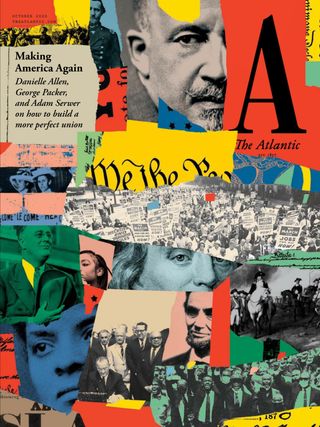

Diese Geschichte stammt aus der October 2020-Ausgabe von The Atlantic.
Abonnieren Sie Magzter GOLD, um auf Tausende kuratierter Premium-Geschichten und über 9.000 Zeitschriften und Zeitungen zuzugreifen.
Sie sind bereits Abonnent? Anmelden
WEITERE GESCHICHTEN VON The Atlantic
The Atlantic
You Had to Be There
An emerging field of history asks if we can ever really understand how our forebears experienced love, anger, fear, and sorrow.

23 mins
January 2026

The Atlantic
By the Horns
The week before the biggest bullfight of her career, in Cádiz, Spain, this past July, 24-year-old Miriam Cabas posted a carefully produced video on Instagram.
1 mins
January 2026

The Atlantic
The New German War Machine
After World War II, Germany embraced pacifism as a form of atonement. Now the country is arming itself again.
18 mins
January 2026
The Atlantic
The Eloquence
The prime minister was watching a disaster movie when we found him.
4 mins
January 2026

The Atlantic
What's for Dinner, Mom?
The women who want to change the way America eats
12 mins
January 2026

The Atlantic
How Terror Works
A 1947 German novel explores the sometimes corrosive, sometimes energizing nature of fear.
8 mins
January 2026

The Atlantic
Yesterday's Idea of a Modern Man
Sam Shepard, a self-made cowboy, was also a poet of masculine angst.
7 mins
January 2026

The Atlantic
ACCOMMODATION NATION
America's colleges have an extra-time-on-tests problem.
11 mins
January 2026

The Atlantic
Respect the Drummer
A new history of rock, told through its overlooked heroes
5 mins
January 2026

The Atlantic
THE MOST POWERFUL MAN IN SCIENCE
WHY IS ROBERT F. KENNEDY JR. SO CONVINCED HE'S RIGHT?
42 mins
January 2026
Translate
Change font size