
Mit Magzter GOLD unbegrenztes Potenzial nutzen
Erhalten Sie unbegrenzten Zugriff auf über 9.000 Zeitschriften, Zeitungen und Premium-Artikel für nur
Losing The Democratic Habit
The Atlantic
|October 2018
Americans once learned self-governance by practicing it constantlyin lodge halls, neighborhood associations, and labor unions. As participation in these institutions has dwindled, so has public faith in democracy. To restore it, we must return democratic practices to everyday life.

Democracy is a most unnatural act. People have no innate democratic instinct; we are not born yearning to set aside our own desires in favor of the majority’s. Democracy is, instead, an acquired habit.
Like most habits, democratic behavior develops slowly over time, through constant repetition. For two centuries, the United States was distinguished by its mania for democracy: From early childhood, Americans learned to be citizens by creating, joining, and participating in democratic organizations. But in recent decades, Americans have fallen out of practice, or even failed to acquire the habit of democracy in the first place.
The results have been catastrophic. As the procedures that once conferred legitimacy on organizations have grown alien to many Americans, contempt for democratic institutions has risen. In 2016, a presidential candidate who scorned established norms rode that contempt to the Republican nomination, drawing his core support from Americans who seldom participate in the rituals of democracy.
American government’s most obvious problems—from its dysfunctional legislature to Donald Trump himself— are merely signs of this underlying decay. The political system’s previous strength and resilience flowed from Americans’ anomalously high rates of participation in democratically governed organizations, most of them a political. There is no easy fix for our current predicament; simply voting Trump out of office won’t suffice. To stop the rot afflicting American government, Americans are going to have to get back in the habit of democracy.
--IN--
THE EARLY YEARS of the United States, Europeans made pilgrimages to the young republic to study its success. How could such a diverse and sprawling nation flourish under a system of government that originated in small, homogeneous city-states?
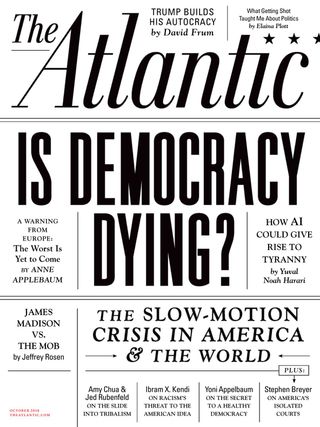

Diese Geschichte stammt aus der October 2018-Ausgabe von The Atlantic.
Abonnieren Sie Magzter GOLD, um auf Tausende kuratierter Premium-Geschichten und über 9.000 Zeitschriften und Zeitungen zuzugreifen.
Sie sind bereits Abonnent? Anmelden
WEITERE GESCHICHTEN VON The Atlantic

The Atlantic
You Had to Be There
An emerging field of history asks if we can ever really understand how our forebears experienced love, anger, fear, and sorrow.

23 mins
January 2026

The Atlantic
By the Horns
The week before the biggest bullfight of her career, in Cádiz, Spain, this past July, 24-year-old Miriam Cabas posted a carefully produced video on Instagram.
1 mins
January 2026

The Atlantic
The New German War Machine
After World War II, Germany embraced pacifism as a form of atonement. Now the country is arming itself again.
18 mins
January 2026
The Atlantic
The Eloquence
The prime minister was watching a disaster movie when we found him.
4 mins
January 2026

The Atlantic
What's for Dinner, Mom?
The women who want to change the way America eats
12 mins
January 2026

The Atlantic
How Terror Works
A 1947 German novel explores the sometimes corrosive, sometimes energizing nature of fear.
8 mins
January 2026

The Atlantic
Yesterday's Idea of a Modern Man
Sam Shepard, a self-made cowboy, was also a poet of masculine angst.
7 mins
January 2026

The Atlantic
ACCOMMODATION NATION
America's colleges have an extra-time-on-tests problem.
11 mins
January 2026

The Atlantic
Respect the Drummer
A new history of rock, told through its overlooked heroes
5 mins
January 2026

The Atlantic
THE MOST POWERFUL MAN IN SCIENCE
WHY IS ROBERT F. KENNEDY JR. SO CONVINCED HE'S RIGHT?
42 mins
January 2026
Translate
Change font size