Versuchen GOLD - Frei
Back to Chagos
The Atlantic
|July - August 2022
Half a century ago, 2,000 people were forcibly removed from a remote string of islands in the middle of the indian ocean. This year, a group of them set sail for home.

I.Victoria, Seychelles
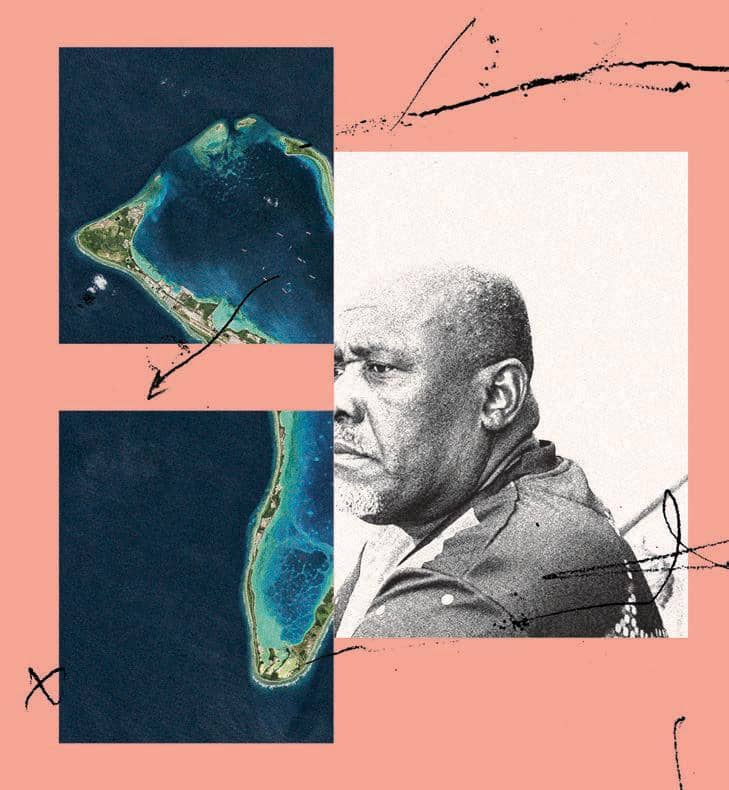
When Olivier Bancoult boarded the ship that was to take him 1,000 miles across the Indian Ocean to the Chagos Archipelago his childhood home, from which he and his fellow islanders had been expelled 50 years earlier-he carried five wrought-iron crosses. Most of them bore a short inscription, hand-lettered in white paint, memorializing the return of Chagossians to their birthplace. The crosses were to be driven into the ground of Peros Banhos and Salomon, two of the archipelago's once-inhabited atolls. But one cross was different. It was inscribed with the name of Bancoult's grandfather Alfred Olivier Elysé, and it was destined for an island cemetery. Elysé had died in 1969, as expulsions from the archipelago were under way.
The expulsions were part of an international bargain, though not one that the 2,000 people of Chagos had any say in. The short version: For many years, the archipelago was a faraway administrative appendage of the British colony of Mauritius, an island off the coast of Africa. When Mauritius sought independence, in the mid-1960s, Britain decided to keep Chagos for itself. It did so primarily to sequester one of the atolls, Diego Garcia, for use by the United States-part of a global American ambition, at the height of the Cold War, to establish military outposts in strategic places. Chagos itself was nowhere, but it was equidistant from everywhere: Draw a long line from Madagascar to Indonesia, and another from India to Antarctica, and stick a pin in the blue at the intersection. The catch for Britain was that under international law, the archipelago could be separated from Mauritius only if it had no permanent population.

Diese Geschichte stammt aus der July - August 2022-Ausgabe von The Atlantic.
Abonnieren Sie Magzter GOLD, um auf Tausende kuratierter Premium-Geschichten und über 9.000 Zeitschriften und Zeitungen zuzugreifen.
Sie sind bereits Abonnent? Anmelden
WEITERE GESCHICHTEN VON The Atlantic

The Atlantic
How America Celebrated Its 100th Birthday
The Centennial Exhibition of 1876 promised a glorious industrial future. Outside its gates, the country seethed with violence and corruption.

12 mins
June 2026

The Atlantic
THE CLOWN SHOW
The Savannah Bananas are reviving one of the most entertaining—and controversial—teams in Negro Leagues history.
21 mins
June 2026

The Atlantic
The Diva
Denyce Graves is retiring from performing after a career as one of opera's leading women. But there's more work for her to do.
10 mins
June 2026

The Atlantic
Cat Heir
Did Karl Lagerfeld really leave millions to Choupette?
26 mins
June 2026

The Atlantic
The Secret of Elizabeth Strout's Appeal
How she writes best sellers that are also critical darlings
10 mins
June 2026

The Atlantic
THE VENTURE-CAPITAL POPULIST
How David Sacks and the new tech right went full MAGA and captured Washington
32 mins
June 2026

The Atlantic
Glory Days
Heartland rock was shot through with nostalgia— but nostalgia for what?
9 mins
June 2026

The Atlantic
Alien Nation
Why Americans want to believe that the government is hiding the truth about extraterrestrial life
11 mins
June 2026

The Atlantic
Dinah's Hat
On the day Dinah lost her hat, I was sitting on the top step of my just-right Scamp trailer doing a crossword.
24 mins
June 2026

The Atlantic
THE AMERICA I'VE KNOWN
In my 93rd year, it's become ever more clear that patriotism requires sacrifice and collective effort.
7 mins
June 2026
Translate
Change font size