Versuchen GOLD - Frei
The Rafale Saga
Geopolitics
|February 2018
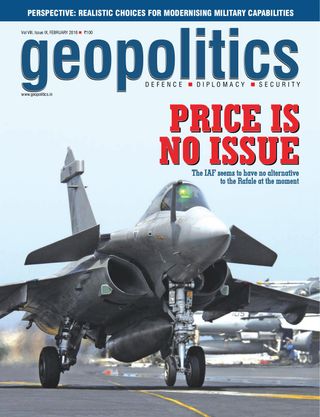
The Indian government’s decision to purchase 36 Rafale fighter jets continues to be shrouded in controversy. There are now allegations that the deal is marked by overpricing and crony capitalism. But is the controversy more political than economic? Is it a storm in a teacup?

The saga of Rafale in India, more than a decade now, has now been embroiled in the country’s highly competitive domestic politics, with the principal opposition Congress party, let alone the other critics, alleging “huge scam” in the procurement of 36 medium multi-role combat aircraft (MMRCA) Dassault Rafale fighter jets, as concluded by the Modi government in 2015. Congress President Rahul Gandhi has led the allegations in recent times, most notably during the electioneering in Gujarat.
In essence, the Congress (through Rahul Gandhi and the official spokesperson Randeep Surjewala) has five issues with the deal that was officially signed on September 23, 2016, though it was announced by Prime Minister Narendra Modi in April 2015 at Paris during his visit to France. One, the deal did not undergo established official Defence Procurement Procedure (DPP). Two, the Modi government violated and bypassed the interests of Hindustan Aeronautics Limited (HAL), which was supposed to co-produce the fighter planes as per the original Agreement in 2012, as made by the Congressled UPA government. Three, while the Modi-government signed the $8.7 billion deal, costing each plane ₹1570 crores, as per the UPA negotiated price, the cost of one plane was ₹526.1 crores. Fourthly, the deal seems to have been made not to benefit the Indian Air Force (IAF) but the “crony capitalist” Anil Ambani’s Reliance Defence. Surjewala finds it intriguing that “while India signed the $8.7 billion deal on September 23 last year, just 10 days later, on October 3, 2016, Reliance Defence Limited entered into a joint venture with the French fighter plane maker Dassault” without any clearance from the government.

Diese Geschichte stammt aus der February 2018-Ausgabe von Geopolitics.
Abonnieren Sie Magzter GOLD, um auf Tausende kuratierter Premium-Geschichten und über 9.000 Zeitschriften und Zeitungen zuzugreifen.
Sie sind bereits Abonnent? Anmelden
WEITERE GESCHICHTEN VON Geopolitics
Geopolitics
IAF seeks Ecuador Jaquar airframes
The Indian Air Force has initiated discussions with the Ecuadorian Air Force to acquire its remaining grounded SEPECAT Jaguar airframes, as part of a broader effort to extend the service life of India's Jaguar strike fleet through 2035.

1 min
January 2026
Geopolitics
INDIA TO LAUNCH INDIGENOUS 6-TONNE HALE UAV
India's effort to build an indigenous High Altitude Long Endurance (HALE) unmanned aerial vehicle has moved into a critical transition stage. The Aeronautical Development Establishment has issued an Expression of Interest to identify a Development-cum-Production Partner for the proposed six-tonne class HALE UAV, while simultaneously preparing to seek cabinet committee on Security approval to formally initiate the development phase.
2 mins
January 2026
Geopolitics
IAF evaluates SPICE 250 for precision strikes
The Indian Air Force is evaluating the SPICE 250 precision-guided munition as part of its effort to strengthen standoff strike capabilities against a wide range of targets in contested environments.
1 min
January 2026
Geopolitics
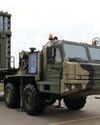
Russia offers S-350 Vityaz with full tech transfer to India
Russia has renewed its offer to supply the Rundian Armed Forces with the S-350 Vityaz air defence system, positioning it as a complementary layer to India's existing S-400 Triumf regiments.
1 min
January 2026
Geopolitics
India inducts first indigenous Pollution Control Vessel
Defence Minister Rajnath Singh recently commissioned Indian Coast Guard Ship Samudra Pratap, the first of two Pollution Control Vessels, calling it a reflection of India's increasingly mature and capable defence industrial ecosystem.
1 min
January 2026
Geopolitics
DAC clears indigenous EW suite for IAF's Mi-17 V5 fleet
The Defence Acquisition Council has accorded Acceptance of Necessity (AON) for multiple DRDO-developed systems, including an advanced Electronic Warfare (EW) Suite for the Indian Air Force's Mi17 V5 helicopter fleet.
1 min
January 2026

Geopolitics
WHY PSLV-C62 FAILURE WILL BADLY HURT INDIA
In space research, satellite launch failures are not uncommon. Yet the failure of ISRO's PSLV-C62 will hurt India, its space ambitions, and its military capabilities for years to come
5 mins
January 2026
Geopolitics
Prime Toolings targets 10 kN thrust milestone by March
Prime Toolings has reiterated its confidence in achieving a 10 kN thrust benchmark by March 2026, even after recent propulsion trials initially fell short of expectations. The company said the development effort was originally structured around an 8 kN thrust objective, but early test runs stabilised at approximately 6 kN. Rather than treating this outcome as a setback, the company views it as a valuable learning phase inherent to complex propulsion development.
1 min
January 2026
Geopolitics
IRRELEVANT UNITED NATIONS
If anything, the U.S. invasion of Venezuela and the capture of its President Nicolás Maduro, or, for that matter, President Donald Trump's habit of imposing economic sanctions on countries effortlessly, constitute a trend that makes the existence of the United Nations (U.N.) irrelevant in its present form. It is an affront to the world body by undermining the principles of collective security and multilateralism.
4 mins
January 2026

Geopolitics
Indian startup Carbine Systems tests first private DEW prototype
Belgaum-based Carbine Systems has testing of its first directed-energy weapon prototype, H.A.R.A. Mk 1 (Hyper Amplification Radiant Array),. marking a notable milestone for India's indigenous laser-weapons ecosystem.
1 min
January 2026
Translate
Change font size