
Mit Magzter GOLD unbegrenztes Potenzial nutzen
Erhalten Sie unbegrenzten Zugriff auf über 9.000 Zeitschriften, Zeitungen und Premium-Artikel für nur
Versuchen GOLD - Frei
Global Arms Industry From Hi-Tech To Lo-Tech
Geopolitics
|April 2018
The international arms industry is now globalised. Gone are the days when a country could engage in techno-nationalism and build a weapons system purely at home—with the exception of a few nations like the US, Russia, China, and France. Instead, countries either collaborate to build systems or include a range of components from other nations. Considering this phenomenon, Indian defence production has to be broken into three categories: that which cannot be imported, that which can be assembled and co-produced in India, and that which can realistically be made in India.

The international arms industry is both globalised and building weapons that range from new game changing 21st technologies— such as hypersonic glide weapons, underwater drones, and stealthy fifth generation fighter aircraft—to the more rudimentary 20th century systems that still cause considerable havoc when used in the modern battlefield. The wars of the 21st century in Afghanistan, Iraq, Libya, Syria, Yemen, and a number of civil wars elsewhere have led to the continued need for weapons systems that are cheap, time-honoured, and rudimentary, but deadly in their effect. What this has done is that there is a huge market for a range of varied products depending on the demands of the modern battlefields.
Nature of 21st century warfare
While military planners in the twentyfirst century continue to prepare for interstate conflicts, and acquire systems that would increase lethality in such conflicts, the vast number of wars in the world now are civil wars or insurgencies. The United States, faced by the rise of Chinese and Russian military capabilities, particularly in the non-strategic nuclear realm, has announced plans to build a range of futuristic weapons systems that will allow Washington to deal with a range of contingencies and to ensure that deterrence prevails at the lowest levels of the conflict spectrum. Thus, the 2018 US Nuclear Posture Review discusses building a small number of submarine launched ballistic missiles with low-yield nuclear weapons, a new submarine launched cruise missile, an air delivered long-range cruise missile, as well as the futuristic B-21 bomber.
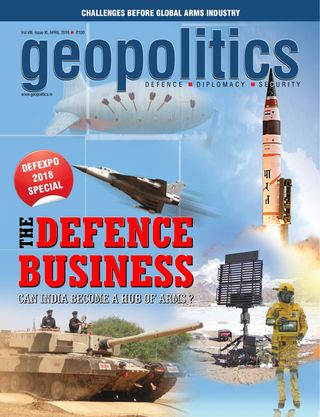

Diese Geschichte stammt aus der April 2018-Ausgabe von Geopolitics.
Abonnieren Sie Magzter GOLD, um auf Tausende kuratierter Premium-Geschichten und über 9.000 Zeitschriften und Zeitungen zuzugreifen.
Sie sind bereits Abonnent? Anmelden
WEITERE GESCHICHTEN VON Geopolitics
Geopolitics
Tata expands Morocco push with LAMV offer
After securing an order for its WhAP 8x8 armoured vehicle from the Royal Moroccan Army, Tata Advanced Systems Limited is now actively promoting its Light Armoured Multipurpose Vehicle in the same market.

1 min
February 2026
Geopolitics
Armenia eyes India's Astra Missile for Su-30SM fleet
Armenia is in advanced discussions with India to acquire the Astra beyond-visual-range air-to-air missile, signalling a deepening of defence ties between the two countries.
1 min
February 2026

Geopolitics
SUVI V1 becomes India's first Type-Certified UAV
In India's unmanned aviation sector has reached a significant regulatory milestone with Okulo Aerospace announcing that its SUVI V1 platform has received Type Certification from the Directorate General of Civil Aviation.
1 min
February 2026

Geopolitics
Swan Defence wins Oman naval training ship contract
Swan Defence and Heavy Industries has secured a defence export contract from the Government of the Sultanate of Oman for the construction and supply of an advanced naval training ship for the Royal Navy of Oman.
1 min
February 2026

Geopolitics
HAL'S 'DHRUV' BET
Hindustan Aeronautics Limited (HAL) is attempting a careful reset of the Dhruv helicopter narrative, positioning the platform simultaneously as a cornerstone of India's future civil helicopter market and as a rehabilitated workhorse returning to frontline maritime service.
2 mins
February 2026
Geopolitics
India Offers Su-30MKM Upgrade to Malaysia
India has offered a midlife modernisation package for Malaysia's fleet of 18 Sukhoi Su-30MKM fighters, marking a significant step in bilateral defence-industrial cooperation.
1 min
February 2026

Geopolitics
Astra upgrade rooted in indigenous R and D
Recent reports linking the Indian Air Force's Astra missile upgrades to Chinese PL-15 technology have been firmly dismissed by defence officials and scientists.
1 min
February 2026

Geopolitics
COMMAND OR COMPLIANCE? RECLAIMING THE SPIRIT OF MILITARY INITIATIVE
What does it truly mean to be a military leader in a democracy? It is a question sparked by the recent controversy surrounding General Manoj Naravane's memoir. While the government always has the final say, a great general shouldn't just wait for instructions; they must lead with confidence, give honest advice, and take decisive action on the battlefield. KARAN KHARAB highlights why India needs a military culture that rewards bold Initiative over hesitation and \"seeking orders.\"
8 mins
February 2026
Geopolitics
India's integrated air combat plan from Mk1A to MkIII
India's combat aviation landscape is entering a defining phase, marked by parallel developments in aircraft production and missile technology that together reflect a broader push toward operational self-reliance.
3 mins
February 2026

Geopolitics
DEFENCE BUDGET 2026-27: FOCUS ON CAPITAL ACQUISITIONS
While there is an overall increase in the latest defence budget, the statistics only tell half of the story, explains AMIT COWSHISH
11 mins
February 2026
Translate
Change font size