
Mit Magzter GOLD unbegrenztes Potenzial nutzen
Erhalten Sie unbegrenzten Zugriff auf über 9.000 Zeitschriften, Zeitungen und Premium-Artikel für nur
Versuchen GOLD - Frei
To The Beach And Beyond Amphibious Assault
Asian Military Review
|June/July 2018
The development of ship-to-shore landing vessels means more volume arriving per trip at higher speed.

The amphibious operation is considered by many military analysts and historians as the most difficult naval expeditionary operation. Its objective is to transition forces and their supporting vehicles and logistics from the sea to the land. As early efforts to move troops and supplies from ships to the beach using existing boats proved inadequate, it increasingly became clear that specially designed craft would be essential.
By the mid-1930s landing craft designs were being introduced by forces of the Japanese, the Soviets, the British and the US Marine Corps (USMC). These solutions were very similar and even drawing from each other. Each used a relatively flat bottom with the engine and most weight aft. This lowered draft forward facilitating beaching the craft. A powerful engine allowed the craft to back off the beach. Most used a propeller drive located in a ‘tunnel’ to protect it from damage in shallow water. The Royal Navy (RN), however, did field prototypes of a simple water jet propulsion design by Samuel Wright. A feature that was also widely adopted was the bow ramp. Seen on the Japanese 14 metre Daihatsuclass landing craft used from 1937 to 1945, the benefits were quickly recognised by other military observers. The USMC encouraged Andrews Higgins to include such a ramp on his landing craft design that they were acquiring. His Landing Craft Vehicle & Personnel (LCVP) became the most widely used craft of its type with over 23,300 produced and fielded. General Dwight D. Eisenhower, Supreme Allied Commander in World War II, stated that the LCVP “won the war”. It also contributed to establishing the amphibious landing as a viable operation.
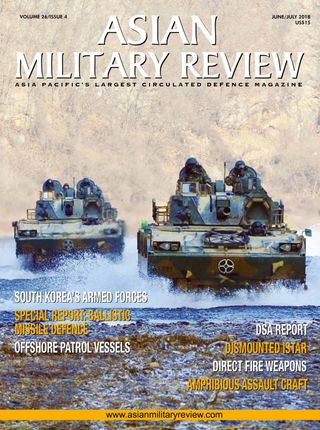

Diese Geschichte stammt aus der June/July 2018-Ausgabe von Asian Military Review.
Abonnieren Sie Magzter GOLD, um auf Tausende kuratierter Premium-Geschichten und über 9.000 Zeitschriften und Zeitungen zuzugreifen.
Sie sind bereits Abonnent? Anmelden
WEITERE GESCHICHTEN VON Asian Military Review

Asian Military Review
SMART MUNITIONS INCREASE MARKET SHARE
Top attack munitions are now widely developed for different artillery calibers with varied ranges.

10 mins
June/July 2021

Asian Military Review
NEXT GEN NVGS - A CLEAR IMPROVEMENT
Fused and enhanced night-vision technology will make the difference to soldiers fighting at night.
8 mins
June/July 2021

Asian Military Review
MILITARY ROTORCRAFT DEVELOPMENT - NO MORE ‘STOVEPIPES'
New rotorcraft are going to come with new abilities founded on open systems that provide easier upgrade paths and cheaper through life costs.
8 mins
June/July 2021

Asian Military Review
INDO PACIFIC UAV DIRECTORY 2021
The development of unmanned aerial vehicles is growing apace, especially in China. New longer range ISR platforms are also on the procurement list of several nations.
27 mins
June/July 2021

Asian Military Review
TIME TO RESET TRILATERAL RELATIONS
United States President Joe Biden has made it a top priority of his Administration to repair and re-energize global alliances during its first year in power. This is a necessary strategic and political calculus made in light of growing global security, public health, and environmental challenges that will require cooperation and multilateral contributions. President Trump’s ‘America first’ policy did much to undermine confidence in such relationships over his time in office.
3 mins
June/July 2021

Asian Military Review
SOCPAC KEEN TO SHARE JOINT DOCTRINE AND TRAINING
The return of Great Power competition means that US SOCPAC is more than ever seeking joint training opportunities with regional special forces.
9 mins
June/July 2021

Asian Military Review
MARINE ENGINE POWER - NOT JUST ABOUT KNOTS
Navies not only want more engine power, there are also coming under increasing pressure to become environmentally conscious.
9 mins
June/July 2021

Asian Military Review
AMPHIBIOUS FORCES
New amphibious concepts are re-shaping marine forces to break the A2AD defensive line.
9 mins
June/July 2021

Asian Military Review
SPACE V AIRBORNE ISR OR MIX AND MATCH
Owning satellite based ISR for military use is still an exclusive ‘club’, but airborne ISR still provides that most countries need.
9 mins
April/May 2021

Asian Military Review
SHIPBUILDING - A NUMBERS GAME
While experience grows among Indo-Pacific naval designers, order numbers remain crucial to keeping costs down and yards in business.
11 mins
April/May 2021
Translate
Change font size