Versuchen GOLD - Frei
UCLA Meteorite Gallery Is Out Of This World
Rock&Gem Magazine
|March 2017
Within their collections, many a rockhound has at least one sample of a space rock, better known as a meteorite. Meteorites are truly rare. One meteorite researcher has been contacted by 2,100 people who claimed to have discovered one. Of the 2,100, only seven had found a true meteorite. The rest of the specimens mailed in were hematite or magnetite (iron ores), heavy minerals such as galena, slag from smelting, or just common rocks.

The researcher wryly noted that many of the samples folks sent to him of rocks that “amazingly appeared out of nowhere” on driveways or in lawns were the same size as rocks that might fit in a child’s palm and be thrown into the air. Still, true meteorites do exist and are sometimes found by amateur rockhounds.
To learn about the appeal of these unearthly rocks, amateur rockhounds of the Ventura Gem & Mineral Society (VGMS) journeyed late last year to the University of California, Los Angeles (UCLA), home to one of the most active groups of space science and meteorite researchers in the world. Appropriately enough, given this research activity, the UCLA Department of Earth & Space Sciences holds the largest collection of meteorites on the West Coast. With more than 2,500 samples from 1,500 different meteorites, it is also the fifth largest collection in the United States.
Meteorites have remained virtually unchanged since the time when the planets within our solar system were forming, some 4.5 billion years ago. From them, therefore, scientists—with the right tools—can tease out of them information about what our early solar system may have been like. They’ve been described as “cosmic history” and “celestial fossils” that provide a precious glimpse into the distant past, long before life gained a foothold on planet Earth.
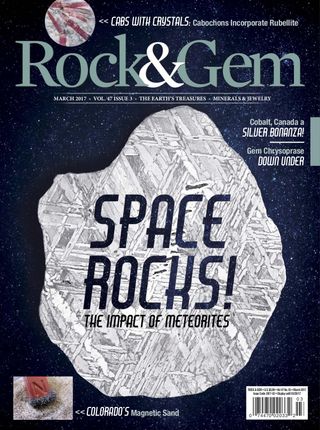

Diese Geschichte stammt aus der March 2017-Ausgabe von Rock&Gem Magazine.
Abonnieren Sie Magzter GOLD, um auf Tausende kuratierter Premium-Geschichten und über 9.000 Zeitschriften und Zeitungen zuzugreifen.
Sie sind bereits Abonnent? Anmelden
WEITERE GESCHICHTEN VON Rock&Gem Magazine
Rock&Gem Magazine
A New Amber Locality Fills a Gap
A sandstone quarry in central Ecuador has yielded the first significant deposit of Mesozoic amber from South America.

1 min
January / February 2026
Rock&Gem Magazine
Did "Left-Handed" Fish Leave Water Earlier than Thought?
Fossil evidence suggests that fish (or \"fishapods\") dragged themselves onto land during the middle Devonian Period.
1 min
January / February 2026

Rock&Gem Magazine
"Lab Quakes” Produce Surprising Results
When faults let loose and earthquakes result, the main effect we mortals experience is the violent shaking.
1 min
January / February 2026
Rock&Gem Magazine
This Egg is No Spring Chicken
How to date a dino egg
1 min
January / February 2026
Rock&Gem Magazine
Have we Already Mined the Critical Minerals We Need
Then why are we throwing them away?!
1 min
January / February 2026
Rock&Gem Magazine
One Toxic Worm
A critter that creates & tolerates orpiment!
1 min
January / February 2026
Rock&Gem Magazine
ROCK & GEM FIELD GUIDE: Silver
Silver (Ag) is a native element and one of Earth's most prized precious metals.
2 mins
January / February 2026
Rock&Gem Magazine
DINOSAURS OF THE HELL CREEK MUSEUM
In the Badlands of South Dakota, just outside the small town of Belle Fourche—pronounced “Bell Foosh”—a new attraction has taken shape that every dinosaur enthusiast should see. The Dinosaurs of the Hell Creek Museum is part hands-on exhibit, part science center and part active research lab.
3 mins
January / February 2026
Rock&Gem Magazine
The Lost Twins of Kongsberg
A Silver Story Resurfaced
3 mins
January / February 2026

Rock&Gem Magazine
Switzerland's ICE PALACE
Walk Inside a Glacier at The Top of Europe
7 mins
January / February 2026
Translate
Change font size