Versuchen GOLD - Frei
Pascal's Artificial Intelligence Wager
Philosophy Now
|August/September 2020
Derek Leben computes the risks of general AI.

In 2008 European physicists at CERN were on the verge of activating the Large Hadron Collider to great acclaim. The LHC held the promise of testing precise predictions of the most important current theories in physics, including finding the elusive Higgs Boson (which was indeed successfully confirmed in 2012). However, some opponents of CERN’s activation raised an almost laughable objection, encapsulated in a lawsuit against CERN from the German chemist Otto Rossler, that switching the LHC on might create a miniature black hole and destroy the Earth. In response, most physicists dismissed the chances of such a catastrophe as extremely unlikely, but none of them declared that it was utterly impossible. This raises an important practical and philosophical problem: how large does a probability of an activity destroying humanity need to be in order to outweigh any potential benefits of doing it? How do we even begin to weigh a plausible risk of destroying all humanity against other benefits?
Recently, prominent figures such as Sam Harris and Elon Musk have expressed similar concerns about the existential risks to humanity posed by the creation of artificial intelligence. This follows earlier work by Nick Bostrom (see for instance his ‘Ethical Issues in Advanced Artificial Intelligence’, 2004) and Eliezer Yudkowsky (for example, ‘Artificial Intelligence as a Positive and Negative Factor in Global Risk’, 2008). Let’s call this position ‘Anti-Natalism’ about artificial (general) intelligence since it proposes that the overall risks of creating AI outweigh its expected benefits, and so demands that AI shouldn’t be brought to birth.
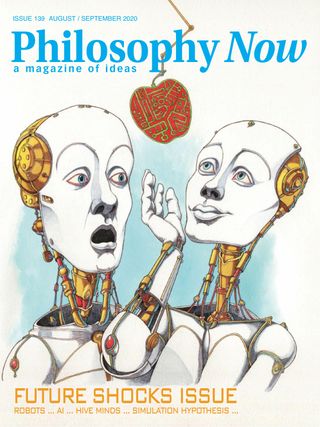

Diese Geschichte stammt aus der August/September 2020-Ausgabe von Philosophy Now.
Abonnieren Sie Magzter GOLD, um auf Tausende kuratierter Premium-Geschichten und über 9.000 Zeitschriften und Zeitungen zuzugreifen.
Sie sind bereits Abonnent? Anmelden
WEITERE GESCHICHTEN VON Philosophy Now

Philosophy Now
Bilbo Theorizes About Wellbeing
Eric Comerford overhears Bilbo and Gandalf discussing happiness.

9 mins
December 2025 / January 2026

Philosophy Now
What Women?
Marcia Yudkin remembers almost choking at Cornell
11 mins
December 2025 / January 2026
Philosophy Now
Islamic Philosophers On Tyranny
Amir Ali Maleki looks at tyranny from an Islamic perspective.
4 mins
December 2025 / January 2026

Philosophy Now
Peter Singer
The controversial Australian philosopher defends the right to choose to die on utilitarian grounds
5 mins
December 2025 / January 2026

Philosophy Now
Another Conversation with Martin Heidegger?
Raymond Tallis talks about communication problems.
7 mins
December 2025 / January 2026

Philosophy Now
Letters
When inspiration strikes, don't bottle it up. Email me at rick.lewis@philosophynow.org Keep them short and keep them coming!
17 mins
December 2025 / January 2026
Philosophy Now
The Philosophy of William Blake
Mark Vernon looks at the imaginative thinking of an imaginative artist.
9 mins
December 2025 / January 2026

Philosophy Now
Philosophical Haiku
Peering through life’s lens God in nature is deduced: The joy of being.
1 mins
December 2025 / January 2026

Philosophy Now
Philosophy Shorts
More songs about Buildings and Food' was the title of a 1978 album by the rock band Talking Heads. It was about all the things rock stars normally don't sing about. Pop songs are usually about variations on the theme of love; tracks like Rose Royce's 1976 hit 'Car Wash' are the exception. Philosophers, likewise, tend to have a narrow focus on epistemology, metaphysics and trifles like the meaning of life. But occasionally great minds stray from their turf and write about other matters, for example buildings (Martin Heidegger), food (Hobbes), tomato juice (Robert Nozick), and the weather (Lucretius and Aristotle). This series of Shorts is about these unfamiliar themes; about the things philosophers also write about.
2 mins
December 2025 / January 2026

Philosophy Now
Hedonic Treadmills in the Vale of Tears
Michael Gracey looks at how philosophers have pursued happiness.
8 mins
December 2025 / January 2026
Translate
Change font size