
Mit Magzter GOLD unbegrenztes Potenzial nutzen
Erhalten Sie unbegrenzten Zugriff auf über 9.000 Zeitschriften, Zeitungen und Premium-Artikel für nur
Versuchen GOLD - Frei
On Casuistry
Philosophy Now
|December 2020 / January 2021
Jason Morgan advocates justice without legislation.

We have largely forgotten that there is another way to pursue justice than by deciding what the answer to every problem is going to be ahead of time through legislation. Casuistry or case-centric jurisprudence is anti-legislation. It is the practice of taking each case as it comes, using judgment to discern the right outcome, while allowing plenty of room for mitigating or exacerbating circumstances. It is not a technique, but a state of mind. It involves taking a few steps back and thinking about what we see and hear with our own eyes and ears instead of trying to fit circumstances into the tight definitions in lawbooks. Judges who practice casuistry put their own intuition and, yes, judgment, ahead of what’s written down in laws compiled by people in faraway places.
Casuistry requires a major conceptual shift, from ‘classical’ to ‘quantum’ jurisprudence we might say. We are used to seeing court cases as equations where legal formulas are filled in with information and the results issue forth in ‘Guilty’ or ‘Innocent’ verdicts. However, casuistry sees cases in terms of relationships among people connected by a common injustice and requiring the careful, attentive, thoughtful, and imaginative application of fair judgment in order to right the wrong and restore all parties to good graces with one another as best as can be done. Under casuistry, justice is a work in progress, with a lot of gray mixed in with the black and white. There are no Newtonian certainties, only Heisenbergian approximations.
Ancient Judgments
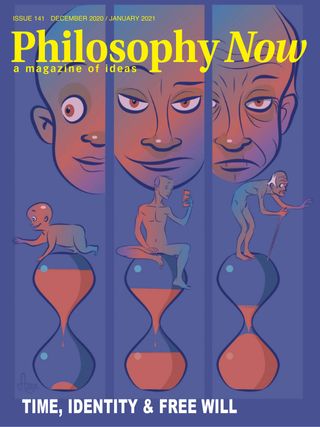

Diese Geschichte stammt aus der December 2020 / January 2021-Ausgabe von Philosophy Now.
Abonnieren Sie Magzter GOLD, um auf Tausende kuratierter Premium-Geschichten und über 9.000 Zeitschriften und Zeitungen zuzugreifen.
Sie sind bereits Abonnent? Anmelden
WEITERE GESCHICHTEN VON Philosophy Now

Philosophy Now
Nosferatu
Stefan Bolea considers two very different artistic approaches to love and death.

6 mins
April/May 2025

Philosophy Now
Heidegger's Ghost
Raymond Tallis wonders where Heidegger's body went when he was philosophising.
7 mins
April/May 2025

Philosophy Now
Is Comedy Good For Us?
Damaris Stock has a laugh with Plato and friends.
10 mins
April/May 2025
Philosophy Now
In Defense of Idleness
Wendell O'Brien says, 'Just Don't Do It'.
10 mins
April/May 2025
Philosophy Now
Leaving Nothing to Chance by Carl Knight
LEAVING NOTHING TO Chance (2025) by Carl Knight, is an informed, proficient and lucid defence of luck egalitarianism.
3 mins
April/May 2025

Philosophy Now
Star Maker by Olaf Stapledon
THE 1937 SCIENCE FICTION novel Star Maker was written by philosophy professor Olaf Stapledon in the dark days as Europe awaited the onslaught of Nazi Germany. This casts a shadow over the whole book.
6 mins
April/May 2025
Philosophy Now
Love & Emptiness in the Sufi Tradition
Medha Ninad Tambe meditates on Rumi, love and self-negation.
7 mins
April/May 2025

Philosophy Now
The Hedgehog's Dilemma: A Metaphor About the Challenges of Human Intimacy
Krishna Chaubey explains Arthur Schopenhauer's poignant thought experiment.
4 mins
April/May 2025
Philosophy Now
The Mirror & the Flame
Rebwar Fatah imagines Attar's & Hegel's shared path.
4 mins
April/May 2025
Philosophy Now
Free and Equal by Daniel Chandler
DANIEL CHANDLER, AN economist and philosopher based at the London School of Economics, begins Free and Equal: What Would a Fair Society Look Like? (2023) by asking an intriguing question. How is it, he wonders, that the most influential political philosopher of the last century has had almost no practical impact on politics or policy? The philosopher in question is John Rawls, whose magnum opus was A Theory of Justice (1971).
5 mins
April/May 2025
Translate
Change font size