Versuchen GOLD - Frei
Where to Invest Now
Kiplinger's Personal Finance
|July 2021
AFTER A POWERFUL START, STOCKS WILL GRIND HIGHER IN THE SECOND HALF OF 2021. BUT WATCH OUT FOR CURVEBALLS.

For most of 2021, it has been easy to hit the proverbial investment ball out of the park. So far this year, the S&P 500 stock index has logged a record high 26 times. Including dividends, the broad market benchmark returned 13.3% through the first week of May—well above the 10.3% average annual return for large-company stocks, going back to 1926. The bull bobbled the ball shortly thereafter, knocked off course by a surge in inflation more powerful than we’ve seen in years. But having just entered its second year, this market likely has more gains ahead, driven by soaring economic growth as the U.S. reopens and corporate profits that are crushing analysts’ expectations.
Still, as we go deeper into 2021, investors should expect fewer grand slams and more singles and doubles. That means staying nimble and on the alert for curveballs, whether in the form of higher inflation, rising interest rates or COVID setbacks. Instead of relying on the momentum of an unstoppable U.S. market, investors should be open to new strategies and should be comfortable on a global playing field.
Wall Street’s handicappers are all over the place in this mercurial market, with portfolio strategists pegging year-end targets for the S&P 500 that range from 3800 (down 10% from its early May close of 4233) to 4600 (up 9%). Investors should probably expect something more toward the middle of that range (closer to 4300), with the S&P 500 delivering low-single-digit percentage gains from here to year-end. That would put gains for the full year at close to 15%, plus roughly another 1.4 percentage points from dividends. (Prices, returns and other data are as of May 7.)
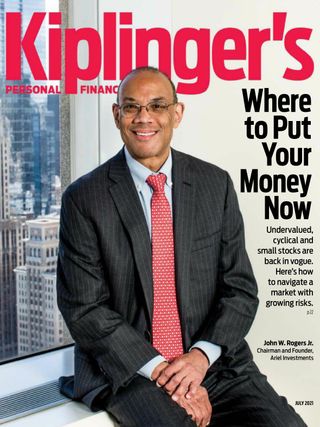

Diese Geschichte stammt aus der July 2021-Ausgabe von Kiplinger's Personal Finance.
Abonnieren Sie Magzter GOLD, um auf Tausende kuratierter Premium-Geschichten und über 9.000 Zeitschriften und Zeitungen zuzugreifen.
Sie sind bereits Abonnent? Anmelden
WEITERE GESCHICHTEN VON Kiplinger's Personal Finance

Kiplinger's Personal Finance
A TAX BREAK FOR MEDICAL EXPENSES
The editor of The Kiplinger Tax Letter responds to readers asking about health care write-offs.

2 mins
February 2026

Kiplinger's Personal Finance
Volunteering to Help Others at Tax Time
Through an IRS program, qualifying individuals can get free assistance with their tax returns.
2 mins
February 2026

Kiplinger's Personal Finance
CATCH-UP SAVERS FACE A TAXING 401(K) CHANGE
Under new rules, you may lose an up-front deduction but gain tax-free income once you retire.
2 mins
February 2026

Kiplinger's Personal Finance
The Case for Emerging Markets
Economic growth, earnings acceleration and bargain prices favor EM stocks.
3 mins
February 2026

Kiplinger's Personal Finance
THE NEW RULES OF RETIREMENT
Popular guidelines about how to save, invest and spend need to be updated and personalized to ensure you'll never run out of money.
15 mins
February 2026

Kiplinger's Personal Finance
Smart Ways to Share a Credit Card
Adding an authorized user has its benefits, but make sure you set the ground rules.
2 mins
February 2026

Kiplinger's Personal Finance
THE BEST AFFORDABLE FITNESS TRACKERS
These devices monitor your exercise, sleep patterns and more- and they don't cost an arm and a leg.
4 mins
February 2026
Kiplinger's Personal Finance
A VALUE FOCUS CLIPS RETURNS
THERE'S more to Mairs & Power Growth than its name implies. The managers favor firms with above-average earnings growth. But a durable, competitive position in their market- “a number-one or number-two position and gaining share,” says comanager Andrew Adams—and a reasonable stock price matter even more.
1 mins
February 2026

Kiplinger's Personal Finance
Look Beyond the Tech Giants
I am hooked on a podcast called Acquired, in which two smart guys do a deep analytical dive, typically lasting three or four hours, on a single successful company such as Coca-Cola or Trader Joe's. Ben Gilbert and David Rosenthal, a pair of venture capitalists, are especially adept at explaining what's behind the success of such tech giants as Alphabet (symbol GOOGL, $320), the former Google, which recently merited 11 hours and 42 minutes of dialogue all by itself.
4 mins
February 2026

Kiplinger's Personal Finance
How to Pay for Long-Term Care
A couple of months ago, I wrote that many Americans significantly underestimate how long they could live in retirement (see “Living in Retirement,” Dec.). With the possibility of a 30-year retirement becoming more common, retirees need to plan for so-called longevity risk to make sure their assets last a lifetime. And the longer you live, the more likely you'll need to pay for some form of long-term care. That can range from assistance with activities of daily living to in-home care to a nursing home stay.
2 mins
February 2026
Translate
Change font size