Versuchen GOLD - Frei
Frequently Asked Questions About Keto Diet
Diabetes Health
|February - March 2019
Dr Janak Nathan answers some commonly asked questions about Keto diet.
-

What is Ketogenic diet?
The Ketogenic diet or Keto diet is a high fat, low carbohydrate and normal protein diet that was introduced to originally treat epilepsy in the 1920s. This diet mimics the effects of fasting which had been used since Hippocrates to treat epilepsy.

How does Keto diet work?
Normally, the primary fuel of the brain and body is glucose which is derived from the carbohydrates that are consumed. However, during fasting and low carbohydrate diets, the body is induced to use fats (stored or ingested) which is metabolised by the liver to form ketones. Thus, Keto diet which is low in carbohydrates, results in ketones being used as the primary fuel.
Ketones have multiple actions such as they:
increase available energy by 50 per cent.
provide an alternative energy source in situations where glucose cannot be utilised.
control programmed cell death where old or damaged cells are destroyed.
act as cytokine inhibitor. Cytokines are molecular messengers that allow the cells of the immune system to communicate with one another to generate a coordinated, robust, but self-limited response to a target antigen. Cytokines cause inflammation which is the primary cause of metabolic syndrome. Thus ketones, by their action on cytokines, have potent anti-inflammatory action.
What is ketosis?
In ketosis, due to the Ketogenic diet, the blood ketone levels are around 2-8 mg/dl (normal values are 0.1 to 0.2 mg/dl). On the other hand in diabetic ketoacidosis, the blood ketone is above 18-20mg/dl.
How should Keto diet be followed?
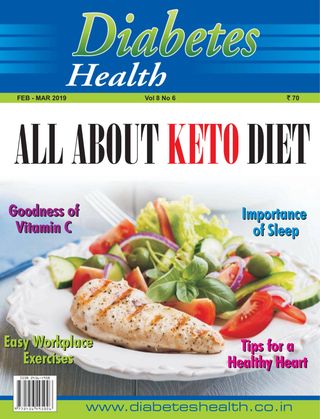

Diese Geschichte stammt aus der February - March 2019-Ausgabe von Diabetes Health.
Abonnieren Sie Magzter GOLD, um auf Tausende kuratierter Premium-Geschichten und über 9.000 Zeitschriften und Zeitungen zuzugreifen.
Sie sind bereits Abonnent? Anmelden
Translate
Change font size