Versuchen GOLD - Frei
True Hues
Apparel
|December 2021
Brinda Gill talks to Dr. Bosco Henriques, a doctorate in plant molecular biology and founder of BioDye India Pvt. Ltd., one of India’s foremost 100% natural dyeing units, about his thoughts on the attributes and potential of natural dyes.

HOW ARE DYES BROADLY DIVIDED AND WHAT ARE THEIR KEY ATTRIBUTES?
Dyes are broadly divided into natural and synthetic. Dyes on textiles need to be tough, resistant to light, washing, rubbing and perspiration. Synthetic dyes are therefore designed by chemists to be recalcitrant. While this is good for fastness, it prevents them from degradeding in effluent treatment plants. Natural dyes need a mordant to colour textiles (indigo is an exception). The dye-mordant complex bestows the coloured textile with its fastness property. The natural dyes and tannin mordants are biodegradable.

Synthetic dyes exhibit very little batch-to-batch variation, and have defined and reproducible light absorption spectra. This makes blending of different coloured dyes of the same chemical class straightforward. Colour matching and reproducibility is easy with synthetic dyes.
Natural dyes, on the other hand, are a mixture of colourants whose composition varies from harvest to harvest. The nature of the colourant also changes during post-harvest storage, during extraction and post-extraction storage, for e.g., the living plant tissue of Indian madder contains the red colourant called galiosin. The sugar molecules are progressively cleaved after harvest to generate an intermediate red colorant-pseudo purpurin, which slowly decays into the third red colourant purpurin. To complicate matters further, Indian madder has another yellowish red colorant munjisthin which has inferior dye properties.
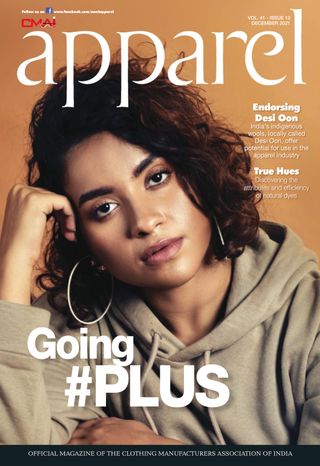

Diese Geschichte stammt aus der December 2021-Ausgabe von Apparel.
Abonnieren Sie Magzter GOLD, um auf Tausende kuratierter Premium-Geschichten und über 9.000 Zeitschriften und Zeitungen zuzugreifen.
Sie sind bereits Abonnent? Anmelden
WEITERE GESCHICHTEN VON Apparel

Apparel
All About Dressing As You Want
A. Das uncovers the current trend which is all about dressing as you want. Easy, over-sized, baggy fits and unstructured cuts are ruling every wardrobe.

6 mins
January 2022

Apparel
Online Shopping Likely To Reach $1.2 Trillion By 2025
Market Watch
1 min
January 2022

Apparel
Weaving A Sustainable Future
Brinda Gill talks to Ashita Singhal, awardwinning weaver, designer and social entrepreneur, and founder, Paiwand Studio, who is committed to converting textile waste into new, meaningful textiles.
6 mins
January 2022

Apparel
Summer of 2022
Heer Kothari walks our eager onlookers through the runways of New York, Milan and Paris, exploring the nuance of summer styling for men in 2022
4 mins
January 2022

Apparel
Journeying for the Joth
Brinda Gill drafts the interesting journey of Vinay Narkar, a textile designer and revivalist based in Solapur, spared no effort in the pursuit of joth, one of the lost weaves of Maharashtra, and reviving it.
8 mins
January 2022

Apparel
Go Digital - Get Organised Reshamandi Style!
Heer Kothari explores India’s first and largest market-place, digitising the natural textile supply chain. It is a full stack ecosystem in the form of a super app, starting from farm to fashion.
4 mins
January 2022

Apparel
Erotissch – Stitching differently
Chitra Balasubramaniam explores Erotissch, a brand by women for women, based on the concept of ‘Bed to street wear'.
3 mins
January 2022

Apparel
Colourful Fable
A. DAS interviews Karan Torani to find out the inspiration behind the designs of his label Torani and his thoughts on it being widely welcomed and connected well.
5 mins
January 2022

Apparel
Going #PLUS
Heer Kothari explores the growth of the Plus Size apparel segment in India.
4 mins
December 2021

Apparel
Endorsing Desi Oon
Brinda Gill discovers India’s indigenous wools, locally called Desi Oon, which hold potential for use in the apparel industry
8 mins
December 2021
Translate
Change font size