
Mit Magzter GOLD unbegrenztes Potenzial nutzen
Erhalten Sie unbegrenzten Zugriff auf über 9.000 Zeitschriften, Zeitungen und Premium-Artikel für nur
Rockport Technologies Avior II Loudspeaker
Stereophile
|August 2017
Following my review of the floorstanding Magico S5 Mk.II last February,1 I spent some time with two-way stand-mounted speakers from Aerial Acoustics, Bowers & Wilkins, and Dynaudio. As much as I appreciated the small speakers’ virtues, I found myself missing the big Magico’s bass extension and ability to play loud; my next loudspeaker review, therefore, would be of another floorstander.

It’s been a while since we published a review of a Rockport Technologies loudspeaker. Michael Fremer raved about Rockport’s Antares in August 2002, which at the time cost $41,500/pair.2 In September 2004, he was also impressed by the combination of the Rockport Merak II loudspeaker and Sheritan II subwoofer ($29,500/system).3
I’ve been consistently impressed by the sound of Rockport speakers at audio shows over the past few years, so I asked Rockport’s Andy Payor for a pair of Avior IIs.
The Avior II
At $38,500/pair, this three-way design is almost identically priced to the Magico S5 Mk.II and is very similar in height, width, and weight—a back-breaking 220 lbs—but is significantly deeper. The review samples were finished in a high-gloss piano black, and the speakers’ appearance belied their bulk. Other than on the stepped rear panel, there’s hardly a straight line to be seen: the top slopes down, the sidewalls are gently curved, and the sloped-back, 6"-thick front baffle is faced with inset black felt and narrows toward the top, to optimize the tweeter’s acoustic environment.
The raked-back enclosure is heavily braced and features a triple-laminated, constrained-mode-damped construction with sections of varying thickness, and stands on an integral base, which has a subcompartment for the potted crossover circuitry. The network is wired point to point, and uses film/foil capacitors manufactured exclusively for Rockport Technologies as well as custom inductors and Caddock power resistors. All the crossover components are matched to within 1% tolerance, and each individual network is fine-tuned for the specific drive-units with which it will be used.
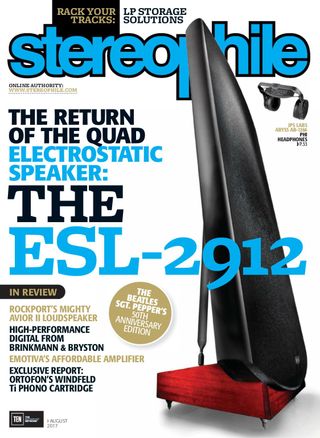

Diese Geschichte stammt aus der August 2017-Ausgabe von Stereophile.
Abonnieren Sie Magzter GOLD, um auf Tausende kuratierter Premium-Geschichten und über 9.000 Zeitschriften und Zeitungen zuzugreifen.
Sie sind bereits Abonnent? Anmelden
WEITERE GESCHICHTEN VON Stereophile

Stereophile
Buzz Me In
If you like 1970s rock music, particularly hard rock music, something you love was recorded or mixed in a Record Plant studio.

3 mins
January 2026

Stereophile
NuPrime MCX-800AD
IMMERSIVE AUDIO PROCESSOR
11 mins
January 2026

Stereophile
Shanachie Records
The term 'sales' is an anachronism. Today, it's about streaming and ancillary income.\"
3 mins
January 2026
Stereophile
Advance Paris X-CD9
CD PLAYER
11 mins
January 2026
Stereophile
T+A Symphonia for phono; a new NAD M10
Out of the box, the T+A Symphonia streaming integrated amplifier Rogier van Bakel reviewed in the November 2025 issue¹ has two pairs of single-ended analog line inputs.
20 mins
January 2026

Stereophile
Why the Music We Love Feels Different Now
There's a scene in the 2002 movie The Pianist in which Adrien Brody's character, the Polish-Jewish pianist Władysław Szpilman, is hiding in the ruins of a Warsaw villa.
3 mins
January 2026

Stereophile
A tale of two Walters
Acommon theme in this space in Stereophile is the need to reach new audiences and generate broader interest in the hi-fi hobby.
3 mins
January 2026

Stereophile
Eversolo Play CD Edition
ALL-IN-ONE STREAMING PLAYER
12 mins
January 2026

Stereophile
Timeless flights
How many adventurous rock’n’roll bands forged in the late-’60s/early-’70s would have been left by the wayside—or relegated to languish in perpetual cutout-bin purgatory—had it not been for the wide-open programming M.O. of stereo-loving FM radio stations? The Moody Blues could very easily have been one of those sidelined, notched-cover footnotes, but they altered their gameplan when guitarist/vocalist Justin Hayward and bassist/vocalist John Lodge joined the fold a few years after the chart success of “Go Now” in 1964.¹
3 mins
January 2026

Stereophile
You still believe in me
One of my foundational memories of becoming an audiophile was waiting to listen to a pair of speakers at Sound by Singer in Manhattan.
12 mins
January 2026
Translate
Change font size