
Mit Magzter GOLD unbegrenztes Potenzial nutzen
Erhalten Sie unbegrenzten Zugriff auf über 9.000 Zeitschriften, Zeitungen und Premium-Artikel für nur
Versuchen GOLD - Frei
Regenerative Farming For Naturally Produced Products
Stockfarm
|October 2020
A regenerative farming system is used in North West to produce veld-reared beef, free-range chickens and eggs, and raw honey on a sustainable and profitable basis. These products are marketed under the farm’s own brand in order to add value to the farming enterprise.

DF Fyfer farms 50km northwest of Vryburg in the Louwna area of the Kalahari thornveld. In addition to the grass species, camelthorn trees, raisin bush and wild sage the area is known for, Vryburg, and Louwna specifically, is regarded as one of the best areas in South Africa in which to rear cattle.
A new approach to farming
The area receives around 500mm of rainfall each year, but over the past few years, it has been well below average. This prompted DF to take a critical look at his farming enterprise; his conclusion was that he needed a new approach.
DF attributes his interest in regenerative agriculture to his father and while studying the ins and outs of the system, he realised that instead of being just a grass farmer, the health of the soil should also receive attention.
Farming entails the entire ecosystem – not just cattle. It is very important to understand that if it isn’t in the soil, it cannot be transferred to the grass and, ultimately, the cattle. Healthy soil and cattle are interrelated.
The major difference between this system and the traditional way of cattle farming is that production on a conventional farm is usually measured in the kilograms of meat produced by each animal. DF has a different approach; he measures kilograms of meat produced and profit per hectare.
Stocking rate and fertility
The two most significant contributors to a sustainable and profitable beef enterprise are the stocking rate (the number of animals that can be accommodated on the grazing) and fertility of the cowherd. “I therefore try to carry as many animals as possible on the grazing without compromising fertility. But achieving this is quite tricky,” says DF.
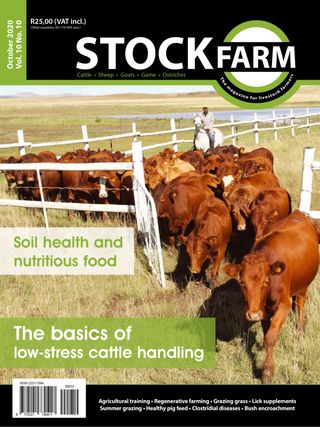

Diese Geschichte stammt aus der October 2020-Ausgabe von Stockfarm.
Abonnieren Sie Magzter GOLD, um auf Tausende kuratierter Premium-Geschichten und über 9.000 Zeitschriften und Zeitungen zuzugreifen.
Sie sind bereits Abonnent? Anmelden
WEITERE GESCHICHTEN VON Stockfarm

Stockfarm
World School Milk Day: A national celebration of dairy
The Department of Basic Education (DBE), in partnership with Milk SA's Consumer Education Project (CEP), marked the national celebration of World School Milk Day (WSMD) at Mandlomsobo Primary School in Bronkhorstspruit on 26 September.

2 mins
January 2026
Stockfarm
A breed that you like will work with you
Data can't fix what selection broke, and your grandpa knew it.
4 mins
January 2026
Stockfarm
2025 Santam Agriculture Silage Competition: Wet conditions, winning silage
Plaas Media's twelfth Santam Agriculture National Silage Competition once again showcased impressive expertise among its participants.
4 mins
January 2026
Stockfarm
Unravelling the regulations for dairy and imitation dairy products
Regulation R1510 of 22 November 2019, which governs dairy and imitation dairy products, recently took centre stage during a webinar hosted by the Dairy Standard Agency (DSA). Thabang Rampa, manager of regulatory affairs at the DSA, provided a technical interpretation of key sections of the regulation, aimed at improving industry's understanding of the prescribed minimum compositional and labelling requirements.
3 mins
January 2026
Stockfarm
2025 ARC National Master Dairyman Awards: Top dairy farmers honoured
The Agricultural Research Council (ARC) announced the winners of its 2025 National Master Dairyman Awards during a ceremony held in November at Lanzerac Estate in Stellenbosch.
2 mins
January 2026
Stockfarm
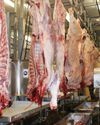
Abattoirs: The hidden pulse of meat safety
In conversations regarding the meat supply chain, the first and final links tend to take prominence, while the work performed by the middlemen often goes unnoticed. Yet every link plays a vital role. The real question is: Do we truly understand the value each link adds? Or has ‘value addition’ become shorthand for 'price addition, leaving producers and consumers feeling the financial strain?
5 mins
January 2026
Stockfarm
Silage equipment you can't do without
Silage is an invaluable resource on many livestock farms but producing it is not always simple or cheap.
3 mins
January 2026
Stockfarm
The value of a vaccination programme for cattle
Vaccination is essential for any cattle operation, especially given the increasing risk of disease outbreaks. According to Dr Paul Reynolds, a veterinarian at the Warden and Vrede Animal Hospitals, vaccines are never developed arbitrarily. Each exists because a specific disease threat warranted it.
4 mins
January 2026
Stockfarm
Silage competition winners: Key success factors
The Santam Agriculture National Silage Competition once again delivered impressive results, maintaining its high standards and enthusiastic participation. This year’s judging spanned six key categories: nutrient composition, fermentation quality, aerobic stability, top-layer losses, compaction or density, and visual assessment.
2 mins
January 2026
Stockfarm
Why use a silage inoculant?
Producing high-quality silage is critical for any livestock operation, especially in regions where seasonal forage shortages are common. One of the most effective ways to improve silage fermentation and preservation is with a silage inoculant.
2 mins
January 2026
Translate
Change font size