Versuchen GOLD - Frei
Correct Adaptation Of Livestock On Crop Residues In Winter
Stockfarm
|July 2020
For many livestock farmers crop residues are an indispensable link in their fodder flow programmes, especially in the eastern sourveld areas of the country, where the grazing value of winter veld is very low.

The percentage crude protein of saved winter veld varies between 3,5 and 5,3%, while that of maize residues ranges from 6 to 8,6%.
Digestible organic matter (DOM) of saved winter veld ranges between 50 and 53% and total digestible nutrients (TDN) of maize residues amount to between 60 and 84%.
According to Dr Josef van Wyngaard, technical manager at Voermol, the stocking rate on crop residues will depend on several factors, including plant density and yield, cultivar type, harvesting method and climate factors such as drought.
Adaptation on crop residues
Although crop residues are undoubtedly a valuable and inexpensive winter feed source for livestock, he warns that some potential problems may arise when animals are moved onto fields without having been properly adapted beforehand. This includes:
• Acidosis on grain crop residues due to excess starch.
• Bladder stones on maize crop residues due to excess phosphorus.
• Bloat on legume crop residues due to high levels of soluble protein.
• Prussic acid poisoning when late rains and warm temperatures lead to the regrowth of young shoots.
• Iodine deficiencies on Brassica crop residues (such as cabbage and cauliflower) due to anti-nutritional factors that can impair iodine uptake over a long grazing period.
• A trace mineral as well as vitamin A deficiency.
• Although not common, choking on maize cobs, whole vegetables such as carrots and potatoes, and tubers.
Proper management and lick supplementation can solve all these nutritional problems and deficiencies, and allows for proper utilisation of crop residues as winter grazing.
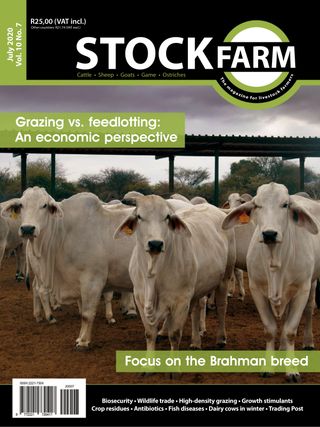

Diese Geschichte stammt aus der July 2020-Ausgabe von Stockfarm.
Abonnieren Sie Magzter GOLD, um auf Tausende kuratierter Premium-Geschichten und über 9.000 Zeitschriften und Zeitungen zuzugreifen.
Sie sind bereits Abonnent? Anmelden
WEITERE GESCHICHTEN VON Stockfarm

Stockfarm
World School Milk Day: A national celebration of dairy
The Department of Basic Education (DBE), in partnership with Milk SA's Consumer Education Project (CEP), marked the national celebration of World School Milk Day (WSMD) at Mandlomsobo Primary School in Bronkhorstspruit on 26 September.

2 mins
January 2026

Stockfarm
A breed that you like will work with you
Data can't fix what selection broke, and your grandpa knew it.
4 mins
January 2026
Stockfarm
2025 Santam Agriculture Silage Competition: Wet conditions, winning silage
Plaas Media's twelfth Santam Agriculture National Silage Competition once again showcased impressive expertise among its participants.
4 mins
January 2026
Stockfarm
Unravelling the regulations for dairy and imitation dairy products
Regulation R1510 of 22 November 2019, which governs dairy and imitation dairy products, recently took centre stage during a webinar hosted by the Dairy Standard Agency (DSA). Thabang Rampa, manager of regulatory affairs at the DSA, provided a technical interpretation of key sections of the regulation, aimed at improving industry's understanding of the prescribed minimum compositional and labelling requirements.
3 mins
January 2026

Stockfarm
2025 ARC National Master Dairyman Awards: Top dairy farmers honoured
The Agricultural Research Council (ARC) announced the winners of its 2025 National Master Dairyman Awards during a ceremony held in November at Lanzerac Estate in Stellenbosch.
2 mins
January 2026
Stockfarm
Abattoirs: The hidden pulse of meat safety
In conversations regarding the meat supply chain, the first and final links tend to take prominence, while the work performed by the middlemen often goes unnoticed. Yet every link plays a vital role. The real question is: Do we truly understand the value each link adds? Or has ‘value addition’ become shorthand for 'price addition, leaving producers and consumers feeling the financial strain?
5 mins
January 2026
Stockfarm
Silage equipment you can't do without
Silage is an invaluable resource on many livestock farms but producing it is not always simple or cheap.
3 mins
January 2026
Stockfarm
The value of a vaccination programme for cattle
Vaccination is essential for any cattle operation, especially given the increasing risk of disease outbreaks. According to Dr Paul Reynolds, a veterinarian at the Warden and Vrede Animal Hospitals, vaccines are never developed arbitrarily. Each exists because a specific disease threat warranted it.
4 mins
January 2026
Stockfarm
Silage competition winners: Key success factors
The Santam Agriculture National Silage Competition once again delivered impressive results, maintaining its high standards and enthusiastic participation. This year’s judging spanned six key categories: nutrient composition, fermentation quality, aerobic stability, top-layer losses, compaction or density, and visual assessment.
2 mins
January 2026
Stockfarm
Why use a silage inoculant?
Producing high-quality silage is critical for any livestock operation, especially in regions where seasonal forage shortages are common. One of the most effective ways to improve silage fermentation and preservation is with a silage inoculant.
2 mins
January 2026
Translate
Change font size