
Mit Magzter GOLD unbegrenztes Potenzial nutzen
Erhalten Sie unbegrenzten Zugriff auf über 9.000 Zeitschriften, Zeitungen und Premium-Artikel für nur
Versuchen GOLD - Frei
Dangerous To Time The Market
Outlook Money
|November 2019
How the stock market will perform post Diwali and what strategy retail investors should adopt?

When you will be reading this story, in any form (print or digital), we must have entered the new Vikram Samvat 2076 and we will be witnessing a laying down of a solid foundation of a long-lasting bull run in the Indian stock market. Actually that will be a continuation of what we saw on September 20, 2019, when the finance minister (FM) Nirmala Sitharaman in her last of the four booster doses announced a hefty cut in corporate tax rate and we witnessed one of the highest gains in the benchmark indices Nifty and the Sensex.
Though the benchmark indices of the markets have returned only nine per cent (Sensex and Nifty gained 3,157 points and 1213 points respectively) during current Samvat year 2075, which will end on October 27, 2019 (this story was written on October 21), the stage of optimism is being set in such a way for Samvat 2076, that all-time peak level achieved by frontline measures (Sensex at 40,312 points and Nifty at 12,089 points) during June 2019 will be surpassed and new record level will be achieved. However, the journey to the new peak will be equally stormy and will pass through high volatile path. The market movements in the second half of the financial year 2019-20 (FY20), post Diwali, will be crucial and we will be discussing how to make a way out of it in the following lines.
Just a couple of weeks back, there was pessimism all around with the slowdown in economic growth, lack of consumer demand, liquidity or the crisis of confidence, negative sentiment in the capital markets leading to a huge erosion in the market capitalisation (M-Cap). It is very easy to be coloured by the newsflow and dwell on the past and present data points. The four booster doses announced by the FM for the economy, spread over five Fridays during AugustSeptember, have the vigour to kick start the economy and improve the sentiment for businesses and for the capital market participants.
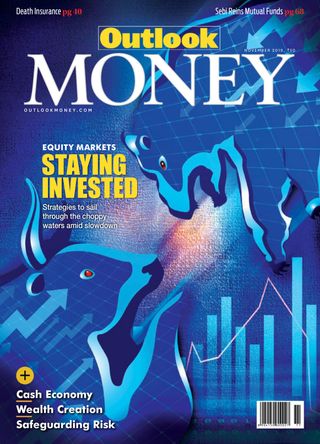

Diese Geschichte stammt aus der November 2019-Ausgabe von Outlook Money.
Abonnieren Sie Magzter GOLD, um auf Tausende kuratierter Premium-Geschichten und über 9.000 Zeitschriften und Zeitungen zuzugreifen.
Sie sind bereits Abonnent? Anmelden
WEITERE GESCHICHTEN VON Outlook Money
Outlook Money
How Budget Touches Your Life
There are two perspectives on how does the Union Budget impact us. One is that as a citizen, macro developments are relevant for us, as macro percolates in some way to make a micro impact.

4 mins
February 2026
Outlook Money
SIP Returns Beat Bank FDs' Over Long Term
I am 22 years old and have just started working. I want to invI am 22 years old and have just started working.
2 mins
February 2026

Outlook Money
Thematic Investing Without The Hype
How to turn trends into portfolios using discipline valuation checks and sensible sizing for investors
2 mins
February 2026

Outlook Money
Stop Raiding Your Long Term SIP
Short term goals need stability long term goals need equity. Time is what changes risk
2 mins
February 2026

Outlook Money
SIP VS SIP + Buying Market Dips: A Reality Check
It's common to assume that buying during market dips can enhance returns. We ran numbers to see what happens if you invest in a plain SIP and compared it with scenarios when you topped up during market dips. The results will shock you
7 mins
February 2026

Outlook Money
India's Evolving Equity Markets And The Design Of Flexi Cap Funds
India's market leadership rotates between large, mid and small caps, and flexi cap funds are built to rotate with it.
2 mins
February 2026

Outlook Money
Base Expense Ratio
The Securities and Exchange Board of India (Sebi) has changed how mutual fund expenses are disclosed by introducing the base expense ratio (BER). Sebi approved the change on December 17, 2025, under the new Sebi (Mutual Funds) Regulations, 2026. Previously, investors kept a track of their mutual fund expenses through the total expense ratio (TER), which combined fund management fees with taxes and statutory charges, such as goods and services tax (GST) and securities transactions tax (STT). This made it difficult for investors to see what fund houses actually charged. In contrast, BER includes only the core expenses of running a mutual fund scheme, and statutory charges are disclosed separately.
2 mins
February 2026

Outlook Money
Top-Up Solution To Piling Claims
Base policies are proving to be inadequate because of rising medical costs and premiums. To ensure a large coverage at affordable rates, they need to be combined with a super top-up insurance that takes care of rising family claims
7 mins
February 2026

Outlook Money
Retirement Is Not About Slowing Down
At 63, Murli Sundrani doesn't come across as the typical retired gentleman. He treks, goes on world tours, is pursuing multiple courses, and is financially savvy, too
5 mins
February 2026

Outlook Money
'Ideal Retirement' Lasts Only A Couple Of Years, Says Riley Moynes
Retirement is not just about cavorting on the beach with a glass of wine, but also about coming to terms with loss and trauma, and then re-picking yourself to find a purpose, believes Riley Moynes, a former public educator and financial advisor and now TED speaker, podcaster and author of many books, including The Four Phases Of Retirement. In an interview with Nidhi Sinha, Editor, Outlook Money, as part of the Wealth Wizards series, he talks about the challenges seniors face as they stare at around 30 years of retirement years
8 mins
February 2026
Translate
Change font size