
Mit Magzter GOLD unbegrenztes Potenzial nutzen
Erhalten Sie unbegrenzten Zugriff auf über 9.000 Zeitschriften, Zeitungen und Premium-Artikel für nur
Versuchen GOLD - Frei
Share For Growth
Indian Management
|April 2018
Knowledge assumes value only when it is disseminated across the board.

Like human beings, organisations too learn as they grow. As a company progresses along the trajectory of its life cycle, it gathers information on all fronts—business, technology, operations, human resources, the market, the industry, and the political and regulatory environment, to name a few. But what do they do with this plethora of information? It would do well for an organisation to know how to assimilate, manage, and disseminate knowledge. The aim of effective knowledge management is to improve organisation-wide efficiencies as well as widen its opportunities for growth. This knowledge is not the prerogative of the HR function or only the senior management. Knowledge is meant to percolate across hierarchies and be of use to every employee.
There is a need for a knowledge repository for every company, irrespective of its size and the industry in which it operates. Knowledge management helps create assets that are of use perpetually, without having to scramble for data/information when it is needed, or being dependent on a few individuals. One may argue that knowledge management is just another fancy way of saying that people in the company should know of internal and external developments, and that every company does it in some way or the other. So is it that important?
Indeed, it is. An organised process of getting together insights and experiences and managing them comprises knowledge management. This is of much more use than unsystematic bits of information that one has to piece together as per one’s need. It saves a large amount of time and brings together relevant and contextual data to one place. The most important thing is to build a culture of knowledge management and knowledge sharing. Employees should understand and imbibe that most information must and should be shared with coworkers, that it will not lead to unhealthy competition, and that they will not be at a disadvantage by sharing what they know.
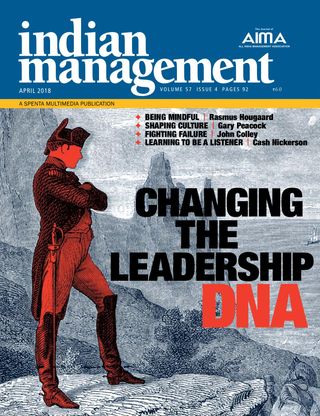

Diese Geschichte stammt aus der April 2018-Ausgabe von Indian Management.
Abonnieren Sie Magzter GOLD, um auf Tausende kuratierter Premium-Geschichten und über 9.000 Zeitschriften und Zeitungen zuzugreifen.
Sie sind bereits Abonnent? Anmelden
WEITERE GESCHICHTEN VON Indian Management

Indian Management
Digital independence
From digital adoption to digital sovereignty, India is leveraging AI to recalibrate its power.

4 mins
Feb 2026
Indian Management
Creativity with consistency: Rewarding reinvention
Every enduring institution carries within it a paradox. The very strengths that create longevity can, over time, become constraints on renewal. Managing this paradox—remaining consistent in purpose while being creative in action—has become one of the most critical capabilities for organisations seeking to stay relevant in an uncertain world.
3 mins
Feb 2026

Indian Management
Building cultures of adaptability
In a world shaped by intelligent systems, the most successful organisations will be those that continually reinvent themselves.
5 mins
Feb 2026

Indian Management
Make your message stick
A simple story framework that every leader needs.
5 mins
Feb 2026

Indian Management
The real leadership risk
Ego isn't the problem; unconscious leadership is, opines Christie Garcia, founder and Ego Management expert, Mindful Choice and author, Your Ego is Showing: How Ego Management Unlocks Authentic Confidence & Meaningful Success.
4 mins
Feb 2026

Indian Management
Unconscious competence
Leadership is not taught in isolation; context shapes who becomes an effective leader.
5 mins
Feb 2026

Indian Management
Smarter care, lower costs
Artificial Intelligence (AI) is ushering in a new era in healthcare—providing transformative improvements across diagnostics, patient care, drug development, and health system efficiency. More than just a technological upgrade, AI has begun reshaping the cost structures of medical services, enabling more personalised care at reduced expense.
5 mins
December 2025
Indian Management
Staying Connected When It Matters Most: Why Communication Resilience Defines Modern Organisations
In a world continually reshaped by geopolitical volatility, technological progress, and rapid disruption, resilient communication is a foundational capability, one of the most crucial that an organisation can develop. Organisations stumble when information travels slowly, when teams operate with different versions of the truth, or when uncertainty creeps in.
2 mins
December 2025

Indian Management
From pushback to progress
Influence happens not when you push your idea, but when you open the space for others'.
5 mins
December 2025

Indian Management
Financial metamorphosis
The financial services sector is undergoing a profound metamorphosis, spurred by technological advancements, evolving customer expectations, and the emergence of innovative business models (Bueno et al., 2024).
6 mins
December 2025
Translate
Change font size