Versuchen GOLD - Frei
Breeding For Maximum Profit With Minimum Fuss
Farmer's Weekly
|October 25, 2019
The success of a livestock breeding concern depends on choosing a breed that makes economic sense and optimises return on investment. For a part-time farmer, an additional requirement is that the breed is hardy enough to thrive without pampering. Part-time stud breeder Dirco Swart of Frankfort told Annelie Coleman that the Beefmaster ticked all these boxes.

Dirco Swart and his wife, Robyn, keep their Blinkmeneer Beefmaster stud on 580ha near Frankfort in the Eastern Free State. The stud, started in 2010, consists of 180 breeding females, of which a third are replacement heifers.
Swart uses eight bulls (four from his own stud) on his cows. A Blinkmeneer stud bull, DR 16 7302, went for R120 000 at the Sarwipi Beefmasters Auction held in August. In July, another Blinkmeneer bull, DR 16 1507, realised R48 000, the highest price at the Makiti Auction in Frankfort.
Annually, the stud produces 20 quality registered bulls, most of which are sold to commercial farmers. The focus is on producing top-performing animals, not on selling as many as possible. Swart has followed in the footsteps of his father, Manie, a former principal of the Wilgerivier High School, who farmed parttime until his retirement. Swart, who works in the banking sector, says his father instilled in him a love of beef cattle. The stud is named Blinkmeneer in memory of Swart’s late brother, Pieter, whose nickname for him was ‘Blink meneer’.
“It’s a pleasure to combine my love of numbers and the skills I acquired in the corporate environment with livestock breeding,” he says. “Numbers are important because, as a part-time breeder, I can’t afford to maintain animals that don’t excel economically.”
To maximise profit, Swart opted for a stud from day one, starting with 38 cows and two bulls on 210ha of leased land. He maintains that producing stud animals costs very little more than raising commercial ones, but the return on investment for a stud animal is considerably higher.
CHOOSING THE BREED
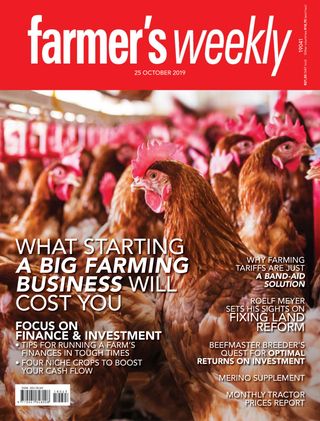

Diese Geschichte stammt aus der October 25, 2019-Ausgabe von Farmer's Weekly.
Abonnieren Sie Magzter GOLD, um auf Tausende kuratierter Premium-Geschichten und über 9.000 Zeitschriften und Zeitungen zuzugreifen.
Sie sind bereits Abonnent? Anmelden
WEITERE GESCHICHTEN VON Farmer's Weekly

Farmer's Weekly
How AFGRI uses technology to unlock farm finance from asset to market
As modern farming becomes more capital-intensive and digitally driven, AFGRI is reinventing agricultural finance by linking technology directly to lending decisions.

5 mins
January 16-23, 2026

Farmer's Weekly
Adele's Mohair: a living tapestry of craft, colour and rural heritage
Octavia Avesca Spandiel spoke to Adele Cutten, founder of Adele's Mohair, to explore how a small spinning experiment grew into a thriving rural craft enterprise rooted in South Africa's rich mohair heritage.
6 mins
January 16-23, 2026
Farmer's Weekly
Cannabis and marketing in South Africa
The path from cultivation to commercial success remains complicated by regulatory ambiguity. Cultivators who master compliant marketing while delivering verifiable quality will build sustainable businesses, says Thomas Walker.
2 mins
January 16-23, 2026
Farmer's Weekly
Foot-and-mouth disease project targets waste reduction and regulatory reform
A groundbreaking research collaboration between Red Meat Industry Services, the University of Pretoria, and global animal health leader Zoetis is aiming to transform South Africa's approach to foot-and-mouth disease.
3 mins
January 16-23, 2026
Farmer's Weekly
What to expect in 2026
The world faces a complex interplay of economic, geopolitical, environmental, technological, and social pressures.
3 mins
January 16-23, 2026

Farmer's Weekly
How drones are revolutionising pest and disease detection in agriculture
Drones are reshaping modern crop protection by giving farmers a powerful new vantage point: the sky. With advanced sensors, high-resolution imaging, and artificial intelligence-driven analytics, these unmanned aerial vehicles can detect early signs of disease, water stress, and pest damage long before the human eye can. Jedrie Harmse spoke to agricultural drone specialist Monique Heydenrych.
7 mins
January 16-23, 2026
Farmer's Weekly
Generic advertising in perspective
Dr Koos Coetzee explains how industry organisations and the agriculture sector actually have the ability to prudently manage the negative perceptions surrounding generic advertising campaigns.
2 mins
January 16-23, 2026
Farmer's Weekly
The modern Merino: the benchmark breed
The Merino breed has transformed dramatically over the past seven decades-from the skin-folded wool specialists of the 1950s to today's plain-bodied, fertile, well-balanced sheep prized for their dual-purpose productivity. Yet, despite its versatility, myths persist. Willie van Heerden, manager at Merino South Africa, dispels some of these myths.
2 mins
January 16-23, 2026

Farmer's Weekly
Elsenburg Agricultural Training Institute celebrates excellence
The Elsenburg Agricultural Training Institute marked a major milestone in December 2025, conferring over 200 agricultural qualifications, including bachelor's degrees and various national certificates.
2 mins
January 16-23, 2026
Farmer's Weekly
Grain SA issues guidelines as poor-quality agri inputs threaten farmers livelihoods
Grain SA has urged South African grain and oilseed farmers to act fast when seeds, fertilisers, or agrochemicals underperform, providing clear guidelines to protect crops.
2 mins
January 16-23, 2026
Translate
Change font size