Versuchen GOLD - Frei
Time To Look For 2nd Gen Vaccines
BioSpectrum Asia
|BioSpectrum Asia September 2020
Most pharmaceutical companies, across the world, are working at a breakneck speed to develop a vaccine for the novel coronavirus. Some companies are concerned that these vaccines may not be particularly effective in preventing COVID-19 infections in the long-term. This has evoked the need in them to develop improved, next-generation vaccines against the novel coronavirus. BioSpectrum discusses this next phase of vaccine development and if it’s too early to think about the second generation when we don’t even have the first ready yet.

The first confirmed death from COVID-19 occurred on January 9, 2020 and triggered the race to find a course of treatment that would treat, cure and prevent the ill-effects of this novel severe acute respiratory syndrome coronavirus 2 (SARS-CoV-2). Most of the pharmaceutical firms chose to work on developing a vaccine for the new virus.
According to the World Health Organization (WHO) various types of vaccines are being researched and tested; some traditional and others experimental. There are about 30 candidate vaccines in clinical evaluation and 139 candidate vaccines in preclinical evaluation as of August 20, 2020.
Although this rapid pace is an impressive example of how science and medicine can be deployed to address public health, there are potential problems that could arise.
Sharing his concerns on the safety issues related to COVID-19 vaccine, Dr Michael S Kinch, Director, Center for Research Innovation in Biotechnology & Drug Discovery, Washington University in St Louis, USA said, “Importantly, I am just as impatient for a vaccine as everyone else and am confident that we will achieve our goal, but we must be aware that certain risks will likely arise if or because we are cutting corners. A vaccine is intended to trigger a long-lived response, ideally conferring lifelong protection. Were a vaccine to trigger an unsafe cross-reaction that causes persistent inflammation or auto-immunity, the outcomes could be tragic. Hopefully, the clinical trials will exclude this but the time in which follow up investigation occurs will be so brief that we might miss some of this.”
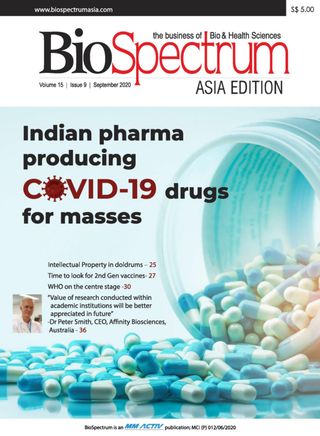

Diese Geschichte stammt aus der BioSpectrum Asia September 2020 -Ausgabe von BioSpectrum Asia.
Abonnieren Sie Magzter GOLD, um auf Tausende kuratierter Premium-Geschichten und über 9.000 Zeitschriften und Zeitungen zuzugreifen.
Sie sind bereits Abonnent? Anmelden
WEITERE GESCHICHTEN VON BioSpectrum Asia

BioSpectrum Asia
Kyorin and Lunatus partner to launch Lasvic tablets in 9 Middle Eastern countries
Japan's Kyorin Pharmaceutical has entered into an exclusive distribution agreement with Lunatus Marketing & Consulting FZCO for Lasvic tablets (Lascufloxacin hydrochloride).

1 min
BioSpectrum Asia Feb 2026

BioSpectrum Asia
Biotium launches GlycoLiner Cell Surface Glycoprotein Labeling Kits
US-based Biotium, a leading innovator in fluorescent dyes and life science reagents, has announced the launch of GlycoLiner Cell Surface Glycoprotein Labeling Kits for rapid, selective, and covalent labeling of cell surface glycoproteins.
1 min
BioSpectrum Asia Feb 2026

BioSpectrum Asia
Vaxxas appoints former Merck Global Vaccines President David Peacock as CEO
Australia-based Vaxxas has announced the appointment of global biopharmaceutical executive David Peacock as Chief Executive Officer (CEO) to lead the commercialisation of the company's proprietary high-density microarray patch (HD-MAP) vaccination technology.
1 min
BioSpectrum Asia Feb 2026

BioSpectrum Asia
Thermo Fisher partners with NVIDIA leveraging AI to advance scientific instrumentation
US-based Thermo Fisher Scientific Inc. has announced a strategic collaboration with NVIDIA to power artificial intelligence (AI)based solutions and laboratory automation at scale.
1 min
BioSpectrum Asia Feb 2026

BioSpectrum Asia
Bruker consolidates ownership of TOFWERK in expansion of mass spectrometry portfolio
Bruker Corporation has announced the acquisition of an additional 60 per cent ownership stake in TOFWERK AG, a Switzerland-based innovator in ultra-fast time-of-flight (TOF) mass spectrometry technology for small molecule applied markets, consolidating Bruker's ownership to 100 per cent.
1 min
BioSpectrum Asia Feb 2026
BioSpectrum Asia
Bioengineered tissue by Japan emerges as revolutionary treatment for secondary lymphedema
A research team led by Associate Professor Kosuke Kusamori from the Faculty of Pharmaceutical Sciences at Tokyo University of Science (TUS), Japan, is pioneering an innovative technique for lymphatic tissue engineering that could revolutionize the treatment of secondary lymphedema.
1 min
BioSpectrum Asia Feb 2026
BioSpectrum Asia
Chitose and Fujifilm Biosciences to drive global innovation and biopharma manufacturing
Japan-based Chitose Laboratory Corp. & Fujifilm Biosciences Inc. have announced a new strategic alliance that leverages the strengths of both companies in advancing biopharmaceutical production.
1 min
BioSpectrum Asia Feb 2026

BioSpectrum Asia
Vibrant Therapeutics on-boards Dr Han Lee as Co-CEO
Vibrant Therapeutics, a clinical-stage biotechnology company based in China and US, has announced the appointment of Dr Han Lee as co-chief executive officer (CEO).
1 min
BioSpectrum Asia Feb 2026

BioSpectrum Asia
IIT-D and AIIMS develop swallowable microdevice for microbiome study
Researchers at the Indian Institute of Technology (IIT) Delhi, and All India Institute of Medical Sciences (AIIMS) have developed an ingestible device that can sample bacteria directly from the small intestine, opening a new window into the human gut microbiome.
1 min
BioSpectrum Asia Feb 2026

BioSpectrum Asia
Ambitious research to develop multivalent vaccines against multiple deadly filoviruses
Scientists at the University of Oxford, in collaboration with partners, will spearhead the development of new vaccines that aim to provide comprehensive protection against multiple lethal filoviruses, including Ebola virus, Sudan virus, Bundibugyo virus, and Marburg virus.
1 min
BioSpectrum Asia Feb 2026
Translate
Change font size