
Mit Magzter GOLD unbegrenztes Potenzial nutzen
Erhalten Sie unbegrenzten Zugriff auf über 9.000 Zeitschriften, Zeitungen und Premium-Artikel für nur
Versuchen GOLD - Frei
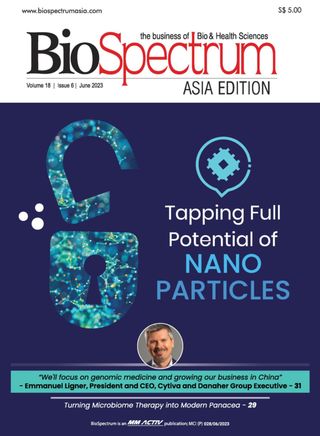
Tapping Full Potential Of Nanoparticles
BioSpectrum Asia
|BioSpectrum Asia June 2023
Nanoparticles are another powerful tool in the biotech industry’s arsenal for targeted drug delivery. Their extremely small size, measured in nanometres, makes them highly effective carriers for therapeutic agents. These miniature carriers can be customised to encase drugs, benefiting from their biocompatibility, controlled release capabilities, stability, and low toxicity. The precision offered by nanoparticles opens up a world of possibilities for treating various diseases, including infectious diseases, cancer, and neurological disorders. These tiny particles offer tremendous potential for targeted drug delivery, enhanced therapeutic efficacy and precise disease targeting. Moreover, the global market for nanoparticle drug delivery is projected to grow significantly, reaching $123.6 billion by 2025, according to BCC Research. Let’s deep dive into the fascinating field of nanomedicines, advancements and challenges in nanoparticle drug delivery.

At the peak of COVID-19, the pharma industry’s push for an mRNA drug for emergency use became known as the most notable intervention in recent history. The success of mRNA vaccines can be attributed to the utilisation of lipid-based nanoparticles, which played a crucial role in enabling this groundbreaking achievement and bolstering the field of nanomedicines.
Nanoparticles, ranging from 1 to 100 nanometres, are smaller than human hair, which is typically several hundred micrometres in diameter. There are three main types commonly used, polymeric nanoparticles, liposomes, and lipid nanoparticles (LNPs). The majority of the research at present is focused on LNPs.
Encouraged by the success of Pfizer and Moderna’s vaccine, several other companies and researchers are working to develop different modes of drug delivery using nanoparticles. One such company is Australia’s Vaxxas. The firm has developed a platform called ‘Nanopatch’ that utilises lipid nanoparticle-coated projections to deliver vaccines directly to immune cells in the skin, potentially improving vaccine efficacy and eliminating the need for refrigeration during distribution. In March 2023, the firm reported positive phase 1 results from nanopatch, paving the way for needle-free/self-administered vaccines.
Australian biotech behemoth CSL is also trying to get on board with this technology. In 2022, CSL, partnered with US-based Arcturus to develop and commercialise infectious disease vaccines using Arcturus’ self-amplifying mRNA technology and LUNAR lipid nanoparticle delivery platform.

Diese Geschichte stammt aus der BioSpectrum Asia June 2023-Ausgabe von BioSpectrum Asia.
Abonnieren Sie Magzter GOLD, um auf Tausende kuratierter Premium-Geschichten und über 9.000 Zeitschriften und Zeitungen zuzugreifen.
Sie sind bereits Abonnent? Anmelden
WEITERE GESCHICHTEN VON BioSpectrum Asia
BioSpectrum Asia
India–EU FTA Paves Way for Expanded Healthcare Trade
On January 27, 2026, after years of negotiations, India and the European Union announced a landmark Free Trade Agreement.

4 mins
BioSpectrum Asia March 2026
BioSpectrum Asia
PreferCo and Glatt to open CoE for precision fermentation bioprocess scale-up in India
In a major boost to Government of India's BioE3 push, German major Glatt and India-based startup PreferCo have announced the launch of \"PreferCo-Glatt Centre of Excellence (CoE) for Bioprocess Scale-Up\" in Hyderabad's Genome Valley.
1 min
BioSpectrum Asia March 2026

BioSpectrum Asia
Women's Health Surge in APAC
The rising burden of diseases such as ovarian cancer, breast cancer, cervical cancer, infertility, etc. is emerging as the key driver of the women's healthcare market across the globe. While North America led the women healthcare market in 2025, Asia Pacific (APAC) is expected to witness the fastest growth this year onwards. As a result, governments across the APAC region, are recognising the importance of women's health and are launching initiatives, particularly under female leaders, to improve access to healthcare services. Moreover, a number of women-led startups are now developing new solutions to address this growing burden of women-associated diseases in the APAC region. Let's take a closer look.
6 mins
BioSpectrum Asia March 2026

BioSpectrum Asia
Hanchor Bio receives US FDA Orphan Drug Designation for HCB101 in gastric cancer
Taiwan-based biotech startup HanchorBio, Inc. has announced that the US Food and Drug Administration (FDA) has granted Orphan Drug Designation (ODD) to HCB101 for the treatment of gastric cancer.
1 min
BioSpectrum Asia March 2026

BioSpectrum Asia
Daiichi Sankyo names Dr John Tsai as Global Head of R&D
Japan-based Daiichi Sankyo Company has appointed Dr John Tsai to succeed Dr Ken Takeshita, who is stepping down as Global Head of R&D, effective April 1, 2026.
1 min
BioSpectrum Asia March 2026

BioSpectrum Asia
"The global trend is moving beyond centralised hubs toward distributed networks and domestic capability"
King Faisal Specialist Hospital & Research Centre (KFSHRC) and US-based Germfree Laboratories have announced a strategic partnership to develop Saudi Arabia's first fully integrated, modular Advanced Therapy Medicinal Product (ATMP) Manufacturing Campus.
4 mins
BioSpectrum Asia March 2026

BioSpectrum Asia
SEOUL'S RISKY DRUG PRICING RESET
Drug pricing has once again moved to the centre of policy debate in South Korea, with the government recently stepping back from its proposed generic drug pricing reform.
2 mins
BioSpectrum Asia March 2026

BioSpectrum Asia
Takeda and Iambic sign $1.7 B deal to advance AI driven design of small molecules
Iambic, a US-based clinical-stage life science and technology company developing novel medicines using its artificial intelligence (AI)-driven discovery and development platform, has announced a multi-year technology and discovery collaboration agreement with Japan-based Takeda Pharma that will use Iambic's industry leading AI drug discovery models to advance a select set of high-priority small molecule programmes, initially in Takeda's Oncology and Gastrointestinal and Inflammation therapeutic areas.
1 min
BioSpectrum Asia March 2026

BioSpectrum Asia
S.Biomedics announces partnership with Catalent to develop and manufacture TED-A9
US-based Catalent and South Korea-based S.Biomedics have announced a strategic partnership to support the development and manufacturing of TED-A9, S.Biomedics' allogeneic pluripotent stem-cell-derived ventral midbrain-specific dopaminergic precursor cell therapy being developed for the treatment of Parkinson's disease.
1 min
BioSpectrum Asia March 2026
BioSpectrum Asia
China revises drug administration regulations to spur innovation
China has revised regulations concerning drug administration in a bid to promote drug innovation, strengthen management of online sales of medicines and reinforce drug safety supervision.
1 min
BioSpectrum Asia March 2026
Translate
Change font size