Versuchen GOLD - Frei
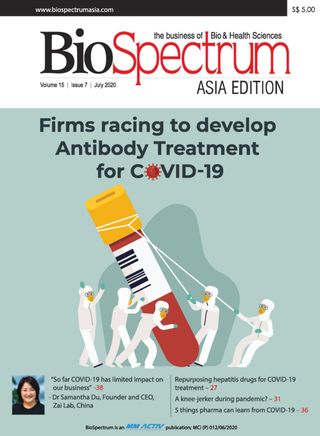
Firms Racing To Develop Antibody Treatment For Covid-19
BioSpectrum Asia
|July 2020
The Coronavirus COVID-19 has raged the world and has infected 8,993,659 cases and killed 469,587 (as of June 23, 2020. Source World Health Organization (WHO)). Pharma firms, scientists and governments all over the world are racing to find a cure for the virus. The entire world is waiting for the vaccine; Moderna’s mRNA vaccine will begin phase III study in July. Amidst all this, some biopharma companies are pushing to develop antibody-based treatments for the virus. Does that have any merit? Why are firms putting billions of dollars into it when vaccines are the ultimate solution? Let’s find out.

Since the start of the outbreak; researchers, pharma firms, governments all over the world are scrambling to find a treatment. From herbal medications to repurposing older drugs as potential COVID-19 therapies, anything which could possibly save lives is being tested and of course the hunt for a vaccine is on. There are 16 vaccine candidates in clinical evaluations and 125 candidates in preclinical evaluation around the world. (As of June 24, 2020. Source: WHO)
Developing a vaccine is a time-consuming process. Vaccines, on an average, take 10 years to develop. The fastest vaccine ever developed till date was approved for the mumps in 1967, took four years. The latest vaccine developed for an epidemic, Ebola vaccine, also took five years,was approved in 2019. Both the vaccines were developed by Merck.
Though the vaccine is touted as the fastest to develop, developing a vaccine that is safe, effective and producing it in large quantities that the world needs to fight a pandemic is a surmountable challenge. It is interesting to note that there is still no licensed vaccine for an earlier Coronavirus, Severe acute respiratory syndrome (SARS). Studies showed that some preliminary SARS vaccines enhanced the disease in model experiments.
That’s why the hunt is on to find the alternative treatment to save people’s lives till the vaccine arrives. And the antibody-based treatments offer an excellent hope. That’s what companies like Regeneron, Eli Lilly, Vir Biotechnology and many more from USA, Europe and Asia Pacific are working on antibodies for COVID-19.
Why antibodies?

Diese Geschichte stammt aus der July 2020-Ausgabe von BioSpectrum Asia.
Abonnieren Sie Magzter GOLD, um auf Tausende kuratierter Premium-Geschichten und über 9.000 Zeitschriften und Zeitungen zuzugreifen.
Sie sind bereits Abonnent? Anmelden
WEITERE GESCHICHTEN VON BioSpectrum Asia

BioSpectrum Asia
Kyorin and Lunatus partner to launch Lasvic tablets in 9 Middle Eastern countries
Japan's Kyorin Pharmaceutical has entered into an exclusive distribution agreement with Lunatus Marketing & Consulting FZCO for Lasvic tablets (Lascufloxacin hydrochloride).

1 min
BioSpectrum Asia Feb 2026
BioSpectrum Asia
Biotium launches GlycoLiner Cell Surface Glycoprotein Labeling Kits
US-based Biotium, a leading innovator in fluorescent dyes and life science reagents, has announced the launch of GlycoLiner Cell Surface Glycoprotein Labeling Kits for rapid, selective, and covalent labeling of cell surface glycoproteins.
1 min
BioSpectrum Asia Feb 2026

BioSpectrum Asia
Vaxxas appoints former Merck Global Vaccines President David Peacock as CEO
Australia-based Vaxxas has announced the appointment of global biopharmaceutical executive David Peacock as Chief Executive Officer (CEO) to lead the commercialisation of the company's proprietary high-density microarray patch (HD-MAP) vaccination technology.
1 min
BioSpectrum Asia Feb 2026

BioSpectrum Asia
Thermo Fisher partners with NVIDIA leveraging AI to advance scientific instrumentation
US-based Thermo Fisher Scientific Inc. has announced a strategic collaboration with NVIDIA to power artificial intelligence (AI)based solutions and laboratory automation at scale.
1 min
BioSpectrum Asia Feb 2026

BioSpectrum Asia
Bruker consolidates ownership of TOFWERK in expansion of mass spectrometry portfolio
Bruker Corporation has announced the acquisition of an additional 60 per cent ownership stake in TOFWERK AG, a Switzerland-based innovator in ultra-fast time-of-flight (TOF) mass spectrometry technology for small molecule applied markets, consolidating Bruker's ownership to 100 per cent.
1 min
BioSpectrum Asia Feb 2026
BioSpectrum Asia
Bioengineered tissue by Japan emerges as revolutionary treatment for secondary lymphedema
A research team led by Associate Professor Kosuke Kusamori from the Faculty of Pharmaceutical Sciences at Tokyo University of Science (TUS), Japan, is pioneering an innovative technique for lymphatic tissue engineering that could revolutionize the treatment of secondary lymphedema.
1 min
BioSpectrum Asia Feb 2026
BioSpectrum Asia
Chitose and Fujifilm Biosciences to drive global innovation and biopharma manufacturing
Japan-based Chitose Laboratory Corp. & Fujifilm Biosciences Inc. have announced a new strategic alliance that leverages the strengths of both companies in advancing biopharmaceutical production.
1 min
BioSpectrum Asia Feb 2026

BioSpectrum Asia
Vibrant Therapeutics on-boards Dr Han Lee as Co-CEO
Vibrant Therapeutics, a clinical-stage biotechnology company based in China and US, has announced the appointment of Dr Han Lee as co-chief executive officer (CEO).
1 min
BioSpectrum Asia Feb 2026

BioSpectrum Asia
IIT-D and AIIMS develop swallowable microdevice for microbiome study
Researchers at the Indian Institute of Technology (IIT) Delhi, and All India Institute of Medical Sciences (AIIMS) have developed an ingestible device that can sample bacteria directly from the small intestine, opening a new window into the human gut microbiome.
1 min
BioSpectrum Asia Feb 2026
BioSpectrum Asia
Ambitious research to develop multivalent vaccines against multiple deadly filoviruses
Scientists at the University of Oxford, in collaboration with partners, will spearhead the development of new vaccines that aim to provide comprehensive protection against multiple lethal filoviruses, including Ebola virus, Sudan virus, Bundibugyo virus, and Marburg virus.
1 min
BioSpectrum Asia Feb 2026
Translate
Change font size