Versuchen GOLD - Frei
10 Covid-19 Candidate Vaccines In Clinical Evaluation
BioSpectrum Asia
|June 2020
The rapid spread of the novel coronavirus is a reminder of how global populations and economies are interconnected. The pandemic is integrating the global healthcare force by exposing the obvious realities that no single individual, company, or country can solve the pandemic crisis alone. Researchers are optimistically demonstrating best-in-class resources from the lab to manufacturing to advance the innovations at multiple vaccine candidates. Indeed, the global biopharma manufacturing industry is funding and expanding its capabilities for vaccine production on an ‘’at-risk basis’’ to facilitate the world’s immediate need and demand. Novel paradigms of Next-generation vaccine technology platforms are accelerating the development of “one life-saving vaccine” to nullify the repulsive humanitarian and economic impact. According to the WHO, as of May 30 there are 10 vaccines under clinical evaluation which have already progressed to human trials and 121 candidates are in preclinical evaluation.

As COVID-19 continues to ravage the global population, vaccination is becoming the sole hope for an effective disease control and prevention. Numerous pharmaceutical firms are racing and competing to develop a potential vaccine by deploying all their skills and resources. Companies have substantially accelerated the timeframe of vaccine production in comparison to the typical vaccine development process.
The publication of genetic sequence of SARS-CoV-2 on January 11, triggered intense global R&D activity towards vaccine development. Fortunately, up until the virus has not mutated to any significant extent maintaining its relatively stable SARS-CoV-2 genome. Currently, there exist roughly 4 to 10 genetic variations between the origin virus from Wuhan and the strains currently circulating. That’s a relatively small number of mutations for having passed through a large number of people. This makes it advantageous towards researchers attempt to create a single version of the COVID-19 vaccine.
This genomic data paved the way for range of novel technology platforms to evaluate vaccine development landscape for COVID-19, including nucleic acid (DNA and RNA), virus-like particle, peptide, viral vector (replicating and nonreplicating), recombinant protein, live attenuated virus and inactivated virus approaches. Vaccines based on viral vectors offer a high level of protein expression and long-term stability, and induce strong immune responses. Of the confirmed active vaccine candidates, 72 per cent are being developed by private/industry developers, with the remaining 28 per cent of projects being led by academic, public sector and other non-profit organizations.
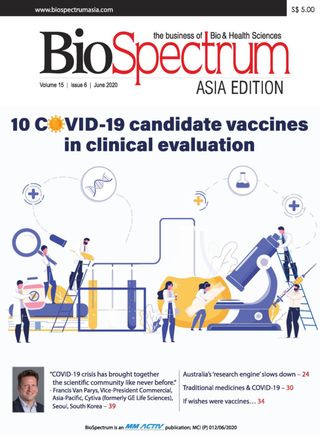

Diese Geschichte stammt aus der June 2020-Ausgabe von BioSpectrum Asia.
Abonnieren Sie Magzter GOLD, um auf Tausende kuratierter Premium-Geschichten und über 9.000 Zeitschriften und Zeitungen zuzugreifen.
Sie sind bereits Abonnent? Anmelden
WEITERE GESCHICHTEN VON BioSpectrum Asia
BioSpectrum Asia
India–EU FTA Paves Way for Expanded Healthcare Trade
On January 27, 2026, after years of negotiations, India and the European Union announced a landmark Free Trade Agreement.

4 mins
BioSpectrum Asia March 2026
BioSpectrum Asia
PreferCo and Glatt to open CoE for precision fermentation bioprocess scale-up in India
In a major boost to Government of India's BioE3 push, German major Glatt and India-based startup PreferCo have announced the launch of \"PreferCo-Glatt Centre of Excellence (CoE) for Bioprocess Scale-Up\" in Hyderabad's Genome Valley.
1 min
BioSpectrum Asia March 2026

BioSpectrum Asia
Women's Health Surge in APAC
The rising burden of diseases such as ovarian cancer, breast cancer, cervical cancer, infertility, etc. is emerging as the key driver of the women's healthcare market across the globe. While North America led the women healthcare market in 2025, Asia Pacific (APAC) is expected to witness the fastest growth this year onwards. As a result, governments across the APAC region, are recognising the importance of women's health and are launching initiatives, particularly under female leaders, to improve access to healthcare services. Moreover, a number of women-led startups are now developing new solutions to address this growing burden of women-associated diseases in the APAC region. Let's take a closer look.
6 mins
BioSpectrum Asia March 2026

BioSpectrum Asia
Hanchor Bio receives US FDA Orphan Drug Designation for HCB101 in gastric cancer
Taiwan-based biotech startup HanchorBio, Inc. has announced that the US Food and Drug Administration (FDA) has granted Orphan Drug Designation (ODD) to HCB101 for the treatment of gastric cancer.
1 min
BioSpectrum Asia March 2026

BioSpectrum Asia
Daiichi Sankyo names Dr John Tsai as Global Head of R&D
Japan-based Daiichi Sankyo Company has appointed Dr John Tsai to succeed Dr Ken Takeshita, who is stepping down as Global Head of R&D, effective April 1, 2026.
1 min
BioSpectrum Asia March 2026

BioSpectrum Asia
"The global trend is moving beyond centralised hubs toward distributed networks and domestic capability"
King Faisal Specialist Hospital & Research Centre (KFSHRC) and US-based Germfree Laboratories have announced a strategic partnership to develop Saudi Arabia's first fully integrated, modular Advanced Therapy Medicinal Product (ATMP) Manufacturing Campus.
4 mins
BioSpectrum Asia March 2026

BioSpectrum Asia
SEOUL'S RISKY DRUG PRICING RESET
Drug pricing has once again moved to the centre of policy debate in South Korea, with the government recently stepping back from its proposed generic drug pricing reform.
2 mins
BioSpectrum Asia March 2026

BioSpectrum Asia
Takeda and Iambic sign $1.7 B deal to advance AI driven design of small molecules
Iambic, a US-based clinical-stage life science and technology company developing novel medicines using its artificial intelligence (AI)-driven discovery and development platform, has announced a multi-year technology and discovery collaboration agreement with Japan-based Takeda Pharma that will use Iambic's industry leading AI drug discovery models to advance a select set of high-priority small molecule programmes, initially in Takeda's Oncology and Gastrointestinal and Inflammation therapeutic areas.
1 min
BioSpectrum Asia March 2026

BioSpectrum Asia
S.Biomedics announces partnership with Catalent to develop and manufacture TED-A9
US-based Catalent and South Korea-based S.Biomedics have announced a strategic partnership to support the development and manufacturing of TED-A9, S.Biomedics' allogeneic pluripotent stem-cell-derived ventral midbrain-specific dopaminergic precursor cell therapy being developed for the treatment of Parkinson's disease.
1 min
BioSpectrum Asia March 2026
BioSpectrum Asia
China revises drug administration regulations to spur innovation
China has revised regulations concerning drug administration in a bid to promote drug innovation, strengthen management of online sales of medicines and reinforce drug safety supervision.
1 min
BioSpectrum Asia March 2026
Translate
Change font size