
Mit Magzter GOLD unbegrenztes Potenzial nutzen
Erhalten Sie unbegrenzten Zugriff auf über 9.000 Zeitschriften, Zeitungen und Premium-Artikel für nur
Reverse logistics in e-retailing can help to contain e-waste
BUSINESS ECONOMICS
|August 16-31, 2019
Disruptive digital forces that include the internet of things (IoT), robotic process automation (RPA), cloud computing and analytics have affected e-commerce businesses at large.

While the e-commerce industry is actively engaged in trimming the channels to make the goods available to the consumers at earliest, hasty purchases by consumers may lead to the selection of a wrong product. Such products are often returned to the producers. Therefore, modern day e-commerce companies along with the ‘buy anywhere’ mantra are equally concerned about ‘return anywhere’ concept, as poor service with respect to the return of goods may lead to the loss of customers. This arrangement of flow of goods back from customers to the company is termed as’ reverse logistics’. Advocates of strong ‘reverse logistics’ state that five R’s cover all aspects of reverse logistics. These 5 R’s comprises are
Returns and Exchanges: Here the customers start returning the products due to reasons like damaged/defective products or the product failing to meet expectations.Estimates state that in developed countries, 47% of high-tech shoppers have returned or exchanged an item purchased online.
Recalls: When a sold product encounters a defector potential hazard, it calls for a system and processes in place to receive, replace, reclaim or resell that product.
Repairs: Companies generally prefer to repair and return the product rather than replace it, owing to inventory costs. In case the faults in the returned products are too severe, then the manufacturers refurbish or remanufacture the products to a condition that is more like new. Reusing materials from returned products is becoming a common practice today.
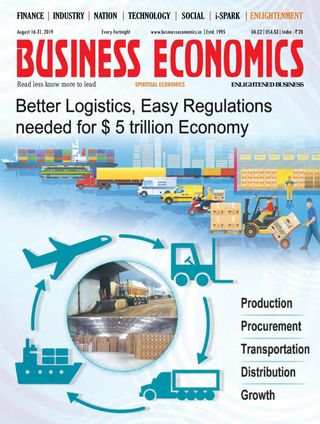

Diese Geschichte stammt aus der August 16-31, 2019-Ausgabe von BUSINESS ECONOMICS.
Abonnieren Sie Magzter GOLD, um auf Tausende kuratierter Premium-Geschichten und über 9.000 Zeitschriften und Zeitungen zuzugreifen.
Sie sind bereits Abonnent? Anmelden
WEITERE GESCHICHTEN VON BUSINESS ECONOMICS

BUSINESS ECONOMICS
Rupee has weakened
The rupee has weakened significantly over the past year, falling from 84.7 to 89.7 against the US dollar. Its depreciation has been even sharper against the euro (9.4 per cent) and the British pound (14.3 per cent). It has also lost value against the Japanese yen and the Chinese yuan. In nominal terms, therefore, the rupee has depreciated against all major global currencies.

1 mins
December 1 - 31, 2025

BUSINESS ECONOMICS
Foundations of Indian Yoga Philosophy
Yoga, in very simple terms, means union.
4 mins
December 1 - 31, 2025

BUSINESS ECONOMICS
The New Indian Professional: Work, Wealth & Wellness in 2026 Changing aspirations, consumption patterns, and lifestyle expectations
As 2025 draws to a close, a new archetype is emerging across India's corporate and entrepreneurial landscape.
4 mins
December 1 - 31, 2025
BUSINESS ECONOMICS
Where Rhythm Meets Divinity: A Three-Day Odyssey of Indian Classical Art
An Artistic Journey Through Dance, Melody & Tradition (27-29 November 2025)
3 mins
December 1 - 31, 2025
BUSINESS ECONOMICS
Bharat Electronics Ltd
BEL is a public sector undertaking (PSU) under the Indian government's Ministry of Defence.
2 mins
December 1 - 31, 2025

BUSINESS ECONOMICS
A New Crisis: Impact of US Tariff hikes on UP's Industries
Long-established industrial centres such as Kanpur, Moradabad, Bhadohi and Firozabad are currently facing severe disruptions due to the imposition of steep US tariffs.
2 mins
December 1 - 31, 2025

BUSINESS ECONOMICS
Nobel Prize in Physiology or Medicine 2025 Significance of the Laureates' Work in the Medical World
Mary E. Brunkow, Fred Ramsdell, and Shimon Sakaguchi have been awarded the 2025 Nobel Prize in Physiology or Medicine for their pioneering discoveries on peripheral immune tolerance—the mechanisms that prevent the immune system from attacking the body’s own tissues.
2 mins
December 1 - 31, 2025

BUSINESS ECONOMICS
The RBI's Balancing Act: Strategy and Execution in 2025
In 2025, the Reserve Bank of India (RBI) has adopted a cautious yet steady monetary policy, distinguishing itself from the more aggressive actions of several global central banks.
3 mins
December 1 - 31, 2025

BUSINESS ECONOMICS
From stagnation to surge: 10 reasons the Indian market rallied hard
The Indian stock market spent most of 2025 moving sideways in a narrow and frustrating band.
5 mins
December 1 - 31, 2025

BUSINESS ECONOMICS
Uttar Pradesh witnesses renovations of pilgrimage sites propelling multi-dimensional growth
Last month, Prime Minister Narendra Modi ceremonially hoisted the saffron flag, the Dharma Dhwaj, atop the Ram Temple in Ayodhya, marking the completion of the temple's construction.
3 mins
December 1 - 31, 2025
Translate
Change font size