Versuchen GOLD - Frei
Hanging Curtains & Drapery 1900-1939
Arts and Crafts Homes
|Fall 2017
From the turn of the 20th century until the World War II, window treatments moved from Victorian excess through Arts & Crafts simplicity and then settled into classic historical styles.

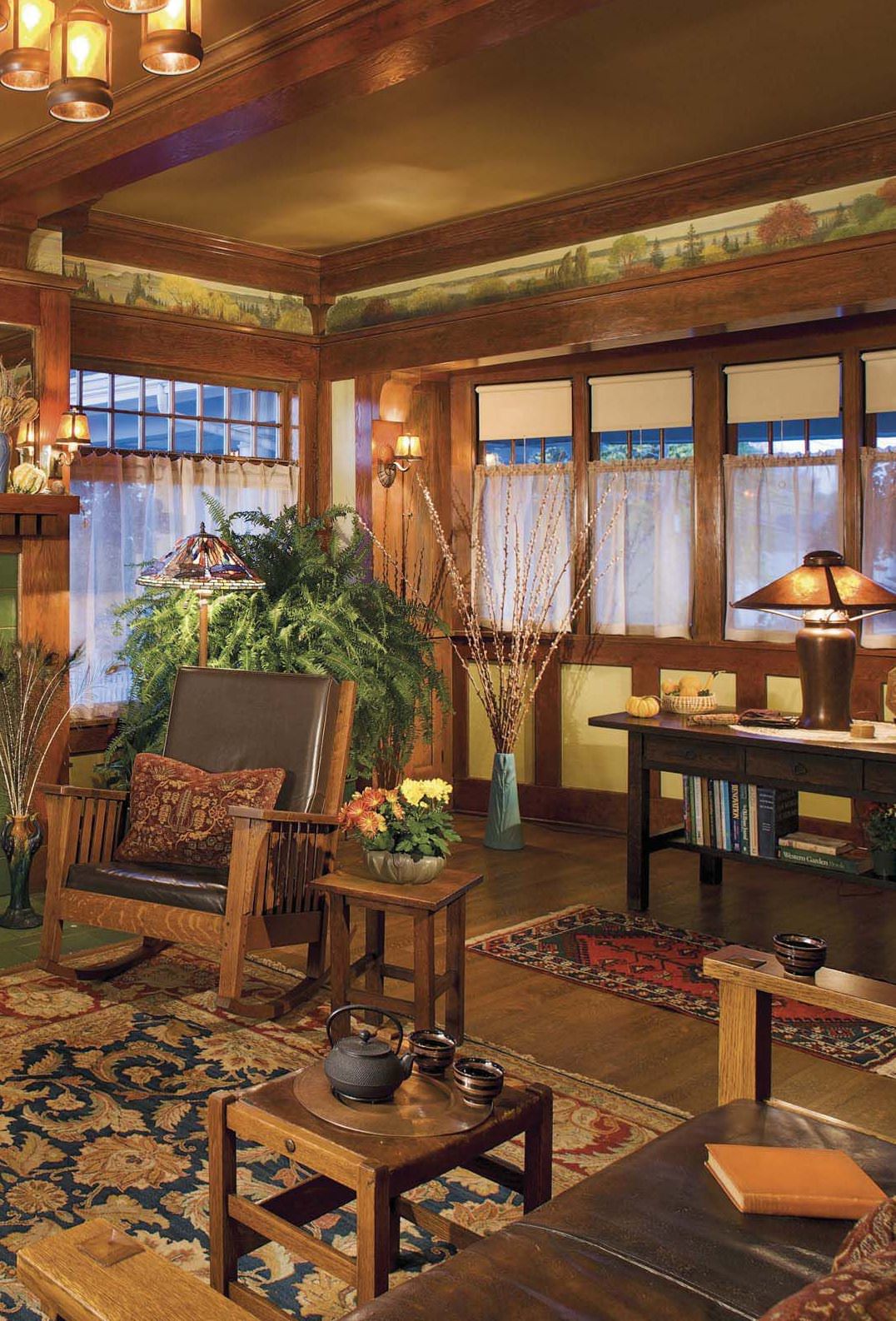
Window dressings changed along with everything else as the Victorian era drew to a close, and Arts & Crafts became influential, at the turn of the 20th century. Lower ceilings meant a change in window proportions. Everything was more informal: curtains often ended at the sill rather than puddling on the floor; dressings included just one or two layers (maybe with a valance or pelmet). Drapery panels attached to simple rings, hung from fabric tabs, or were shirred on rods, doing away with the fancy cording and tiebacks of the 19th century.
Utility areas might have just a roller shade, which was also used in bedrooms or as a first layer. Venetian blinds and Roman shades were also seen in bedrooms. A typical treatment was a sheer or lace “glass curtain” mounted inside the trim, overlaid by unfussy drapery panels on rings (to open and close), and, for a more tailored look, a stenciled or embroidered top treatment.
Samuel R. Scrottron had invented the manufactured curtain rod in 1892, then Charles Kirsch took it a step further with the first telescoping adjustable length) rod in 1907. Now curtains could be hung on an inexpensive, 3/8" brass rod stock held by brackets attached inside the frame (inside mount) or on the header trim (outside mount).


Diese Geschichte stammt aus der Fall 2017-Ausgabe von Arts and Crafts Homes.
Abonnieren Sie Magzter GOLD, um auf Tausende kuratierter Premium-Geschichten und über 9.000 Zeitschriften und Zeitungen zuzugreifen.
Sie sind bereits Abonnent? Anmelden
WEITERE GESCHICHTEN VON Arts and Crafts Homes

Arts and Crafts Homes
Kitchen of Art & Craft
Part of a whole-house renovation and addition to a 1905 house, this kitchen is in deephaven, minnesota, on lake minnetonka.

2 mins
Fall 2016

Arts and Crafts Homes
Immovable Furniture
Think them ingenious, historic, or simply charming, millwork built-ins are an essential part of the Arts & Crafts house.
4 mins
Fall 2016

Arts and Crafts Homes
The Cabin at Point Reyes
Local building custom was preserved in the rehabilitation of an at-risk 1905 cabin, now a family retreat on the wild coast.
3 mins
Fall 2016

Arts and Crafts Homes
Ultimate Timber
Inspired by Greene and Greene, fine woodwork in mahogany enhances an elegantly rustic timber-frame house in the woods.
3 mins
Fall 2016

Arts and Crafts Homes
Garden Edging for Maintenance & Ornament
A staple of English Arts & Crafts gardens, edging has practical as well as historical appeal. Choose from buried barriers to brick, stone, iron, or tile.
3 mins
Fall 2016

Arts and Crafts Homes
The Arts & Crafts Room
Inspired design for vintage & new.
2 mins
Annual Resource Guide 2017

Arts and Crafts Homes
Kitchen + Bath + Tile
Approaches for revival design.
1 mins
Annual Resource Guide 2017

Arts and Crafts Homes
Simple Living In Santa Barbara
Their bungalow isn’t big, even with an upstairs rear addition. But with a pleasing plan and period details, it has been a charming family home.
3 mins
Winter 2017

Arts and Crafts Homes
Ranch Redemption
Stone, tile, and reclaimed wood were used to transform a generic 1949 ranch.
3 mins
Winter 2017

Arts and Crafts Homes
Vernacular To A Fare-Thee-Well
In Charnwood Forest, Stoneywell was imagined by British Arts & Crafts designer Ernest Gimson for his brother’s family. Built with local materials and labor, it is indigenous and spare, attesting This Is How to Live.
3 mins
Winter 2017
Translate
Change font size