
Mit Magzter GOLD unbegrenztes Potenzial nutzen
Erhalten Sie unbegrenzten Zugriff auf über 9.000 Zeitschriften, Zeitungen und Premium-Artikel für nur
Versuchen GOLD - Frei
New Fruit-sorting Technology Helps Curb Food Waste
Farmer's Weekly
|December 14, 2018
Earlier this year, Compac Sorting Equipment, part of TOMRA Food, launched its Field Research Unit, which can be deployed on lands to research the fresh produce industry’s most challenging issues. James Flocchini, Compac’s regional director for South Africa and Asia, spoke to Denene Erasmus about how the unit will be used to develop solutions for the citrus industry specifically and how the technology can ultimately help limit food waste.

HOW DID THE NEED AND THE IDEA FOR THE FIELD RESEARCH UNIT (FRU) ARISE?
Compac provides integrated post-harvest solutions and services to the global fresh produce industry, using the world’s most advanced grading technology. However, the demands of feeding the growing global population are driving the need to know more about each piece of produce as it is sorted in the packhouse and in repackaging centres. By measuring other attributes, we can further improve sorting to optimise productivity, reduce waste and maximise customer value. One of the biggest challenges that developers of new equipment and technology for the food and agriculture sector confront is getting the type of data and information that can inform decisions about what new capabilities the market really needs from high-tech equipment.
A while ago, the president and CEO of TOMRA Food, Stefan Ranstrand, asked me what the biggest problem was for the citrus industry. Judging from the presentations given at recent international conferences and symposiums, I told him it was probably false coddling moth (FCM). We realised that if we could find a solution that would enable us to visually sort and sense for FCM in fruit and remove the affected fruit before it is packaged for marketing, that would be a huge benefit to the industry. We decided about a year ago to make a big effort to find a solution. We first tried to get fruit to our research and sensor development centre in Germany to analyse it using a spectrometer and other sensors, but getting fruit, especially if it was affected by FCM, to Germany, was very difficult. That is when we got the idea: if we couldn’t get the fruit to the laboratory, why not take the lab to the fruit?
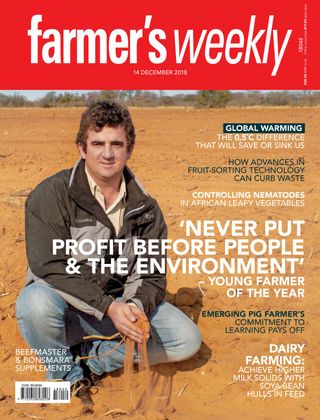

Diese Geschichte stammt aus der December 14, 2018-Ausgabe von Farmer's Weekly.
Abonnieren Sie Magzter GOLD, um auf Tausende kuratierter Premium-Geschichten und über 9.000 Zeitschriften und Zeitungen zuzugreifen.
Sie sind bereits Abonnent? Anmelden
WEITERE GESCHICHTEN VON Farmer's Weekly
Farmer's Weekly
Cash flow budgets: keeping farmers in control of liquidity, risk, and their survival
Profit doesn't guarantee a farm's survival - cash does. Cobus du Plessis explains why cash flow budgets are one of the most important yet underused financial tools on South African farms.

5 mins
February 27 - March 06, 2026

Farmer's Weekly
The toast of the Navy
The incredible story of the World War II-era Great Dane dog Nuisance being enlisted in the Royal Navy is well documented. Graham Jooste shared some entertaining anecdotes involving the canine shipmate.
6 mins
February 27 - March 06, 2026
Farmer's Weekly
Healthier soils deter destructive locusts
Locust swarms remain a serious global threat, capable of devastating crops, livelihoods and local economies across vast regions.
1 min
February 27 - March 06, 2026
Farmer's Weekly
Wheat crisis dominates Grain SA regional meetings
As the ongoing wheat crisis continues to erode producers' margins, emotions ran high at Grain SA's regional meeting in Moorreesburg in the Western Cape.
2 mins
February 27 - March 06, 2026

Farmer's Weekly
A FARMER'S EXPERIENCE
Street Wallet has been a game-changer for Mario Athanasopoulos, hydroponic production consultant and owner of Green City Farms.
1 mins
February 27 - March 06, 2026
Farmer's Weekly
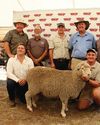
Kesieberg Merino Stud Production Sale
The Kesieberg Merino Stud Production Sale was held on the farm Leeuwfontein on 4 February on behalf of Willie and Herman Henning.
1 min
February 27 - March 06, 2026
Farmer's Weekly
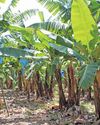
Not cheaper, just different: what you should know about farming in Mozambique
Although Mozambique is often viewed as a cheaper, easier farming location than South Africa, cost comparisons tell a more complex story. But while cross-border production presents real challenges, it also offers opportunities for complementary trade, diversification and regional food security, particularly when it comes to subtropical crops such as bananas.
10 mins
February 27 - March 06, 2026

Farmer's Weekly
The all-rounder anchoring South Africa's beef value chain
Louis Steyl, CEO of the Bonsmara Cattle Breeders' Society of South Africa, spoke to Octavia Avesca Spandiel about how the versatile Bonsmara breed anchors the country's beef value chain, delivering balanced performance, reproductive and feed efficiency, and carcass traits across extensive and intensive systems.
6 mins
February 27 - March 06, 2026

Farmer's Weekly
THE HITCHING POST
I'm a 60-year-old white woman who loves camping, animals, the outdoors, and watching sport.
2 mins
February 27 - March 06, 2026
Farmer's Weekly
Foot-and-mouth disease in pigs
Recently, the radio news mentioned an outbreak of foot-and-mouth disease (FMD) in pigs in South Africa.
2 mins
February 27 - March 06, 2026
Translate
Change font size