Prøv GOLD - Gratis
From The White House To The World
Forbes Woman Africa
|October-November 2016
How much has changed since women first got their right to vote almost a century ago? Whether Hillary Clinton wins or not, it signals the slow but sure ascent of women in public office the world over.

Regardless of whether Hillary Clinton becomes the next president of the United States (US) or not, women are slowly but steadily taking up political power.
The numbers of women leaders are still relatively low – only one-tenth of all leaders of the United Nation’s 193 member states are women and Clinton would be only the 19th female to currently govern her country. Research shows that over 60 of 142 countries have had women leaders at some point over the past 50 years, although most have held power for less than four years. Recent figures from UN Women also show that only 17% of government ministers are women, with most of their portfolios relating to social issues. And only two countries have a female majority in Parliament – Rwanda and Bolivia – although many countries have reached the one-third mark.
Clearly, there is still a long way to go. But here in the US, findings by the Pew Research Centre show that most women believe that whether Clinton achieves her second run for the presidency or not, a woman will be president at some point in their lifetime. According to one CNN poll, eight of 10 Americans think the country is ready for a woman president, but only one third think it’s a priority. Younger American women, it seems, take for granted the growing role of women in positions of power – both in government and business.
Among Clinton’s many detractors are those who would like to see a woman president but don’t necessarily believe she is the right woman for the job. Others are more appreciative of how much has changed since women first got the vote in 1920 (black women from the South faced voting hurdles until the 1960s), and are impatient to see Clinton in the White House as another important milestone on the path towards gender equality.
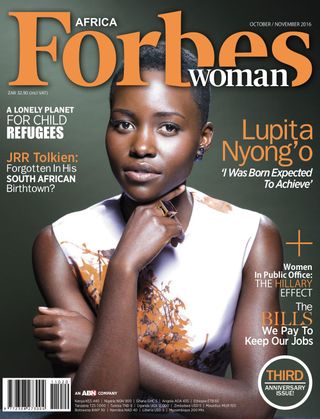

Denne historie er fra October-November 2016-udgaven af Forbes Woman Africa.
Abonner på Magzter GOLD for at få adgang til tusindvis af udvalgte premiumhistorier og 10.000+ magasiner og aviser.
Allerede abonnent? Log ind
FLERE HISTORIER FRA Forbes Woman Africa

Forbes Woman Africa
Wives. Widows. Survivors.
The widows of Marikana. Different faces. The same setting. The same inconsolable fate. The same seething anger at the cops who killed their men and changed their lives forever.

4 mins
October-November 2015

Forbes Woman Africa
Lupita Nyong'o: What I've Learned
The Oscar-winning Kenyan actress talks about sudden fame, why she has a lot to thank television for, self-righteousness and why her childhood prepared her for this life in more ways than she could have imagined.
3 mins
October-November 2016

Forbes Woman Africa
From The White House To The World
How much has changed since women first got their right to vote almost a century ago? Whether Hillary Clinton wins or not, it signals the slow but sure ascent of women in public office the world over.
6 mins
October-November 2016

Forbes Woman Africa
Why The Richest And Most Powerful Go To Davos
For years, I’ve been a silent observer of the World Economic Forum (WEF), reading about it on the internet, editing reams of copy on it or watching it on TV. But one question has always remained in my mind. What drives thousands of people each year to a small alpine town in Switzerland to live out Professor Klaus Schwab’s dream, who founded the forum in 1971?
3 mins
February-March 2017

Forbes Woman Africa
Tales From A Tense Place
Two women, one country, one fear. The tales of Linda Masarira and Nyasha Musandu tell of the fear on the ground in Zimbabwe with its tottering economy. They are an unlikely duo, an activist and a communications strategist, but both have felt the hand of authority over them for speaking out, sitting in a park and asking questions.
2 mins
February-March 2017

Forbes Woman Africa
Gloom, Growth And The New World Order
Global prospects with international economist Dambisa Moyo in Cape Town.
3 mins
April-May 2017

Forbes Woman Africa
The Kind Soul With Iron Resolve
Ahmed Kathrada was one of the great worker bees of south Africa’s struggle against apartheid in the 1950s and early 1960s; at Liliesleaf farm, in the middle class Johannesburg suburb of rivonia that was used as a hideout for the underground movement, Kathrada, wrote, worked and photocopied pamphlets tirelessly.
3 mins
April-May 2017

Forbes Woman Africa
Beating The Expiry Date Of A Human Egg
The answer to the ever-ticking biological clock is the woman who can freeze her eggs – and serve as her own future egg donor.
2 mins
April-May 2017

Forbes Woman Africa
Fighting To The End
In May, 82 more Chibok girls were released in exchange for Boko Haram prisoners. Oby Ezekwesili, a strong advocate in the campaign to bring them back, has vowed to never stop fighting.
2 mins
June-July 2017

Forbes Woman Africa
Not Just Hard Work, But Heart Work
As incidents of gender-based violence increase in Africa, those like Nigeria’s Kemi Dasilva-Ibru, are trying to bring relief to stigmatized victims.
5 mins
June-July 2017
Translate
Change font size