
استمتع بـUnlimited مع Magzter GOLD
احصل على وصول غير محدود إلى أكثر من 9000 مجلة وصحيفة وقصة مميزة مقابل
يحاول ذهب - حر
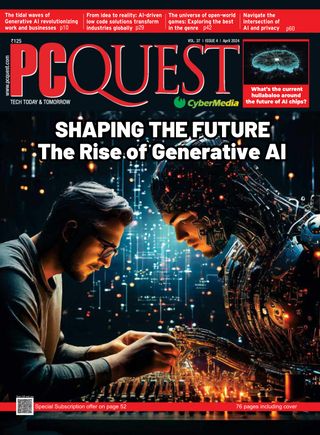
The tidal waves of Generative AI revolutionizing work and businesses
April 2024
|PCQuest
Al-powered tools are empowering creators to explore new ideas and concepts, expanding the boundaries of creativity and innovation

Generative Artificial Intelligence (AI) stands at the forefront of technological innovation, heralding a new era where machines possess the ability not only to analyze data but also to create entirely new content, designs, and solutions autonomously. Unlike traditional AI systems, which are constrained to perform specific tasks based on pre-programmed rules, generative AI models leverage deep learning algorithms to understand and mimic human creativity. In this comprehensive analysis, we delve into the transformative power of generative AI across various industries, exploring its mechanisms, applications, challenges, and the implications for the future.
▾ How Generative AI works
Generative AI operates on the principle of learning from vast datasets to predict and generate new content that closely resembles human-produced output. At the heart of generative AI are sophisticated deep learning algorithms, which are trained on large datasets to discern underlying patterns and structures. Unlike traditional AI, which excels at pattern recognition and analysis, generative AI models such as OpenAI’s GPT series and DALL-E possess the remarkable capability to create entirely new content based on the learned patterns. These models can generate text, images, videos, and even code, blurring the lines between human and machine creativity.
▾ Impact Across Fields and Industries
The impact of generative AI spans across a myriad of industries, ushering in unprecedented opportunities for innovation and efficiency:
Art and Design:

هذه القصة من طبعة April 2024 من PCQuest.
اشترك في Magzter GOLD للوصول إلى آلاف القصص المتميزة المنسقة، وأكثر من 9000 مجلة وصحيفة.
هل أنت مشترك بالفعل؟ تسجيل الدخول
المزيد من القصص من PCQuest

PCQuest
When Software Drives the Machine Need for Enterprise-Grade Software
Cars used to fail because of broken parts.Now they fail because of broken code. As vehicles become rolling computers, enterprise-grade software, ruthless testing, and fail-safe architecture decide one thing: whether a car keeps moving safely at 100 km/h

2 mins
March 2026

PCQuest
AI on the ground Practical use cases of AI in large enterprise operations
AI isn't a side project anymore, it's the quiet operator inside global giants. It reads invoices, senses machine fatigue, tailors every customer moment, flags risk in real time, and feeds leaders sharper instincts. Scale just got smarter
3 mins
March 2026

PCQuest
From AI experiments in 2025 to enterprise scale in 2026: Why data foundations will decide the winners
Everyone's betting big on Al, but most are burning cash instead of building value. The hidden culprit? Dirty data, clunky processes, and missing context. What if fixing your foundation, not your algorithms, was the real AI game-changer?
4 mins
March 2026

PCQuest
How automation at the periphery is accelerating digital transformation
Digital transformation is not tearing down the core anymore. It is happening at the edges. With AI and automation layered onto existing systems, companies are cutting costs, boosting productivity by up to 40%, and scaling smarter without risking operational chaos
2 mins
March 2026

PCQuest
When AI moves from chips to racks
AI performance is no longer just about faster chips. It is about how racks, power, networking, and orchestration work together. As agentic AI grows, infrastructure must become predictable, open, and built for scale from day one
4 mins
March 2026

PCQuest
Designing enterprise AI systems that stay fair
In 2026, bias is no longer treated as a communications issue or a public relations headache.
6 mins
March 2026

PCQuest
HALO smart sensor
What if bathrooms, locker rooms, and isolated spaces could become safer without adding cameras?
2 mins
March 2026

PCQuest
Building enterprise AI that doesn't discriminate
Bias in enterprise AI is not a side issue. It starts in data pipelines, training systems, product design, and engineering workflows. As AI scales, fairness, transparency, and accessibility are becoming core software requirements
4 mins
March 2026

PCQuest
Bias travels faster than code
Bias in enterprise AI is not a surface issue. It enters through data, features, model training, APIs, and UI logic, then spreads across the stack. The technical response is shifting from audits to architecture, observability, and deployment controls
6 mins
March 2026

PCQuest
How hospitals can use AI without risking patient data
With the fast pace of adoption of Artificial Intelligence (AI) and digital health systems in Indian hospitals, issues related to the security of patient data are also increasing at an equal rate.
2 mins
March 2026
Listen
Translate
Change font size