يحاول ذهب - حر
FROM DESIGN TO MANUFACTURE: A Practical Guide To Faster Product Development
January 2026
|Electronics For You
Manufacturing has reached a point where speed and precision reinforce each other. Whether the focus is on an enclosure or a machined part, engineering teams now benefit from rapid validation and flexible production methods. When design decisions reflect how parts will ultimately be manufactured, development cycles shorten naturally.
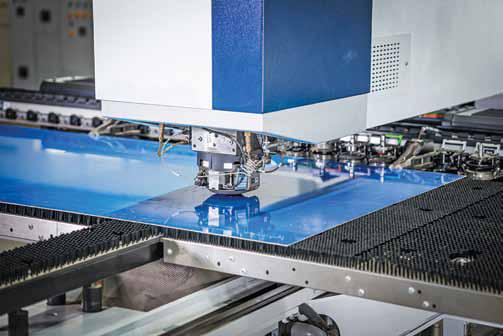
Across repeated engagements with product teams in enclosure engineering, sheet metal fabrication, 3D printing, and moulding, a clear pattern emerges: teams that embrace this pace iterate faster, reduce uncertainty, and move from prototype to production with greater confidence.
The opposite scenario is equally familiar. Strong ideas are often delayed not by manufacturing constraints, but by early design decisions that fail to align with real fabrication behaviour. This guide helps engineers avoid slowdowns and fully leverage the speed and clarity available in today's manufacturing environment.
Faster product development begins with a clearer intent
Most delays in mechanical product development do not originate on the shop floor. They begin upstream, when assumptions are made without fully considering the realities of forming, machining, moulding, or assembly.
Reversing this pattern is entirely achievable, and it begins with understanding. When engineers account for early in the design process how a bracket, frame, or enclosure will be built, the first prototype is much closer to the final product. This alignment can dramatically shorten development cycles.
Many enclosure designs appear flawless in CAD, yet include bends too close to holes, flanges without relief, or wall thicknesses that behave unpredictably during bending or machining. These are not failures but opportunities to refine. With small adjustments early in the design stage, such designs transition far more smoothly into fabrication.
Similarly, plastic enclosures intended for moulding behave differently when machined or 3D printed. Teams that anticipate these differences achieve clearer outcomes at every stage of development.
The key point is simple: these challenges are solved through awareness, not guesswork.
Choosing the right process unlocks speed


هذه القصة من طبعة January 2026 من Electronics For You.
اشترك في Magzter GOLD للوصول إلى آلاف القصص المتميزة المنسقة، وأكثر من 9000 مجلة وصحيفة.
هل أنت مشترك بالفعل؟ تسجيل الدخول
المزيد من القصص من Electronics For You

Electronics For You
Smart Air Quality MONITORING SYSTEM
Air pollution is a critical concern in modern living environments, particularly in enclosed spaces such as homes, offices, factories, and laboratories, where prolonged exposure to harmful gases presents serious health risks. Continuous air quality monitoring is therefore essential to maintain safe and healthy indoor conditions. Here we detail the design and implementation of a compact, low-cost, smart air-quality monitoring system based on the Arduino Nano platform.

3 mins
February 2026

Electronics For You
"We Are Strengthening Supply Chains, Automation, And Talent To Drive Scalable, Sustainable Manufacturing Growth"
In an interaction with EFY’s Nitisha Dubey, Jayaramu N, from Aimtron Electronics shares insights into key government initiatives, sector challenges, and the company’s strategic growth and expansion plans.
2 mins
February 2026

Electronics For You
"We Are Growing At 30-40% Annually And Plan To Go For An IPO By 2027"
Is managing diverse customers easy in the EMS sector? In a conversation with EFY's Nitisha Dubey, Ashvin Navadia of Vinrox Technologies discusses how EMS companies address customer complexity and high-mix, variable-volume production.
2 mins
February 2026

Electronics For You
Low-Cost 40A, 1200V SOLID-STATE RELAY And VOLTAGE CONTROLLER
Relays are essential components in electronic systems and are widely used in IoT and AC-powered applications to control loads using sensor outputs or low-voltage DC signals. Conventional electromechanical relays rely on a mechanical plunger that physically connects or disconnects AC contacts to perform switching.
5 mins
February 2026

Electronics For You
"Investment In Talent And Automation Is Central To Building Scalable Manufacturing"
Is the Gujarat government supporting the growth of the electronics industry? How does Mefron manage skilled manpower and talent challenges? In an interaction with EFY's Nitisha, Hiren Bhandari of Mefron Technologies India Pvt Ltd discusses government support for the electronics sector and Mefron's approach to skilled manpower challenges.
2 mins
February 2026

Electronics For You
IndusAlexa And Google Assistant-Enabled IoT CONTROLLER
AI smart speakers and AI-enabled home automation devices are widely adopted and continue to see strong demand. However, achieving seamless integration with a high level of customisation remains challenging, particularly when adding sensors, lights, switches, relay actuators, fans, and bulbs to meet specific requirements.
6 mins
February 2026
Electronics For You
DIGITAL GAUGE And SUPER ELEVATION MEASURING System For Railway Tracks
Railway track laying, construction, and maintenance demand precise measurement of the gauge between two parallel tracks and superelevation, that is, the height difference between rails.
5 mins
February 2026

Electronics For You
Musical TEMPERATURE ALARM
Monitoring temperature is essential across many applications, from protecting sensitive electronic equipment to maintaining comfortable room conditions. Conventional temperature alarms typically use buzzers or LEDs, providing only visual, monophonic alerts. Here we present a musical temperature alarm that generates a pleasant melody, rather than a simple beep, when a preset temperature threshold is exceeded.
3 mins
February 2026

Electronics For You
THE WIDE SCOPE OF AI: Everything Everywhere!
What exactly should AI do for a business? Where does it stop? How do we define the scope? This lack of definition is the problem.
5 mins
February 2026

Electronics For You
OVERCURRENT/IDMT RELAY Using Arduino Nano And ACS712 Current Sensor
Overcurrent relays with inverse definite minimum time (IDMT) characteristics are widely used in power systems to protect electrical feeders and loads from overheating under abnormal operating conditions.
4 mins
February 2026
Listen
Translate
Change font size