يحاول ذهب - حر
We Probably Aren't Alone
September 2025
|Scientific American
The search for advanced life beyond Earth has periodically been turned upside down
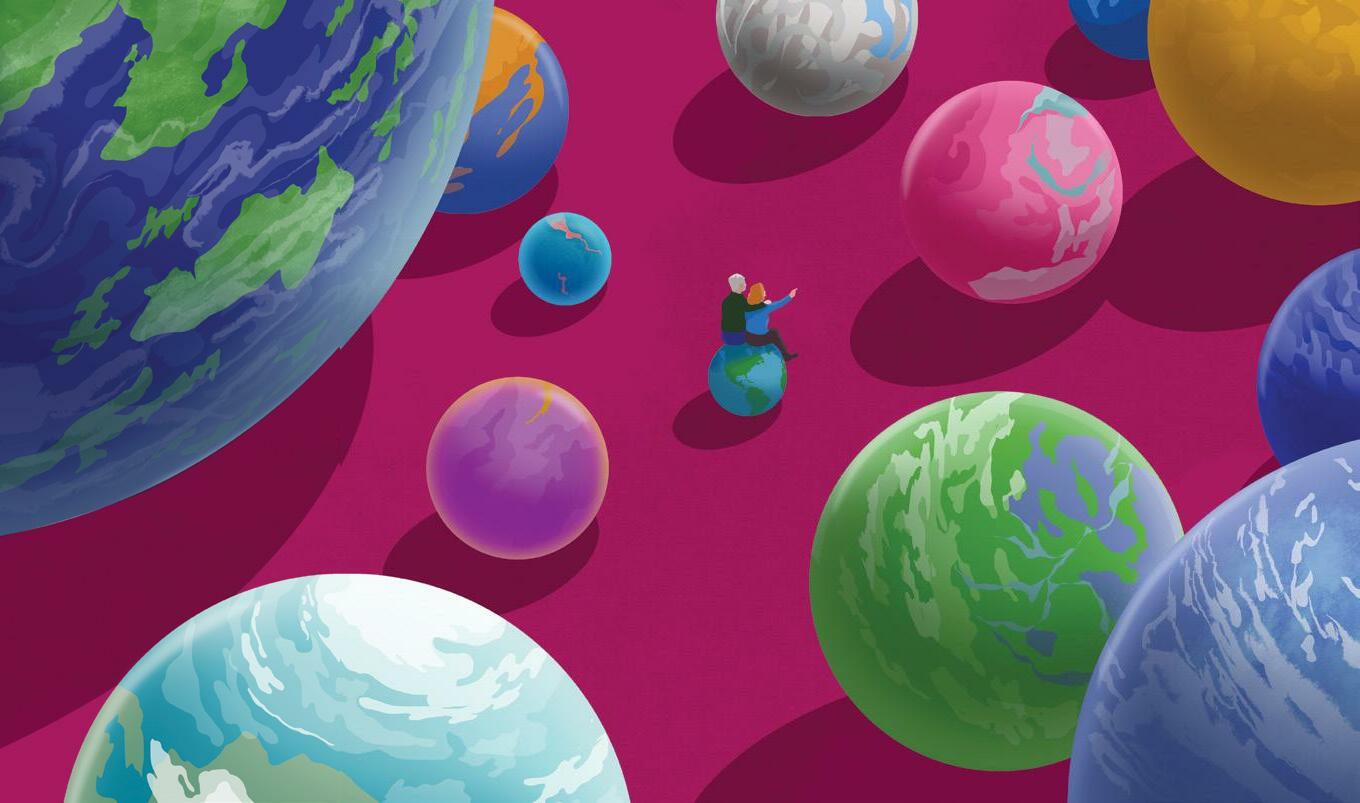
IN THE LATE 1800s Italian astronomer Giovanni Schiaparelli pointed a telescope at Mars and saw something curious: linear features that he called canali, meaning “channels” or “grooves.” A mistranslation of that word helped lead to a widespread belief that the planet closest to Earth hosted a civilization.
American astronomer Percival Lowell took Schiaparelli’s observations and ran with them. He became obsessed with the Martian markings, which he interpreted as evidence of a sophisticated network of water-transportation channels. “That Mars is inhabited by beings of some sort or other we may consider as certain as it is uncertain what those beings may be,” Lowell wrote in his 1906 book Mars and Its Canals.
It sounds ludicrous now, but it wasn't back then. At the time, ideas about life were evolving rapidly, says David Baron, author of the new book The Martians: The True Story of an Alien Craze That Captured Turn-of-the-Century America. In 1858 Charles Darwin published his theory of natural selection. One year later German scientists Robert Wilhelm Bunsen and Gustav Robert Kirchhoff invented the spectroscope, which they and others used to analyze the chemical signatures in light from the sun and the planets. These studies revealed that other worlds are made of the same elemental constituents as Earth. If life evolves by a natural process, and all planets form in similar ways, why wouldn't life take hold on the Red Planet, too?


هذه القصة من طبعة September 2025 من Scientific American.
اشترك في Magzter GOLD للوصول إلى آلاف القصص المتميزة المنسقة، وأكثر من 9000 مجلة وصحيفة.
هل أنت مشترك بالفعل؟ تسجيل الدخول
المزيد من القصص من Scientific American

Scientific American
The Quiet Math Problem That Runs the Planet
How Diffie-Hellman key exchange secures everything from your text messages to government secrets

7 mins
May 2026

Scientific American
The Fog of Science
Did an adversary just invent a world-changing weapon, or are they making it up? DARPA is building an AI to instantly call their bluff
4 mins
May 2026
Scientific American
The Hubble Space Telescope Is Still Awesome
Hubble is going strong despite its decades in space and next-generation successors
4 mins
May 2026

Scientific American
Meet America's Native Bees
Scientists estimate there are about 4,000 species of native bees in the U.S.
5 mins
May 2026

Scientific American
The Chemistry of Desire
Inside the secretive laboratories where scientists build novel molecules to make luxury fragrance feel like pure emotion
5 mins
May 2026

Scientific American
Scanning the Stone
As ore gets harder to find, the mining industry is turning to subatomic-particle sensors to push deep underground
8 mins
May 2026

Scientific American
YOUR HEART IN FLAMES
Inflammation may be the true cause of cardiovascular diseaseand there's a drug to treat it
13 mins
May 2026

Scientific American
Ancient Lexicon
Stone Age art may reveal a 40,000-year-old precursor to writing
2 mins
May 2026

Scientific American
Thermal Breakthrough
A new super heat conductor challenges fundamental physics
2 mins
May 2026
Scientific American
How to Vacation in Space
Planned orbital hotels promise luxury, but can they deliver?
4 mins
May 2026
Listen
Translate
Change font size