يحاول ذهب - حر
The Black Hole Next Door
September 2025
|Scientific American
Superfast stars could trace back to a behemoth in a neighboring galaxy
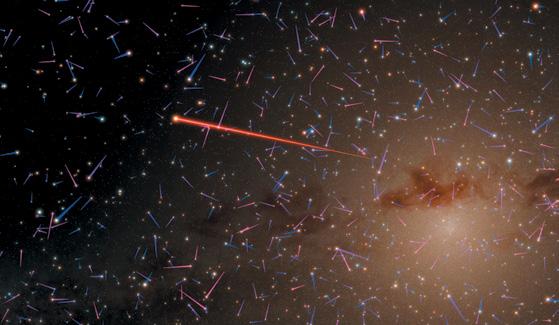
AN ASTONISHING fact known for only the past few decades is that every big galaxy in the universe has a supermassive black hole at its heart. Scientists suspected this was the case in the 1980s, and observations from the Hubble Space Telescope, which has peered deep into the cores of galaxies all across the sky, confirmed it. The “normal” kinds of black holes made when stars explode range from five to about 100 times the mass of our sun, more or less. But the central galactic monsters are millions of times more massive, and some have grown to the Brobdingnagian heft of billions of solar masses.
A lot of mysteries remain, of course, such as how these black holes formed early in the history of the universe, how they grew so humongous so fast and what role they played in their host galaxy’s formation. One odd question in particular nags at astronomers: What’s the galaxy-size cutoff where this trend stops? In other words, is there some lower limit to how massive a galaxy can be and still harbor one of these beasts?
The inklings of an answer are emerging from a surprising place: studies of rare stars moving through our galaxy at truly ludicrous speeds.


هذه القصة من طبعة September 2025 من Scientific American.
اشترك في Magzter GOLD للوصول إلى آلاف القصص المتميزة المنسقة، وأكثر من 9000 مجلة وصحيفة.
هل أنت مشترك بالفعل؟ تسجيل الدخول
المزيد من القصص من Scientific American

Scientific American
Let There Be Weapons
The Department of Energy’s new Genesis Mission promises AI-accelerated discovery. Seven of its first 26 challenges focus on nuclear weapons and national security

4 mins
July/August 2026

Scientific American
How to Fix Science
The federal funding system for scientific research in the U.S. needs reform
9 mins
July/August 2026

Scientific American
Robots Can Now Fold Your Laundry
Home-helper tasks are becoming easier for robotic assistants
4 mins
July/August 2026
Scientific American
50, 100 & 150 Years
NATURAL FISSION REACTOR
3 mins
July/August 2026

Scientific American
Anna Ho
Describing the characteristics of short-lived astrophysical events
1 mins
July/August 2026
Scientific American
THE SOLILOQUY OF SCHRÖDINGER'S CAT
A MEDITATION ON LIFE AND THE VON NEUMANN–WIGNER INTERPRETATION OF QUANTUM MECHANICS
1 min
July/August 2026

Scientific American
Mikhail Kolmogorov
Developing software to reveal large genetic changes that lead to cancer
1 mins
July/August 2026

Scientific American
Jaye Gardiner
Learning how the matrix around cells and tissues impacts cancers
1 mins
July/August 2026

Scientific American
Timnit Gebru
On safeguarding independent research in the age of big tech
3 mins
July/August 2026
Scientific American
A Youthful Illusion Sharpens Memory
By making people feel as if their face is a younger version of itself, researchers can bring childhood memories into sharper focus
4 mins
July/August 2026
Listen
Translate
Change font size