
استمتع بـUnlimited مع Magzter GOLD
احصل على وصول غير محدود إلى أكثر من 9000 مجلة وصحيفة وقصة مميزة مقابل
يحاول ذهب - حر
Impossible Teal
July/August 2025
|Scientific American
Only five people have seen the color "olo"

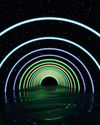
THE AVERAGE HUMAN EYE can see as many as 10 million variations in color, according to some estimates, from purest gray to laser green. Now scientists say they've broken out of that familiar range and into a new world of color. In a paper published in Science Advances, researchers detail how they used a precise laser setup to stimulate the retinas of five participants, making them the first humans to see an impossibly saturated bluish-green beyond our visual range.
Our retinas contain three types of lightdetecting photoreceptors, or cone cells.
S cones pick up relatively short wavelengths, which we see as blue. M cones react to medium wavelengths, which we see as green. And L cones are triggered by long wavelengths, which we see as red. These red, green and blue signals travel to the brain, where they're combined into the full-color vision we experience.
But these three cone types handle overlapping ranges of light: the light that activates M cones will also activate either Scones or L cones. "There's no light in the world that can activate only the M cone cells because if they are being activated, for sure one or both other types get activated as well," says Ren Ng, a professor of electrical engineering and computer science at the University of California, Berkeley. Ng and his research team wanted to get around that fundamental limitation, so they developed a technicolor technique they call Oz.
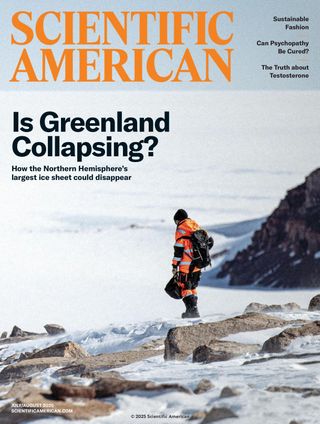

هذه القصة من طبعة July/August 2025 من Scientific American.
اشترك في Magzter GOLD للوصول إلى آلاف القصص المتميزة المنسقة، وأكثر من 9000 مجلة وصحيفة.
هل أنت مشترك بالفعل؟ تسجيل الدخول
المزيد من القصص من Scientific American

Scientific American
Earthquake Life
Yellowstone quakes spark bursts of microbial growth underground

2 mins
March 2026
Scientific American
Sailing the Sun
By designing vertical panels that move in a gale, two Swedish inventors are unlocking a solar future for the windswept north
9 mins
March 2026

Scientific American
Covered in Bees
Ancient bees burrowed deep into discarded mammal jawbones
2 mins
March 2026
Scientific American
Fire Starters
Ancient humans were making fire 350,000 years earlier than thought
3 mins
March 2026
Scientific American
Relativity Revealed
Physicists have observed a bizarre prediction of special relativity for the first time
8 mins
March 2026

Scientific American
Everything You Wanted to Know about Polyamory (but Were Afraid to Ask
The practice is not a faddish excuse to sleep around, research shows. And it has deep roots in American culture
14 mins
March 2026

Scientific American
Let the Rivers Run
An investigation into the rights of nature
4 mins
March 2026

Scientific American
Hidden Proof
\"Effective zero knowledge\" beats long-standing cryptographic impossibilities
2 mins
March 2026
Scientific American
The Universe's Weirdest Optical Illusions
Sometimes the farther away an object is, the bigger it seems to be
4 mins
March 2026

Scientific American
Living in the COPILOT SOCIETY
The promise and peril of artificial intelligence everywhere
2 mins
March 2026
Listen
Translate
Change font size