يحاول ذهب - حر
America Is Choosing to Lose the New Space Race
November 2025
|Scientific American
The U.S. can't be a space superpower if it dismantles NASA's science projects
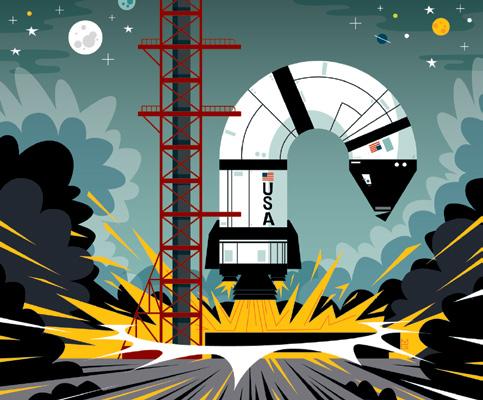
IN THE EARLY 1400s, nearly a century before Columbus's fateful voyage to the Americas, China seemed most poised to use maritime might to create a global empire. Beginning in 1405, Ming Dynasty admiral Zheng He commanded a fleet of immense “treasure ships” on a series of expeditions across the Indian Ocean, showcasing China’s wealth and strength as far afield as the eastern coast of Africa. But by 1433 the state-sponsored voyages had ceased.
Scholars still debate what led 15th-century China to turn inward, ceding its power—and ultimately the discovery of what would become the New World—to others. But regardless of its cause, the missed opportunity is unquestionable.
Today a strange echo of this episode is unfolding—on the high frontier of space rather than the high seas. This time, however, China is rising to prominence as the U.S. squanders its advantages.
Unlike the Ming court that made no secret of decisively abandoning China’s naval aspirations, some U.S. leaders now embrace space as a vital, contested domain. But while they insist they’re setting a course for America’s continued dominance in space science, technology and exploration, their actions are contradicting and undermining that goal.
Skepticism about, if not outright scorn for, civilian space spending is practically a bipartisan tradition in U.S. politics, but we are talking chiefly about the “Make America Great Again” policymaking of President Donald J. Trump.

هذه القصة من طبعة November 2025 من Scientific American.
اشترك في Magzter GOLD للوصول إلى آلاف القصص المتميزة المنسقة، وأكثر من 9000 مجلة وصحيفة.
هل أنت مشترك بالفعل؟ تسجيل الدخول
المزيد من القصص من Scientific American

Scientific American
Dirty Little Secrets
Extremophile molds are invading art museums and devouring their collections. Stigma and climate change have fueled their spread

16 mins
February 2026

Scientific American
Archaeology Is Reviving the Smell of History
How reconstructing long-lost smells connects us to the past
6 mins
February 2026

Scientific American
Heal Injuries Faster
Toss out the old advice that rest is the best recovery strategy
4 mins
February 2026

Scientific American
Can a Time Capsule Outlast Geology?
A ridiculous but instructive thought experiment involving deep time, plate tectonics, erosion and the slow death of the sun
17 mins
February 2026
Scientific American
Fiery Amoeba
A newfound organism thrives in record-breaking heat
2 mins
February 2026
Scientific American
50, 100 & 150 Years
GIANT ATOMS
3 mins
February 2026
Scientific American
Nature's Tile Shop
Life keeps evolving these geometric patterns
2 mins
February 2026
Scientific American
Battle of the Breeds
A large dataset shows that some dog stereotypes are based in reality, and others might be unfair characterizations
1 min
February 2026
Scientific American
The Milky Way's Disk Keeps Getting Weirder
The disk of our galaxy is not flat but warped and waving
5 mins
February 2026
Scientific American
A Winning Loser
If the cards shown here are rearranged to form four new poker hands of five cards each, what is the low- est possible winning or tying hand?
1 min
February 2026
Listen
Translate
Change font size