
استمتع بـUnlimited مع Magzter GOLD
احصل على وصول غير محدود إلى أكثر من 9000 مجلة وصحيفة وقصة مميزة مقابل
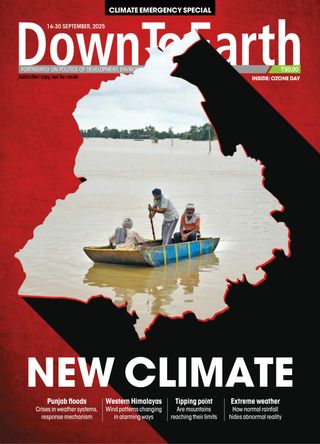
WESTERN HIMALAYA AT POINT OF NO RETURN?
September 16, 2025
|Down To Earth
This monsoon season has been unusually severe for the Western Himalayan region, which has witnessed extreme weather events almost daily. Relentless, intense rainfall and repeated cloudbursts have triggered flash floods, landslides and mudflows, wiping out villages, claiming hundreds of lives, cutting off highways and bringing life to a standstill. DOWN TO EARTH speaks with a climate scientist, geologist, geomorphologist and glaciologist to understand whether the Himalayas have reached a point from which it may be extremely difficult to recover.
The cryosphere, comprising glaciers and glaciated terrain where much of the water exists as ice, has undergone dramatic changes over the last 40 years, especially since the 1980s. Nowhere is this more evident than in the Himalayas, where warming is accelerating faster than the global average. While global temperatures have risen by about 1.5°C since the onset of industrialisation, in the Indian Himalayas, the increase is closer to 2°C.
Interestingly, precipitation levels over the Himalayas have not changed significantly over the past 30-40 years, but there has been a marked shift in the form of precipitation. Snowfall has decreased, while rainfall has increased. This change poses two major challenges: rising temperatures and declining snowfall—both contributing significantly to the retreat of Himalayan glaciers. What does this mean for us?
As glaciers retreat, they leave behind moraines—loose aggregates of sand, soil, boulders and large rocks transported by the glaciers. These moraine-covered areas are highly prone to landslides. Additionally, glaciers, as they advance, tend to carve depressions in the terrain that are filled with meltwater, instead of ice, and form glacial lakes. These lakes, if breached, can lead to sudden and potentially catastrophic floods known as glacial lake outburst floods (GLOFS). Over the past 30-40 years, the number Of such glacial lakes in the Himalayas has risen sharply. While not all of them caused flash floods, they are potential sources of future disasters.
A third concern is the formation of hanging glaciers. On steep slopes, typically those with gradients exceeding 30 degrees, the base of the glacier remains firmly anchored to the underlying rock due to frosty conditions. But as temperatures rise and the ice begins to melt, meltwater seeps down to the contact point between the ice and the rock, weakening the bond and leading to glacier slippage and potential flash floods.

هذه القصة من طبعة September 16, 2025 من Down To Earth.
اشترك في Magzter GOLD للوصول إلى آلاف القصص المتميزة المنسقة، وأكثر من 9000 مجلة وصحيفة.
هل أنت مشترك بالفعل؟ تسجيل الدخول
المزيد من القصص من Down To Earth

Down To Earth
KING OF BIRDS
Revered for centuries, western tragopan now needs protection as its forests shrink, human pressures mount

3 mins
December 16, 2025

Down To Earth
WHISKERS ALL AQUIVER
Climate change threatens creatures that have weathered extreme environments for thousands of years
2 mins
December 16, 2025

Down To Earth
GOLDEN SPIRIT
Survival of the shy primate is closely tied to the health of Western Ghats
3 mins
December 16, 2025

Down To Earth
RINGED EYES IN THE CANOPY
Rapid habitat destruction forces arboreal langur to alter habits
2 mins
December 16, 2025

Down To Earth
HANGING BY THE CLIFF
The Himalaya's rarest wild goat is on the brink of local extinction
2 mins
December 16, 2025

Down To Earth
ANGEL OF THE BEAS
Conservation reserves, citizen science, and habitat protection give the Indus River dolphin a fighting chance in India
2 mins
December 16, 2025

Down To Earth
UNDER MOONLIT SCRUB
Survival of this hidden guardian tells us whether our scrublands still breathe
2 mins
December 16, 2025

Down To Earth
SYMBOL OF SILENT VALLEY
Lion-tailed macaque remains vulnerable despite past victories
2 mins
December 16, 2025

Down To Earth
THE APE IN OUR STORIES
India's only non-human ape species is a cultural icon threatened by forest fragmentation
2 mins
December 16, 2025

Down To Earth
SENTINEL OF THE HIGH COLD DESERT
The bird's evocative call may not continue to roll across the cold desert valley for long
3 mins
December 16, 2025
Listen
Translate
Change font size