
استمتع بـUnlimited مع Magzter GOLD
احصل على وصول غير محدود إلى أكثر من 9000 مجلة وصحيفة وقصة مميزة مقابل
يحاول ذهب - حر
SAFETY IN CIRCULARITY
March 16, 2025
|Down To Earth
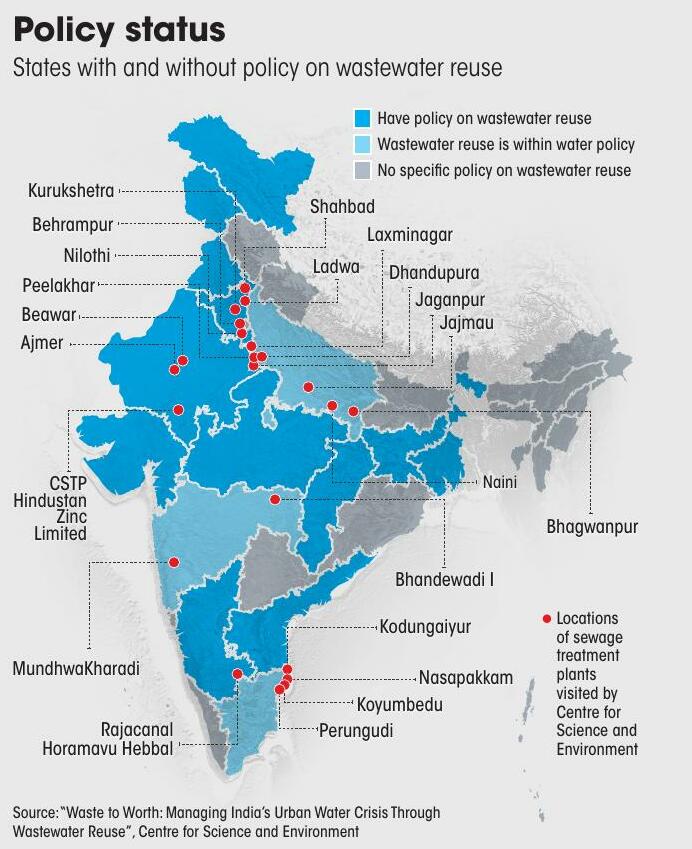
Global standards of water availability show that India is water stressed. Reusing treated wastewater can augment water supply while solving the problem of its safe disposal. FARAZ AHMAD and SUMITA SINGHAL analyse wastewater management practices of 16 cities in seven states to understand the challenges and potential areas of reuse
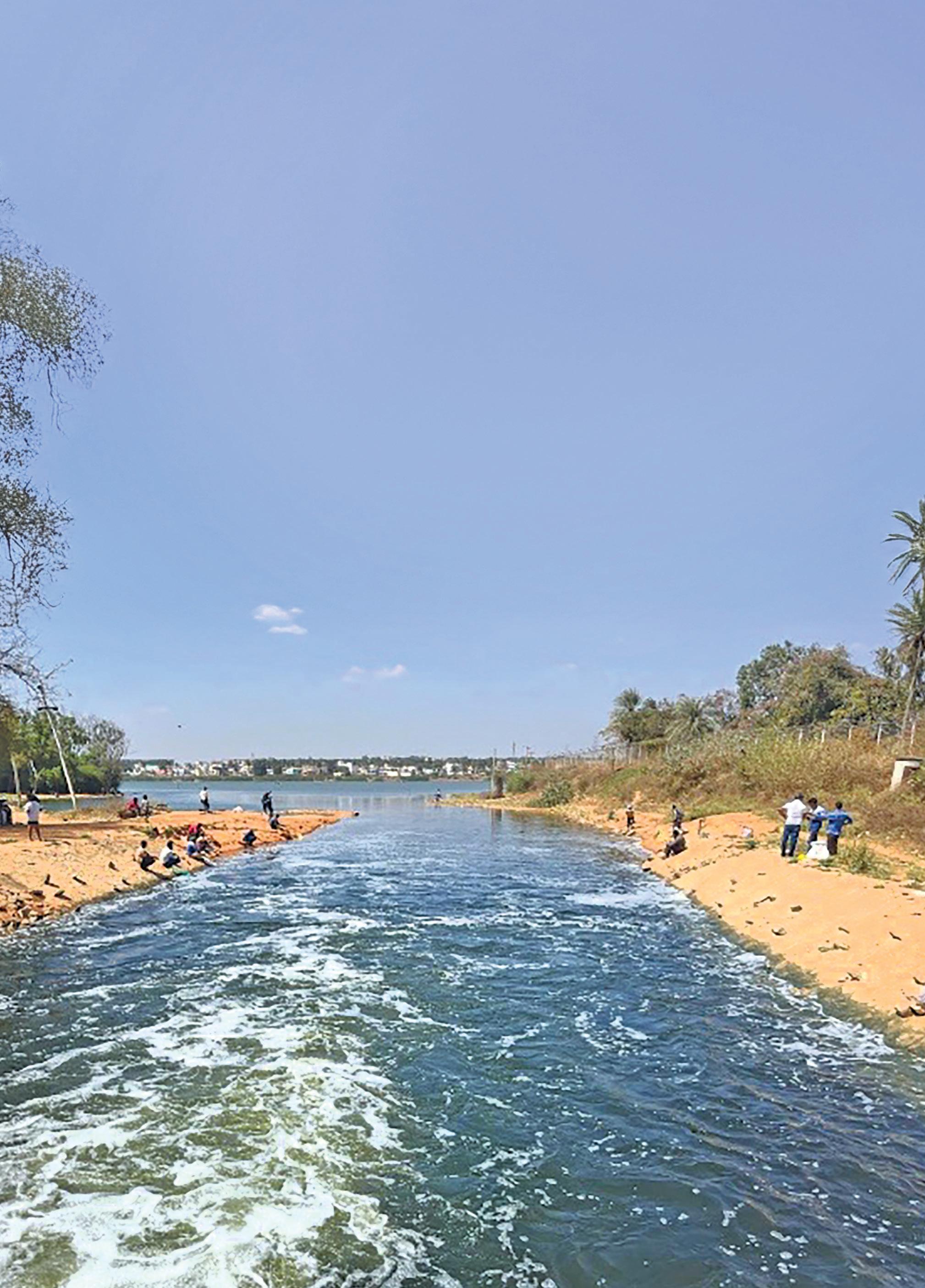
INDIA IS a parched nation. With an annual per capita freshwater availability below the international threshold of 1,700 cubic metres (m³), India ranks 132nd in the world with respect to per capita water availability. This makes the country "water stressed".
Between 1950 and 2024, there has been a decline of 73 per cent in per capita surface water availability in the country, as per the Union government's India Water Resource Information System (see 'Surface water scarcity' on p40). If no steps are taken to address this issue, India could become "water scarce", when water availability drops below 1,000 m³ per capita per year.
Cities such as Delhi, Mumbai, Pune, Hyderabad and Chennai, as well as many small and medium towns, are staring at a scenario where their sources will completely run out of water. Bengaluru faced unprecedented water shortage last year. As India witnesses rapid urbanisation-most of it seemingly unplanned-the situation will get worse, especially with climate change manifesting itself as an intensification of the water cycle, resulting in frequent floods, droughts and water stress.
 Reuse of wastewater is being seen as a new way of supplementing the water supply and mitigating the impending water shortage. Simply put, all used water is wastewater.
Its reuse will serve the twin purpose of augmenting water resources while reducing the environmental impacts of disposing untreated wastewater.

هذه القصة من طبعة March 16, 2025 من Down To Earth.
اشترك في Magzter GOLD للوصول إلى آلاف القصص المتميزة المنسقة، وأكثر من 9000 مجلة وصحيفة.
هل أنت مشترك بالفعل؟ تسجيل الدخول
المزيد من القصص من Down To Earth
Down To Earth
CONSERVED BY COMMUNITY
How a desire to make snow leopard tourism sustainable helped a small Ladakhi settlement became the region's first Community Conserved Area

4 mins
May 16, 2026

Down To Earth
An 'open' and 'shut' case of Al's risky trajectory
Elon Musk's lawsuit against Sam Altman, OpenAl, Microsoft is crucially about open-source versus closed technology for corporate profit
4 mins
May 16, 2026
Down To Earth
Burden of transition
Clean energy transition is once again shifting environmental, human costs to the Global South, finds a UN university investigation
4 mins
May 16, 2026
Down To Earth
One step closer
India attains criticality in fast breeder reactor technology, reaching the second stage of the country's three- stage nuclear programme towards energy security
4 mins
May 16, 2026

Down To Earth
ZESTY SEEDS
Coriander seeds are a traditional antidote to summer heat
3 mins
May 16, 2026

Down To Earth
Sahyadri gets a bird village
Residents of Maharashtra's Pisavare village have embarked on a mission to protect birds in their vicinity through simple practices such as documenting species and building nests
2 mins
May 16, 2026

Down To Earth
CONFLICT IN THE BACKYARD
Across India, farmers are abandoning their fields as conflict with wild and stray animals intensifies. Conservation policy must move beyond protection alone to restore a workable coexistence between people and animals.
18 mins
May 16, 2026

Down To Earth
Capital punishment
Adequate compensation and proper rehabilitation remain a mirage for many displaced by the construction of Chhattisgarh's new capital, Nava Raipur, even two decades after the project began
3 mins
May 16, 2026
Down To Earth
Migrant workers are assets
MIGRATION HAS turned into a potent tool of political warfare across the world. For over a decade, domestic electoral politics across regions, from Europe and North America to Asia and Africa, have fuelled anti-immigration sentiments. This is also increasingly fuelling anti-immigrant vigilantism, as seen widely across Europe in 2015-16, coinciding with the refugee crisis.
2 mins
May 16, 2026

Down To Earth
Petri dish to plate
Synthetic meat production has seen a rise globally, even as environmental benefits of growing foods in laboratory remain debatable
10 mins
May 16, 2026
Listen
Translate
Change font size