
استمتع بـUnlimited مع Magzter GOLD
احصل على وصول غير محدود إلى أكثر من 9000 مجلة وصحيفة وقصة مميزة مقابل
يحاول ذهب - حر
Micro menace
August 16, 2025
|Down To Earth
As nations negotiate a global treaty to regulate plastics, scientists have released a damning report highlighting the health impacts on humans

PLASTICS ARE cheap to buy, but expensive to use, says Sarah Dunlop, director, plastics and human health of Australia-based nonprofit Minderoo Foundation and emeritus professor at the University of Western Australia. She is not talking about the price we pay at checkout counters—but the invisible, long-term cost to our health. “We have studied three chemicals commonly used in plastics—PDBE (a flame retardant), BPA (used in plastics for strength and clarity) and DEHP (used for flexibility)—across 38 countries, covering a third of the global population. The health cost of just these three substances amounts to $1.5 trillion,” says Dunlop. “That is enough to vaccinate every newborn on the planet for the next 200 years.”
Dunlop is referring to the results of “The Lancet Countdown on Health and Plastics”, released on August 3, ahead of the Intergovernmental Negotiating Committee (INC) on Plastic Pollution 5.2, a global meet of countries, civil society and other stakeholders. The meeting on August 5-14 in Geneva is slated to be the final round of negotiations on a Global Plastics Treaty, which was passed in 2022 through a unanimous resolution by the UN Environment Assembly to develop a legally binding agreement to end plastic pollution based on a comprehensive approach that addresses its entire lifecycle.
The Lancet article aims to highlight the staggering toll of plastic on human health, which remains invisible in most public discussions. “Industry externalises these costs while our bodies and the environment absorb the damage,” says Dunlop. What makes it worse is that governments continue to heavily subsidise petrochemicals, the raw material for plastics. In 2024, fossil fuel subsidies in the US reached $43 billion—a figure projected to rise to $78 billion by 2050, according to the Lancet article.
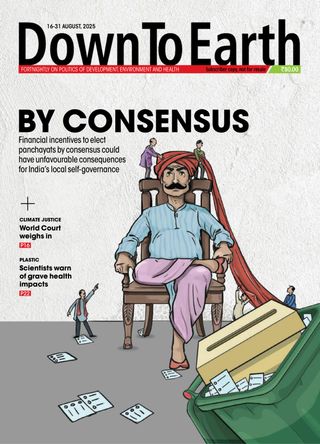

هذه القصة من طبعة August 16, 2025 من Down To Earth.
اشترك في Magzter GOLD للوصول إلى آلاف القصص المتميزة المنسقة، وأكثر من 9000 مجلة وصحيفة.
هل أنت مشترك بالفعل؟ تسجيل الدخول
المزيد من القصص من Down To Earth

Down To Earth
GREAT NICOBAR DILEMMA
In the fragile ecosystem of Nicobar, strategic development must align with constitutional commitment to protect environment, indigenous dignity

3 mins
March 16, 2026
Down To Earth
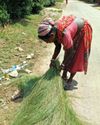
CATCH BY THE ROOTS
Sabai grass could be a game-changer for the marginalised economies of West Bengal's dry uplands. All it needs is an efficient market strategy
4 mins
March 16, 2026

Down To Earth
POWERING TRANSITION
India's renewable ambitions are rising rapidly, with half of its installed power capacity now coming from non-fossil sources. Yet the gap between capacity and generation remains wide. The experiences of two pioneering states, Karnataka and Tamil Nadu, which together generate over a fifth of the country's renewable energy, offer crucial lessons for accelerating the transition, reports PUJA DAS from Bengaluru, Chennai, Mumbai and New Delhi
16 mins
March 16, 2026

Down To Earth
At core of survival
Water scarcity defines life in a village inside Sariska Tiger Reserve's critical habitat, as debates over its relocation drag on
5 mins
March 16, 2026

Down To Earth
What's on your plate
An upcoming digital tool can help people learn about the origin of their meals and make climate-positive food choices
2 mins
March 16, 2026

Down To Earth
'Bad environment can never be good economics'
The Supreme Court of India and even the high courts were once very active and took a proactive role in protecting the environment; unfortunately, that is no longer true
4 mins
March 16, 2026
Down To Earth
Things fall apart
IN THE past year, the world has counted more missiles and bombs than hours.
2 mins
March 16, 2026

Down To Earth
Universities in crisis, innovation is stifled
Political control and skewed policies have led to unrest in academia, stifling creativity and meaningful research
4 mins
March 16, 2026

Down To Earth
SPARK IN THE GAME
The Reserve Bank of India's restored recognition of Default Loss Guarantees re-enables credit flow into last-mile electric mobility
3 mins
March 16, 2026

Down To Earth
Ushering in new eras
An appraisal of the state of biodiversity conservation, pollution reduction and climate adaptation regimes in India
3 mins
March 16, 2026
Listen
Translate
Change font size