يحاول ذهب - حر
Spectroscopy
February 2025
|BBC Sky at Night Magazine
How we learn about stars, nebulae and planets by splitting and analysing their light
-
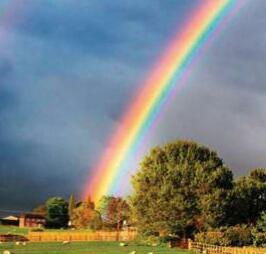
Modern telescopes are capable of providing much more than mere images of distant objects. One of the biggest tools that astronomers use to study the Universe is spectroscopy, the science of splitting light (visible or otherwise) into its component wavelengths, known as a spectrum. Different materials reflect, absorb and emit light at characteristic wavelengths. This means that the object that emitted the light, plus any gas the light travels through and any surface it reflects off, all imprint a signature on the spectrum. We can study this signature to understand the properties of planets, stars, galaxies and nebulae.
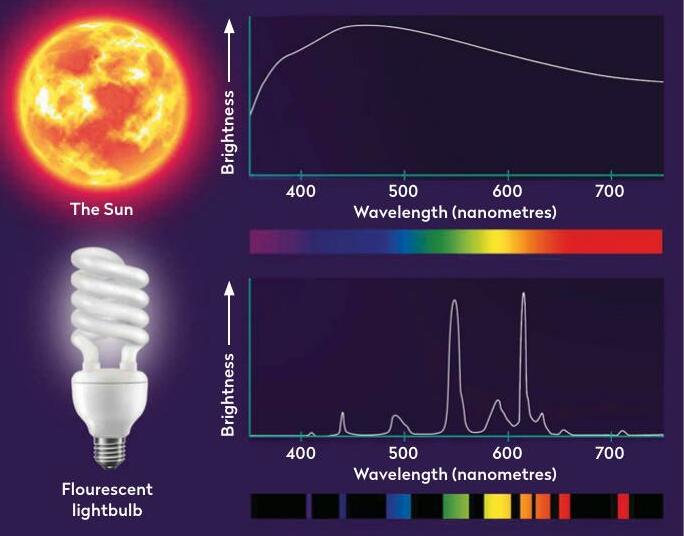 Instruments that split light like this are called spectroscopes or spectrographs, with the resulting spectrum typically plotted as the light's intensity against wavelength. These instruments can make use of a prism, whereby light entering the prism is bent (or refracted), with different wavelengths being bent by different amounts. Many may recall seeing this demonstrated in simple school science experiments, where white light is directed towards a prism. The light enters, is split and exits as a rainbow of colours, with shorter wavelengths towards the blue end and longer towards wavelengths the red. The natural rainbows we see in the sky are also created by the same process, with water droplets in the air acting as prisms to refract and split sunlight. As well as prisms, spectrographs can incorporate gratings, which use a process known as diffraction to split the light.
 What colour can tell us

هذه القصة من طبعة February 2025 من BBC Sky at Night Magazine.
اشترك في Magzter GOLD للوصول إلى آلاف القصص المتميزة المنسقة، وأكثر من 9000 مجلة وصحيفة.
هل أنت مشترك بالفعل؟ تسجيل الدخول
المزيد من القصص من BBC Sky at Night Magazine
BBC Sky at Night Magazine
The Giant Leap: Why Space is the Next Frontier in the Evolution of Life
“Earth is the cradle of humanity, but one cannot live in the cradle forever,” wrote Konstantin Tsiolkovsky in 1911.

1 mins
February 2026
BBC Sky at Night Magazine
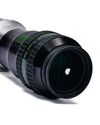
Tele Vue Nagler Type-7 series eyepieces
These premium optics were inspired by Apollo - and deliver a giant leap to your views
4 mins
February 2026
BBC Sky at Night Magazine
Once Upon a Time in Space
While the Space Race of the Cold War years was ultimately a geopolitical contest between the USA and the Soviet Union, the rivalry sparked rapid innovation and inspired multiple generations to look skyward.
1 mins
February 2026
BBC Sky at Night Magazine
The Multiverse: When One Universe Isn't Enough
The concept of a 'multiverse' – the idea that our Universe may be just one of many – is widespread in science fiction and a common thread of online discussions.
1 mins
February 2026
BBC Sky at Night Magazine
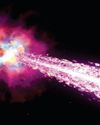
Q&A WITH A GAMMA RAY SPECIALIST
In 2025, astronomers detected a blast from space that lasted seven hours. Now they're uncovering the strange processes behind the exceptional outburst
3 mins
February 2026
BBC Sky at Night Magazine
Astronomy Photographer of the Year
The world-leading astrophotography competition returns. Could your image take the top prize of £10,000?
2 mins
February 2026
BBC Sky at Night Magazine
MOONWATCH
February's top lunar feature to observe
2 mins
February 2026
BBC Sky at Night Magazine
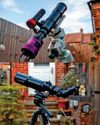
NOVAStar Scarlet A62Q 62mm f/8.4 quadruplet achromatic refractor
Well-built and capable, this beginner scope punches well above its bargain price
4 mins
February 2026
BBC Sky at Night Magazine
STAR OF THE MONTH
Rasalas, Leo the Lion's metal-rich crown
1 min
February 2026
BBC Sky at Night Magazine
Comet 24P/Schaumasse
Having reached perihelion on 8 January, comet 24P/ Schaumasse is now fading. Starting the month at a small-telescope-friendly mag. +10.5, it dims throughout February to below 12th magnitude.
1 min
February 2026
Listen
Translate
Change font size