يحاول ذهب - حر
10 years of reusable rockets
December 2025
|BBC Sky at Night Magazine
Ben Evans charts the rise of multi-flight spacecraft, the tech revolution that's transforming our access to space
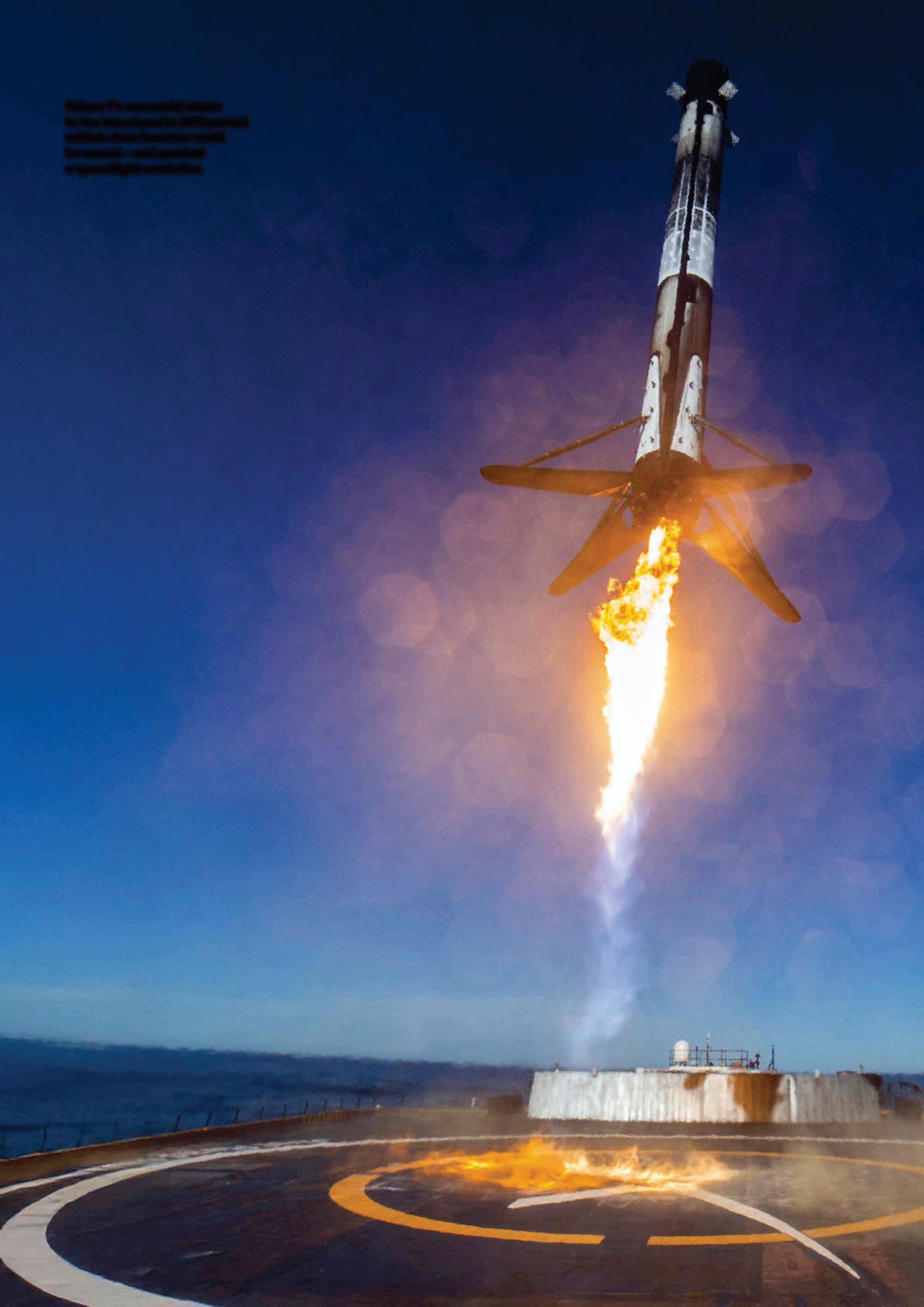
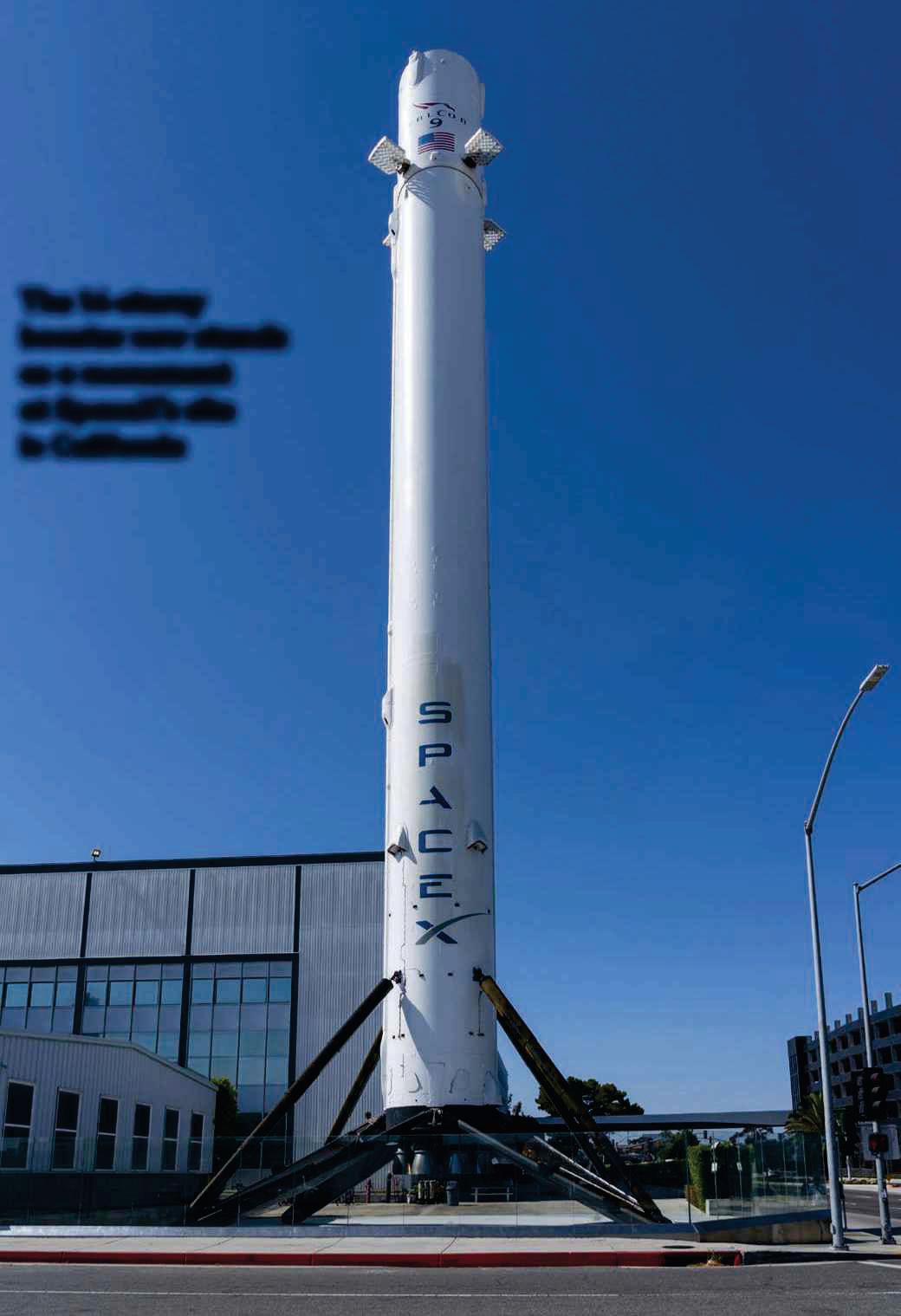
On the intersection of Crenshaw Boulevard and Jack Northrop Avenue in Hawthorne, California, stands an unlikely monument - a modern-day obelisk that bears silent witness to a space revolution. Fourteen storeys tall and partially screened by toughened glass, this SpaceX Falcon 9 was the first orbital-class rocket to launch into space and then return to land intact. Ten years ago, it inspired millions. Today, it inspires even more.
Its nine Merlin engines gleam in the California sunlight. Four aluminium grid fins, like great mechanised ears, helped guide this behemoth back from space to alight on a Cape Canaveral landing pad. And four extendable landing legs, spanning 18 metres (60ft) from tip to tip, recall the night of 21 December 2015, when it blasted into space, flipped around in mid-flight and roared safely home.
Until that night, 'orbital-class' rockets were discarded after every mission – a lack of reusability that kept the cost of space travel eye-wateringly high. After all, scrapping a brand-new airliner to build a new one after each flight would make air travel prohibitively expensive. But rockets are not airliners. They attain greater energies, reach immense speeds and must withstand tremendous thermal, aerodynamic and structural loads. That demands high levels of reliability and makes them hard to inexpensively reuse.
 From Shuttles to SpaceX
Rocket reusability is not new. NASA's partially reusable Space Shuttle flew 135 times between 1981 and 2011. Its fleet of five reusable orbiters - Columbia, Challenger, Discovery, Atlantis and Endeavour - completed multiple missions into low Earth orbit, and its solid-fuelled rocket boosters parachuted into the ocean after each launch and were used again. Only the Shuttle's giant external fuel tank was discarded on each flight.

هذه القصة من طبعة December 2025 من BBC Sky at Night Magazine.
اشترك في Magzter GOLD للوصول إلى آلاف القصص المتميزة المنسقة، وأكثر من 9000 مجلة وصحيفة.
هل أنت مشترك بالفعل؟ تسجيل الدخول
المزيد من القصص من BBC Sky at Night Magazine
BBC Sky at Night Magazine
The Giant Leap: Why Space is the Next Frontier in the Evolution of Life
“Earth is the cradle of humanity, but one cannot live in the cradle forever,” wrote Konstantin Tsiolkovsky in 1911.

1 mins
February 2026
BBC Sky at Night Magazine
Tele Vue Nagler Type-7 series eyepieces
These premium optics were inspired by Apollo - and deliver a giant leap to your views
4 mins
February 2026
BBC Sky at Night Magazine
Once Upon a Time in Space
While the Space Race of the Cold War years was ultimately a geopolitical contest between the USA and the Soviet Union, the rivalry sparked rapid innovation and inspired multiple generations to look skyward.
1 mins
February 2026
BBC Sky at Night Magazine
The Multiverse: When One Universe Isn't Enough
The concept of a 'multiverse' – the idea that our Universe may be just one of many – is widespread in science fiction and a common thread of online discussions.
1 mins
February 2026
BBC Sky at Night Magazine
Q&A WITH A GAMMA RAY SPECIALIST
In 2025, astronomers detected a blast from space that lasted seven hours. Now they're uncovering the strange processes behind the exceptional outburst
3 mins
February 2026
BBC Sky at Night Magazine
Astronomy Photographer of the Year
The world-leading astrophotography competition returns. Could your image take the top prize of £10,000?
2 mins
February 2026
BBC Sky at Night Magazine
MOONWATCH
February's top lunar feature to observe
2 mins
February 2026
BBC Sky at Night Magazine
NOVAStar Scarlet A62Q 62mm f/8.4 quadruplet achromatic refractor
Well-built and capable, this beginner scope punches well above its bargain price
4 mins
February 2026
BBC Sky at Night Magazine
STAR OF THE MONTH
Rasalas, Leo the Lion's metal-rich crown
1 min
February 2026
BBC Sky at Night Magazine
Comet 24P/Schaumasse
Having reached perihelion on 8 January, comet 24P/ Schaumasse is now fading. Starting the month at a small-telescope-friendly mag. +10.5, it dims throughout February to below 12th magnitude.
1 min
February 2026
Listen
Translate
Change font size