
استمتع بـUnlimited مع Magzter GOLD
احصل على وصول غير محدود إلى أكثر من 9000 مجلة وصحيفة وقصة مميزة مقابل
يحاول ذهب - حر
The Not at All Funny Life of Mark Twain
June 2025
|The Atlantic
Ron Chernow's biography dwells more on the wreck of a man than on his sublimely comic work.
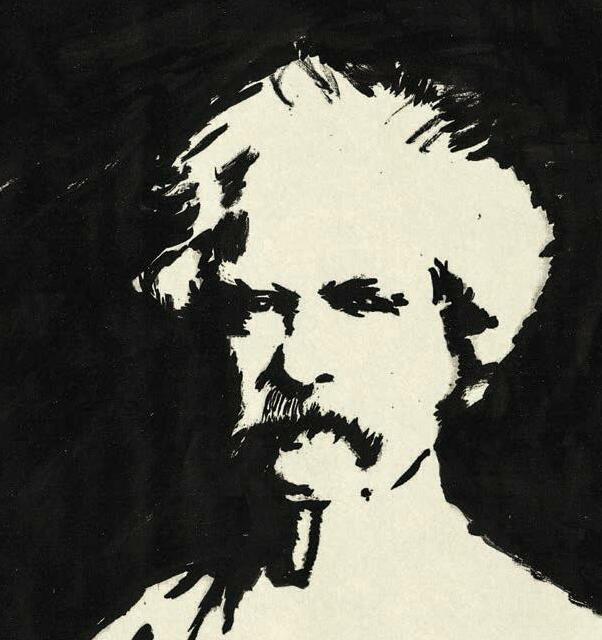
In his last, most pathetic years, Mark Twain threw himself behind the crackpot theory that the true author of Shakespeare's plays may have been Francis Bacon. The penultimate book that Twain published in his lifetime, Is Shakespeare Dead? (1909), asked his readers to consider how few solid biographical details existed about Shakespeare the man, and how much critics had inferred from so little. They had built, Twain wrote, “an Eiffel Tower of artificialities rising sky-high from a very flat and very thin foundation of inconsequential facts.” The literary critic Northrop Frye, who dismissed the Bacon theory, nevertheless had a wry aside of his own about extrapolating too freely from scattered biographical details and the unflattering portrait that is the only surviving image of Shakespeare. “We know nothing about Shakespeare,” Frye wrote, “except a signature or two, a few addresses, a will, a baptismal register, and the picture of a man who is clearly an idiot.”
Ron Chernow’s Mark Twain forces a similar conclusion about its subject: clearly an idiot, and a born sucker. This conclusion will shock anyone who knows Twain only through his writing, in which the author is wise and witty and, above all, devastating in his portrayal of frauds, cretins, and sententious bores. In life, Twain (1835–1910) was quite different. He was gullible, emotionally immature, and prone to shoveling money into obvious scams. Twain therefore presents a tantalizing challenge for literary biography: to explain how someone able to spot and depict frailties of conscience, character, and judgment in others could be so powerless to correct them in himself. Forced to choose, as Yeats wrote, “perfection of the life, or of the work,” Twain left the former a total shambles—and then for good measure was struck by a series of family tragedies that would have been unbearable even for a much less self-destructive man.

هذه القصة من طبعة June 2025 من The Atlantic.
اشترك في Magzter GOLD للوصول إلى آلاف القصص المتميزة المنسقة، وأكثر من 9000 مجلة وصحيفة.
هل أنت مشترك بالفعل؟ تسجيل الدخول
المزيد من القصص من The Atlantic
The Atlantic
The Eighth Deadly Sin
Humankind has devised a new form of debasement.

5 mins
May 2026

The Atlantic
The Art of the (New) Deal
What the murals of the Wilbur J. Cohen Federal Building can teach us about patriotism, propaganda, and beauty
12 mins
May 2026

The Atlantic
New Chairs
Collaboration, for Robert Rauschenberg and Merce Cunningham, began with the arrangement of chairs.
1 mins
May 2026
The Atlantic
HISTORY IS RUNNING BACKWARDS
Why reactionaries are taking over the world
21 mins
May 2026

The Atlantic
SOMEDAY IN TEHRAN
Like Donald Trump, I, too, once underestimated the Islamic Republic of Iran.
16 mins
May 2026

The Atlantic
On Losing a Daughter
The people we were died at the exact moment our child did.
19 mins
May 2026

The Atlantic
I Found It: The Best Free Restaurant Bread in America
Thirteen thousand miles. Infinite contenders. One beautiful loaf.
15 mins
May 2026

The Atlantic
EVERYTHING IS FREE AND NOTHING MATTERS
What I saw at Jeff Bezos's Campfire retreat
9 mins
May 2026

The Atlantic
Who Is Black Comedy For?
A new book is nostalgic for the '90s. But the era of crossover success was not necessarily the pinnacle of Black comedic achievement.
8 mins
May 2026

The Atlantic
The Feeling of Becoming Less and Less of a Person
In Ben Lerner's new novel, technology divides us further from one another, and ourselves.
9 mins
May 2026
Listen
Translate
Change font size