يحاول ذهب - حر
American Insomnia
August 2025
|The Atlantic
Tossing and turning through our national sleep crisis
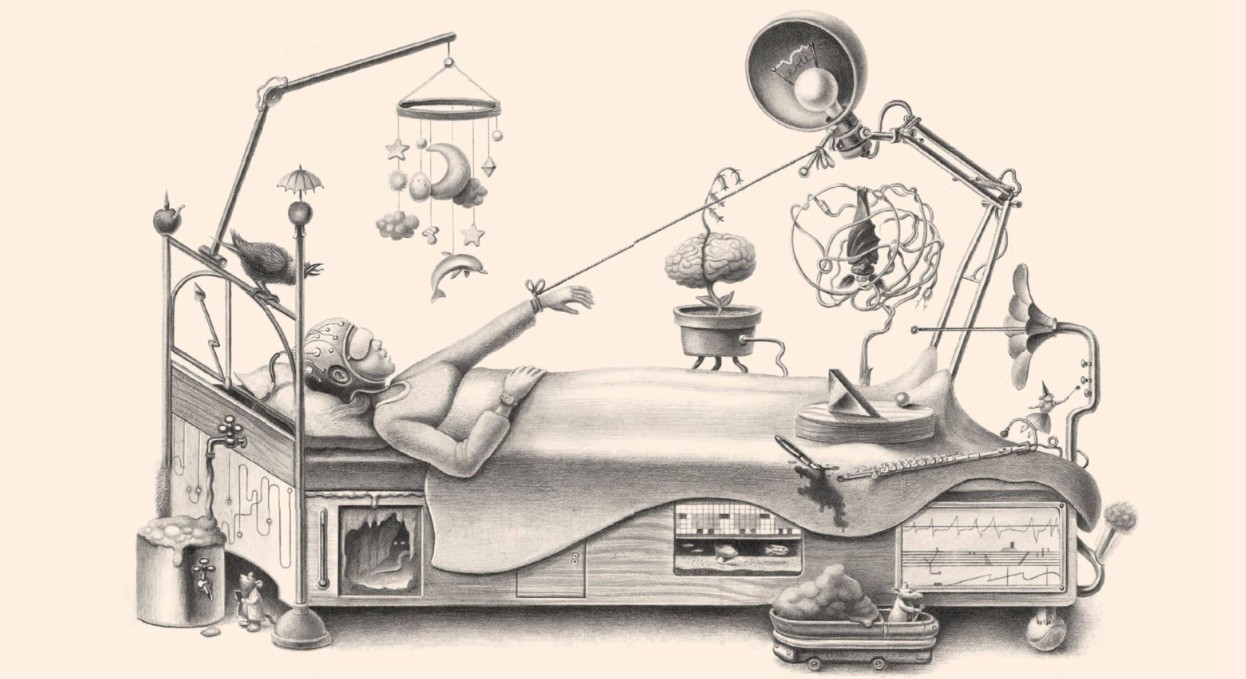
Insomnia like to tell people that the night before I stopped sleeping, I slept. Not only that: I slept well. Years ago, a boyfriend of mine, even-keeled during the day but restless at night, told me how hard it was to toss and turn while I instantly sank into the crude, Neanderthal slumber of the dead. When I found a magazine job that allowed me to keep night-owl hours, my rhythms had the precision of an atomic clock. I fell asleep at 1 a.m. I woke up at 9 a.m. One to nine, one to nine, one to nine, night after night, day after day. As most researchers can tell you, this click track is essential to health outcomes: One needs consistent bedtimes and wake-up times. And I had them, naturally; when I lost my alarm clock, I didn't bother getting another until I had an early-morning flight to catch.
Then, one night maybe two months before I turned 29, that vaguening sense that normal sleepers have when they're lying in bed—their thoughts pixelating into surreal images, their mind listing toward unconsciousness—completely deserted me. How bizarre, I thought. I fell asleep at 5 a.m.
This started to happen pretty frequently. I had no clue why. The circumstances of my life, both personally and professionally, were no different from the week, month, or two months before—and my life was good. Yet I'd somehow transformed into an appliance without an off switch.
I saw an acupuncturist. I took Tylenol PM. I sampled a variety of supplements, including melatonin (not really appropriate, I'd later learn, especially in the megawatt doses Americans take—its real value is in resetting your circadian clock, not as a sedative). I ran four miles every day, did breathing exercises, listened to a meditation tape a friend gave me. Useless.

هذه القصة من طبعة August 2025 من The Atlantic.
اشترك في Magzter GOLD للوصول إلى آلاف القصص المتميزة المنسقة، وأكثر من 9000 مجلة وصحيفة.
هل أنت مشترك بالفعل؟ تسجيل الدخول
المزيد من القصص من The Atlantic
The Atlantic
You Had to Be There
An emerging field of history asks if we can ever really understand how our forebears experienced love, anger, fear, and sorrow.

23 mins
January 2026

The Atlantic
By the Horns
The week before the biggest bullfight of her career, in Cádiz, Spain, this past July, 24-year-old Miriam Cabas posted a carefully produced video on Instagram.
1 mins
January 2026

The Atlantic
The New German War Machine
After World War II, Germany embraced pacifism as a form of atonement. Now the country is arming itself again.
18 mins
January 2026
The Atlantic
The Eloquence
The prime minister was watching a disaster movie when we found him.
4 mins
January 2026

The Atlantic
What's for Dinner, Mom?
The women who want to change the way America eats
12 mins
January 2026
The Atlantic
How Terror Works
A 1947 German novel explores the sometimes corrosive, sometimes energizing nature of fear.
8 mins
January 2026

The Atlantic
Yesterday's Idea of a Modern Man
Sam Shepard, a self-made cowboy, was also a poet of masculine angst.
7 mins
January 2026

The Atlantic
ACCOMMODATION NATION
America's colleges have an extra-time-on-tests problem.
11 mins
January 2026

The Atlantic
Respect the Drummer
A new history of rock, told through its overlooked heroes
5 mins
January 2026

The Atlantic
THE MOST POWERFUL MAN IN SCIENCE
WHY IS ROBERT F. KENNEDY JR. SO CONVINCED HE'S RIGHT?
42 mins
January 2026
Listen
Translate
Change font size