يحاول ذهب - حر
Till Death Do Us Part
February 01, 2025
|Outlook
Jagjit Singh Dallewal has reinforced how a fast unto death can serve as a warning and an appeal to the public and the government
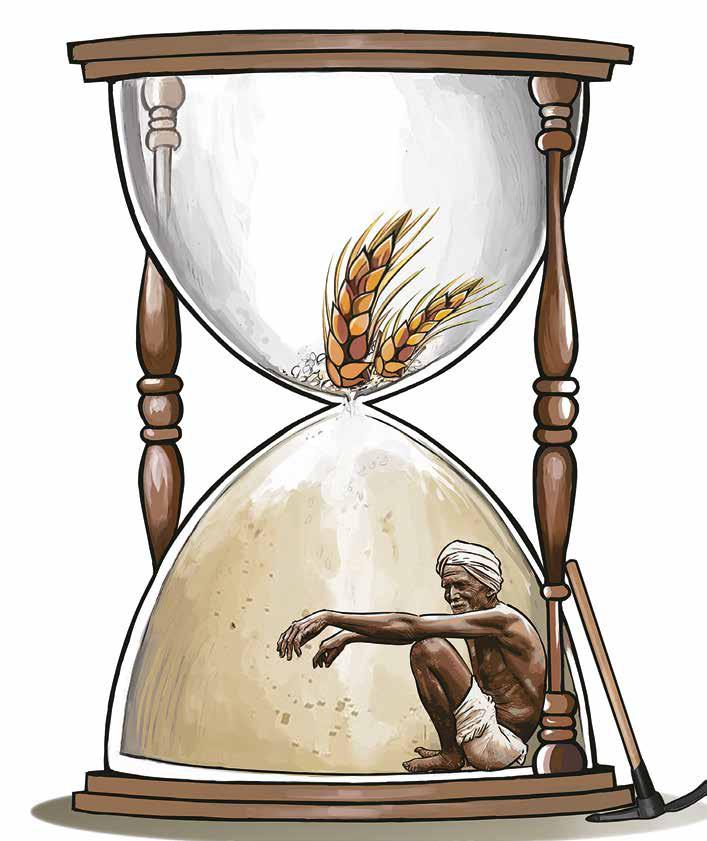
AT the Khanauri border between Punjab and Haryana, a team of doctors anxiously screen the beeping sounds of the monitoring machine. The sensors attached to the frail body of Jagjit Singh Dallewal covered in thick blankets—at times—do not register any reading on the monitor. On Day 52 of his fast-onto-death strike—among the longest in post-Independent India—Dallewal’s body has reached a distressingly critical state. A human body typically cannot survive without food or drink for more than seven days, although there are some records of survivors staying alive for up to 21 days. Dallewal’s strike warrants a second attention, given his age and medical history with life-threatening cancer. His deteriorating health even prompted the Supreme Court to express concern. A striking parallel can be drawn with the case of prominent environmental activist G. D. Agarwal, who died at the age of 86 after a long hunger strike to protest against government inaction on cleaning up the Ganga River in 2018.
With no glucose and severely depleted muscle mass, Dallewal’s heart rate fluctuates frequently, blood pressure is low and ketone levels are elevated. He is unable to consume even a glass of water due to a high level of acidity that makes him vomit. As his body desperately attempts to conserve energy from the fat and muscle tissues, doctors fear the risk of multiple organ failure.
Since November 26 last year, Dallewal, the convener of the Samyukta Kisan Morcha, has been on a hunger strike to demand the implementation of farm reforms, including a Minimum Support Price (MSP) guarantee for all crops. Before starting the fast, Singh declined any medical assistance.


هذه القصة من طبعة February 01, 2025 من Outlook.
اشترك في Magzter GOLD للوصول إلى آلاف القصص المتميزة المنسقة، وأكثر من 9000 مجلة وصحيفة.
هل أنت مشترك بالفعل؟ تسجيل الدخول
المزيد من القصص من Outlook

Outlook
The Big Blind Spot
Caste boundaries still shape social relations in Tamil Nadu-a state long rooted in self-respect politics

8 mins
December 11, 2025
Outlook
Jat Yamla Pagla Deewana
Dharmendra's tenderness revealed itself without any threats to his masculinity. He adapted himself throughout his 65-year-long career as both a product and creature of the times he lived through
5 mins
December 11, 2025
Outlook
Fairytale of a Fallow Land
Hope Bihar can once again be that impossibly noisy village in Phanishwar Nath Renu's Parti Parikatha-divided, yes, but still capable of insisting that rights are not favours and development is more than a slogan shouted from a stage
14 mins
December 11, 2025

Outlook
The Lesser Daughters of the Goddess
The Dravidian movement waged an ideological war against the devadasi system. As former devadasis lead a new wave of resistance, the practice is quietly sustained by caste, poverty, superstition and inherited ritual
2 mins
December 11, 2025

Outlook
The Meaning of Mariadhai
After a hundred years, what has happened to the idea of self-respect in contemporary Tamil society?
5 mins
December 11, 2025

Outlook
When the State is the Killer
The war on drugs continues to be a war on the poor
5 mins
December 11, 2025

Outlook
We Are Intellectuals
A senior law officer argued in the Supreme Court that \"intellectuals\" could be more dangerous than \"ground-level terrorists\"
5 mins
December 11, 2025
Outlook
An Equal Stage
The Dravidian Movement used novels, plays, films and even politics to spread its ideology
12 mins
December 11, 2025
Outlook
The Dignity in Self-Respect
How Periyar and the Self-Respect Movement took shape in Tamil Nadu and why the state has done better than the rest of the country on many social, civil and public parameters
5 mins
December 11, 2025

Outlook
When Sukumaar Met Elakkiya
Self-respect marriage remains a force of socio-political change even a century later
7 mins
December 11, 2025
Listen
Translate
Change font size