
استمتع بـUnlimited مع Magzter GOLD
احصل على وصول غير محدود إلى أكثر من 9000 مجلة وصحيفة وقصة مميزة مقابل
يحاول ذهب - حر
The Memory Keeper
November 01, 2024
|Outlook
Much of Han Kang's fiction traces the impact of the violence inflicted on ordinary lives by authoritarians and the burden of historical traumas

"Some memories never heal. Rather than fading with the passage of time, those memories become the only things that are left behind when all else is abraded. The world darkens, like electric bulbs going out one by one. I am aware that I am not a safe person." -Human Acts, Han Kang
HAN Kang, the 2024 Nobel Laureate for literature, has made history as the first Asian woman writer and the first South Korean author to be awarded the literature prize. Announcing her win, the Nobel Committee praised her “intense poetic prose that confronts historical traumas and exposes the fragility of human life” and “her empathy for vulnerable, often female lives…” Han didn’t hold a press conference after the announcement. She chose not to celebrate her win at a time when wars are raging between Ukraine-Russia and Israel-Palestine, with deaths being reported every day.
Much of Han’s fiction traces the impact of violence on ordinary lives, the suffering inflicted on those who stood up against authoritarian regimes in South Korea’s history, and the burden of historical traumas. She chronicles vulnerable lives with empathy, and looks tyranny in the eye without flinching. Her novel Human Acts gives a voice to the pro-democracy protestors who were massacred by the South Korean military at Gwangju city in 1980. By immortalising them in prose, she has ensured that their memory will live on and the massacre will not be denied. In We Do Not Part, (slated to be published in English next year), the shadows of the mass slaughter of the residents of South Korea’s Jeju Island darkens the fictional present. Many islanders, accused of being collaborators, were shot dead by the military in the 1940s. Both novels capture the brutality of state-sponsored violence and the inherited trauma of future generations.
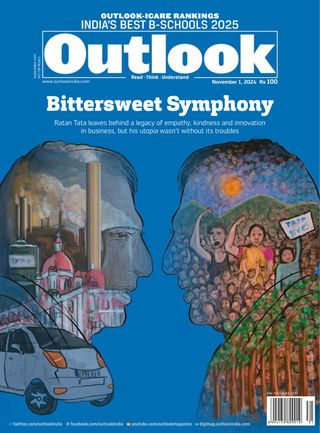

هذه القصة من طبعة November 01, 2024 من Outlook.
اشترك في Magzter GOLD للوصول إلى آلاف القصص المتميزة المنسقة، وأكثر من 9000 مجلة وصحيفة.
هل أنت مشترك بالفعل؟ تسجيل الدخول
المزيد من القصص من Outlook

Outlook
'Why GDP Growth Doesn't Always Translate Into Votes'
The recent election results have once again shown that economic growth alone does not guarantee electoral victory.

3 mins
June 06, 2026
Outlook
Lights, Camera, Othering
The establishment of Israel has been accompanied by a national cinema devoted to negating and erasing the Palestinian Other
5 mins
June 06, 2026

Outlook
Goodbye to All That
Booker-winning British author Julian Barnes' Departure(s) is a unique hybrid work: playful, philosophical, whimsical
4 mins
June 06, 2026

Outlook
Collapse of Trust
As the NEET-UG 2026 paper leak forced the cancellation of India’s biggest medical entrance exam, more than 22 lakh aspirants find themselves trapped in uncertainty
11 mins
June 06, 2026
Outlook
NO LONGER A TWELFTH MAN
Bihar cricket, which has languished in the shadows for long, is all set to improve its strike rate, thanks to Vaibhav Sooryavanshi, the new Bihari kid on the block
5 mins
June 06, 2026

Outlook
BLAZE OF GLORY
The challenges of being a celebrity cricketer at a young age can be tough to handle
5 mins
June 06, 2026

Outlook
THE SWASHBUCKLERS
A new generation of fearless stars is emerging and finding its feet at the very top of an extremely competitive cricketing environment
5 mins
June 06, 2026

Outlook
THE TEEN TORNAD
At the age of 15, Vaibhav Sooryavanshi is already a cricketing legend
10 mins
June 06, 2026
Outlook
A Journey to Remember
The prerecorded message crackled over the din in the compartment: ‘Welcome to the Shatabdi Express.
4 mins
June 06, 2026

Outlook
Crossing Borders
Ruth Martin is the translator of German-Iranian author Shida Bazyar’s novel The Nights are Quiet in Tehran (originally written in German), which has been shortlisted for the 2026 International Booker Prize.
4 mins
June 06, 2026
Listen
Translate
Change font size