
استمتع بـUnlimited مع Magzter GOLD
احصل على وصول غير محدود إلى أكثر من 9000 مجلة وصحيفة وقصة مميزة مقابل
يحاول ذهب - حر
Speak, Memory
June 01, 2025
|Outlook
V.D. Savarkar is everywhere—in and outside the Andaman Cellular Jail—while the contributions of other revolutionaries who were imprisoned there receive little attention
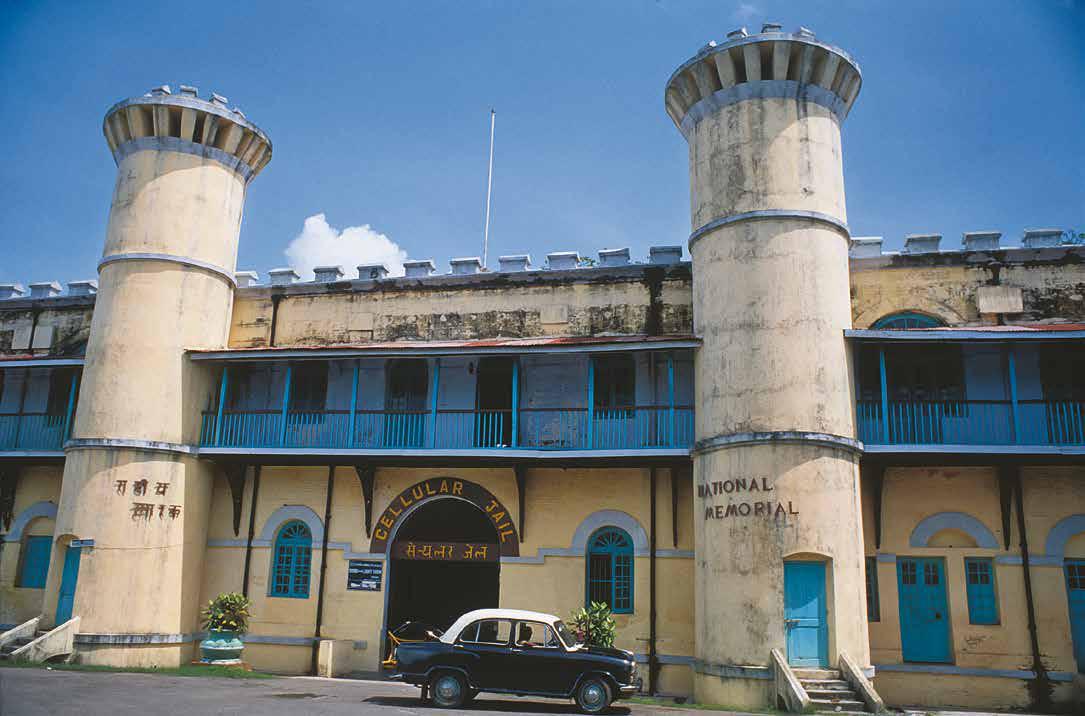
THERE are no busts of freedom fighters Ullaskar Dutta and Barin Ghosh at the Andaman Cellular Jail, and no plans to install them—this is how the Ministry of Culture most recently responded to the query raised on March 13, 2025, by Ritabrata Banerjee, a Trinamool Congress Member of Parliament from West Bengal, serving in the Rajya Sabha since December 2024. The Ministry also made it clear that the jail is not protected under the Ancient Monuments and Archaeological Sites and Remains Act, 1958, and no proposal was made to announce the British-era prison as a national monument, either.
Exactly a month before this exchange, in response to another question raised by Banerjee, the Ministry had said that out of 585 revolutionaries jailed between 1909 and 1938, 398 were from Bengal, making up as much as 68 per cent of the total count. As Banerjee complained, despite undivided Bengal’s lion’s share of the contribution to the freedom struggle, this part has been deliberately ignored by the Bharatiya Janata Party-led government, which spared no effort in promoting Vinayak Damodar Savarkar—the only ‘freedom struggle icon’ of the Hindutva ideologues, imprisoned there for a substantial period of time from 1911-21.
This is not the first time Banerjee has raised the issue. In 2017, as a Rajya Sabha MP on a Communist Party of India (Marxist) ticket, he urged the government to engrave the names of teenaged revolutionaries who took part in the Chittagong uprising of 1930 and were sent to the Cellular Jail (many of whom went on to become Communists), which he claimed was missing from the display on the premises.


هذه القصة من طبعة June 01, 2025 من Outlook.
اشترك في Magzter GOLD للوصول إلى آلاف القصص المتميزة المنسقة، وأكثر من 9000 مجلة وصحيفة.
هل أنت مشترك بالفعل؟ تسجيل الدخول
المزيد من القصص من Outlook
Outlook
Goapocalypse
THE mortal remains of an arterial road skims my home on its way to downtown Anjuna, once a quiet beach village 'discovered' by the hippies, explored by backpackers, only to be jackbooted by mass tourism and finally consumed by real estate sharks.

2 mins
January 21, 2026

Outlook
A Country Penned by Writers
TO enter the country of writers, one does not need any visa or passport; one can cross the borders anywhere at any time to land themselves in the country of writers.
8 mins
January 21, 2026

Outlook
Visualising Fictional Landscapes
The moment is suspended in the silence before the first mark is made.
1 mins
January 21, 2026
Outlook
Only the Upper, No Lower Caste in MALGUDI
EVERY English teacher would recognise the pleasures, the guilt and the conflict that is the world of teaching literature in a university.
5 mins
January 21, 2026
Outlook
The Labour of Historical Fiction
I don’t know if I can pinpoint when the idea to write fiction took root in my mind, but five years into working as an oral historian of the 1947 Partition, the landscape of what would become my first novel had grown too insistent to ignore.
6 mins
January 21, 2026

Outlook
Conjuring a Landscape
A novel rarely begins with a plot.
6 mins
January 21, 2026

Outlook
The City that Remembered Us...
IN the After-Nation, the greatest crime was remembering.
1 min
January 21, 2026
Outlook
Imagined Spaces
I was talking with the Kudiyattam artist Kapila Venu recently about the magic of eyes.
5 mins
January 21, 2026
Outlook
Known and Unknown
IN an era where the gaze upon landscape has commodified into picture postcards with pristine beauty—rolling hills, serene rivers, untouched forests—the true essence of the earth demands a radical shift.
2 mins
January 21, 2026

Outlook
A Dot in Soot
A splinter in the mouth. Like a dream. A forgotten dream.
2 mins
January 21, 2026
Listen
Translate
Change font size