يحاول ذهب - حر
Lutyens' Complex
December 11, 2024
|Outlook
CLIMATE change will likely make the Delhi-Mumbai comparison moot because one will burn and the other will drown. For millions of working people in these two cities, the treadmill of making ends meet, making rent and making it to work on time, makes competing claims to cosmopolitanism feel like nakhra, the narcissism of an English-speaking middle class with time to spare and points to score.

For anglophone Mumbaikars, their city is the nearest thing India has to the western metropolis: nearly London, almost New York, Urbs Prima in Indis with Bollywood bolted on. In this telling, Nariman Point is Wall Street and Bandra West is Brooklyn and the Gateway announces India in the way that Lady Liberty embodies the United States.
For their countrified cousins in Delhi, the capital’s hybrid achievement is to have grafted a Western capitol on to the ruins of several old, superseded cities; think Washington D.C. or Canberra, with History en suite.
I grew up in Lutyens’s Delhi in the government housing supplied by the state to its employees. These were whitewashed homes of various sizes classified by letters and assigned by rank. So if you lived in A/B type houses, it meant your father (more rarely your mother) was at least an additional secretary, whereas C-I or C-II homes housed more middling joint secretaries. Our semi-detached house along with its neighbours looked on to a reasonably level, hedged-in green that was made for playing cricket.
This wasn’t cricket as played in a public maidan (ground) like Shivaji Park. New Delhi in the 1960s wasn’t a high-density metropolis where public parks were shared out in a dozen cricket matches. It was a babu pastoral where space was no consideration, and sarkari children had the run of the greens that their ‘colonies’ enclosed.
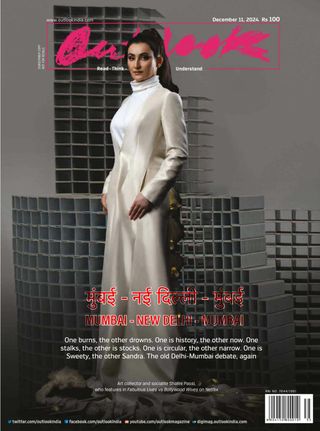

هذه القصة من طبعة December 11, 2024 من Outlook.
اشترك في Magzter GOLD للوصول إلى آلاف القصص المتميزة المنسقة، وأكثر من 9000 مجلة وصحيفة.
هل أنت مشترك بالفعل؟ تسجيل الدخول
المزيد من القصص من Outlook

Outlook
The Big Blind Spot
Caste boundaries still shape social relations in Tamil Nadu-a state long rooted in self-respect politics

8 mins
December 11, 2025

Outlook
Jat Yamla Pagla Deewana
Dharmendra's tenderness revealed itself without any threats to his masculinity. He adapted himself throughout his 65-year-long career as both a product and creature of the times he lived through
5 mins
December 11, 2025

Outlook
Fairytale of a Fallow Land
Hope Bihar can once again be that impossibly noisy village in Phanishwar Nath Renu's Parti Parikatha-divided, yes, but still capable of insisting that rights are not favours and development is more than a slogan shouted from a stage
14 mins
December 11, 2025

Outlook
The Lesser Daughters of the Goddess
The Dravidian movement waged an ideological war against the devadasi system. As former devadasis lead a new wave of resistance, the practice is quietly sustained by caste, poverty, superstition and inherited ritual
2 mins
December 11, 2025

Outlook
The Meaning of Mariadhai
After a hundred years, what has happened to the idea of self-respect in contemporary Tamil society?
5 mins
December 11, 2025

Outlook
When the State is the Killer
The war on drugs continues to be a war on the poor
5 mins
December 11, 2025

Outlook
We Are Intellectuals
A senior law officer argued in the Supreme Court that \"intellectuals\" could be more dangerous than \"ground-level terrorists\"
5 mins
December 11, 2025
Outlook
An Equal Stage
The Dravidian Movement used novels, plays, films and even politics to spread its ideology
12 mins
December 11, 2025
Outlook
The Dignity in Self-Respect
How Periyar and the Self-Respect Movement took shape in Tamil Nadu and why the state has done better than the rest of the country on many social, civil and public parameters
5 mins
December 11, 2025

Outlook
When Sukumaar Met Elakkiya
Self-respect marriage remains a force of socio-political change even a century later
7 mins
December 11, 2025
Listen
Translate
Change font size