يحاول ذهب - حر
Borders on the Boil
June 11, 2025
|Outlook
Whether it is Pakistan, China, Bangladesh or Myanmar, the unfinished business of history haunts the region every day
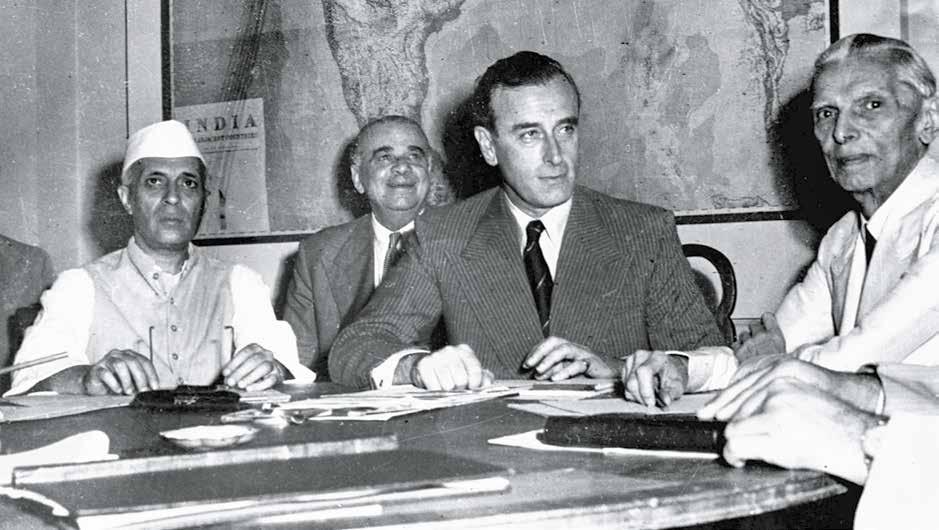
THE sun set on the once powerful British Empire nearly 78 years ago. Yet, the borders hastily drawn by British officers, often conceived to best serve the colonial rulers, continue to haunt South Asia and keep the region in a perpetual state of tension. Contested borders don’t just divide nations—they split histories, cultures, and families and take a heavy toll on ordinary lives. The ghosts of the empire have shaped the destinies of India and Pakistan, as well as India and China, feeding nationalist fires and aggressive military build-ups often resulting in war.
The partition of India in 1947 unleashed an unforeseen communal bloodbath, with neighbours and friends turning against each other. The partition was the handiwork of Lord Cyril Radcliffe, a British lawyer who had never set foot on the subcontinent and knew nothing of its geography, politics, or culture. Ironically, he was chosen precisely because of his ignorance of the region—his lack of prior involvement was seen as a guarantee of neutrality.
Radcliffe was given the near-impossible task of drawing the boundary line between India and Pakistan in just five weeks. The resulting Radcliffe Line partitioned Punjab in the west and Bengal in the east, leading to the birth of the two nations— Pakistan and India—on August 14 and 15, 1947, respectively.
The partition triggered mass displacement, with an estimated 14 million people forced to migrate across the new borders. The communal violence that followed claimed hundreds of thousands of lives. The reverberations of Partition—in terms of trauma, border tensions, and fractured identities—persist till this day.

هذه القصة من طبعة June 11, 2025 من Outlook.
اشترك في Magzter GOLD للوصول إلى آلاف القصص المتميزة المنسقة، وأكثر من 9000 مجلة وصحيفة.
هل أنت مشترك بالفعل؟ تسجيل الدخول
المزيد من القصص من Outlook
Outlook
Maach, Muri, Manush
While disputes around the legitimacy of 27 lakh voters remain unsolved, filmy heroism, comic relief, barbs and jibes added colour to the tainted West Bengal elections

8 mins
May 11, 2026

Outlook
The Width of the Gulf
The Iran crisis has exposed the fragility of the Gulf's traditional security paradigm while forcing its states to confront a more complex and uncertain strategic environment
4 mins
May 11, 2026
Outlook
Samadharma 2.0
This election will test the strength of the 'Dravidian Model' in Tamil Nadu
4 mins
May 11, 2026
Outlook
Broadcasting Without Rules
While critics say the prime minister's recent televised address to the nation violated the poll code, is there a need to address the deeper structural gaps in the airspace framework?
5 mins
May 11, 2026
Outlook
The Final Countdown
THE longest and toughest fight in the four states and a union territory that went to polls in this blistering hot poll season has been in West Bengal.
2 mins
May 11, 2026
Outlook
Where so Few of Us Women
THE conversation about improving women's political representation in India has been going on for years.
2 mins
May 11, 2026

Outlook
House Full
From Bill burning, to a star debuting in the political arena and the tussle with the Centre, the precursor to the Tamil Nadu elections was full of drama. Will the climax be as dramatic?
7 mins
May 11, 2026

Outlook
HALF THE SKY
IN a state still fractured by conflict, Nemcha Kipgen's elevation to Deputy Chief Minister reflects the uneasy politics of navigating both power and grievance.
16 mins
May 11, 2026
Outlook
Derided We Fall
The deeper concern is not about Pakistan's diplomatic ambitions, but about our own interpretive habits
5 mins
May 11, 2026

Outlook
The Merchant of Images
Raghu Rai, the pioneer of photojournalism in India, had a way of bringing out the soul of a picture
1 mins
May 11, 2026
Listen
Translate
Change font size