يحاول ذهب - حر
What Simone de Beauvoir Got — And Didn't Get – About Motherhood
June/July 2025
|Philosophy Now
Nura Hossainzadeh argues that motherhood is both physical and transcendent.
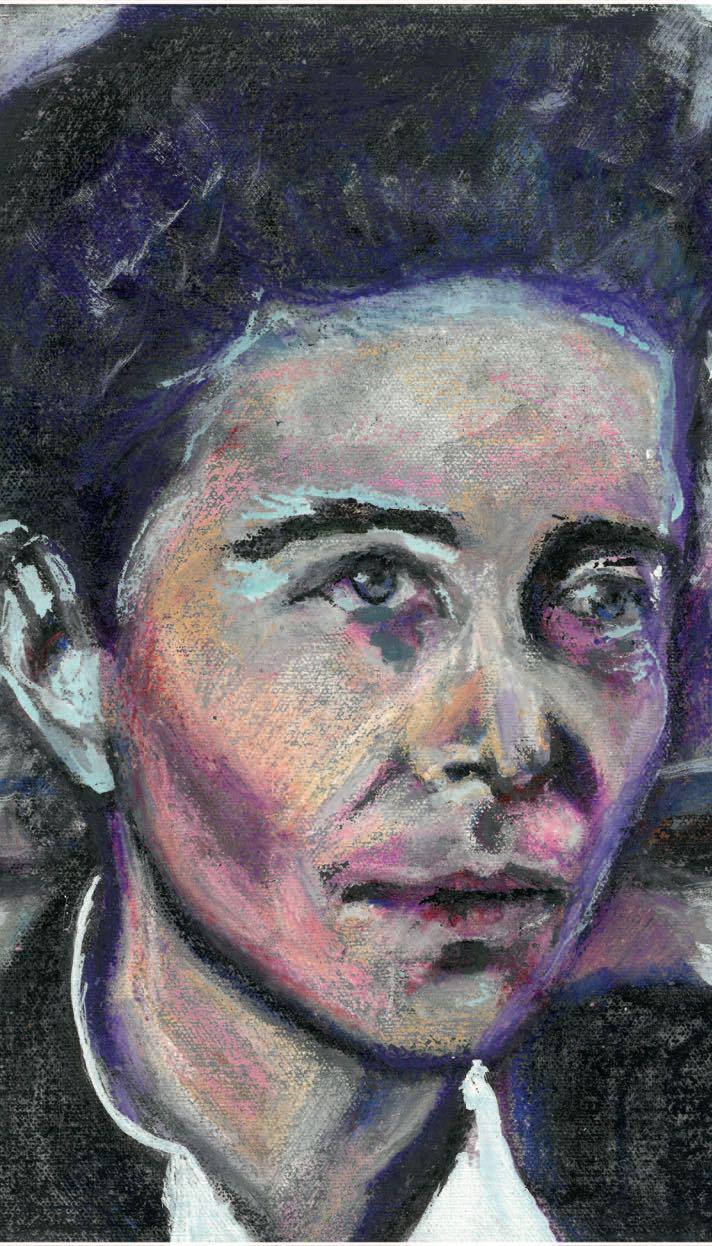
It is often said that becoming a parent is a profound transition. This transition feels different to everyone, since it occurs within the particular context of each person’s life. For me, it felt like a jolt from the abstract to the concrete; from the philosophical to the everyday; from the freedom to speculate, to the need to make decisions. When I had my first child, I was teaching political theory at Princeton, and when I had my second, I was teaching in a ‘great books’ program at Stanford. So I moved abruptly from spending my days thinking about the big ideas — justice, freedom, Islamic theories of government, love in Christian mystic writings, love in medieval Italian poetry — to dwelling in the more physical dimensions of life: changing diapers at what often felt like 1,000 times a day; experiencing the inevitable lack of sleep that comes with having a newborn; and asking my body to nourish this growing lifeform with breastmilk.
In the midst of being caught (as it often felt) in the physical components of motherhood, the words of the twentieth century French existentialist and feminist thinker Simone de Beauvoir have often come back to me. She writes about both womanhood and motherhood in The Second Sex (1949), which I taught at Stanford. Beauvoir, who was never a mother herself, except insofar as she once adopted a protégé who was in her thirties, often has unflattering things to say about motherhood, and she looks down on the physical nature of it. Experiencing motherhood has helped me to understand Beauvoir’s concerns; but it has also helped me to see where her arguments fall short — where she doesn’t quite grasp how the parts of motherhood that seem simply to be physical toil and sacrifice can be something greater. Those parts of motherhood that are deeply physical—such as breastfeeding and pregnancy itself—lead to spiritual growth precisely because of, and through, their physical nature.
Breastfeeding is Authentic

هذه القصة من طبعة June/July 2025 من Philosophy Now.
اشترك في Magzter GOLD للوصول إلى آلاف القصص المتميزة المنسقة، وأكثر من 9000 مجلة وصحيفة.
هل أنت مشترك بالفعل؟ تسجيل الدخول
المزيد من القصص من Philosophy Now

Philosophy Now
Star Trek: Enterprise
Sofia Villaweaver asks, what kind of future do we want — Gene Roddenberry's, or Friedrich Nietzsche's?

7 mins
June/July 2026
Philosophy Now
The Delphic Injunctions
Massimo Pigliucci philosophises about prophetic principles.
4 mins
June/July 2026

Philosophy Now
What’s the Value of Mountaineering?
Suleyman Moollan wonders why people climb mountains.
8 mins
June/July 2026

Philosophy Now
Death as Life’s Picture Frame
Joshua Clements puts us in the picture.
10 mins
June/July 2026
Philosophy Now
Philosophers on Butterflies
Summer is upon those of us in the northern hemisphere. That invites reflection.
2 mins
June/July 2026
Philosophy Now
Margalit & Limits to Political Compromise
Laure Gillot-Assayag reflects on the political philosophy of Avishai Margalit.
12 mins
June/July 2026
Philosophy Now
Making Omelettes & A Future Like Ours
Jimmy Alfonso Licon wonders what's wrong with killing — first chickens, then humans.
5 mins
June/July 2026
Philosophy Now
Breakfast with Habermas
Matt Qvortrup recalls chat over coffee and scrambled eggs with a champion of reasoned debate.
5 mins
June/July 2026

Philosophy Now
Who Wants to Live Forever?
Dan Pollen weighs up the pros and cons of indefinitely extended life.
10 mins
June/July 2026

Philosophy Now
Carl Schmitt (1888-1985)
Marco Pandolfini on the ideas of a highly contentious legal theorist.
9 mins
June/July 2026
Listen
Translate
Change font size