
استمتع بـUnlimited مع Magzter GOLD
احصل على وصول غير محدود إلى أكثر من 9000 مجلة وصحيفة وقصة مميزة مقابل
يحاول ذهب - حر
FRONTIER TOURISTS
August 2022
|BBC History UK
Since its earliest days, the great barrier at the Roman empire's north-western edge has been a source of wonder. Rob Collins traces the history of tourism and souvenirs at Hadrian's Wall
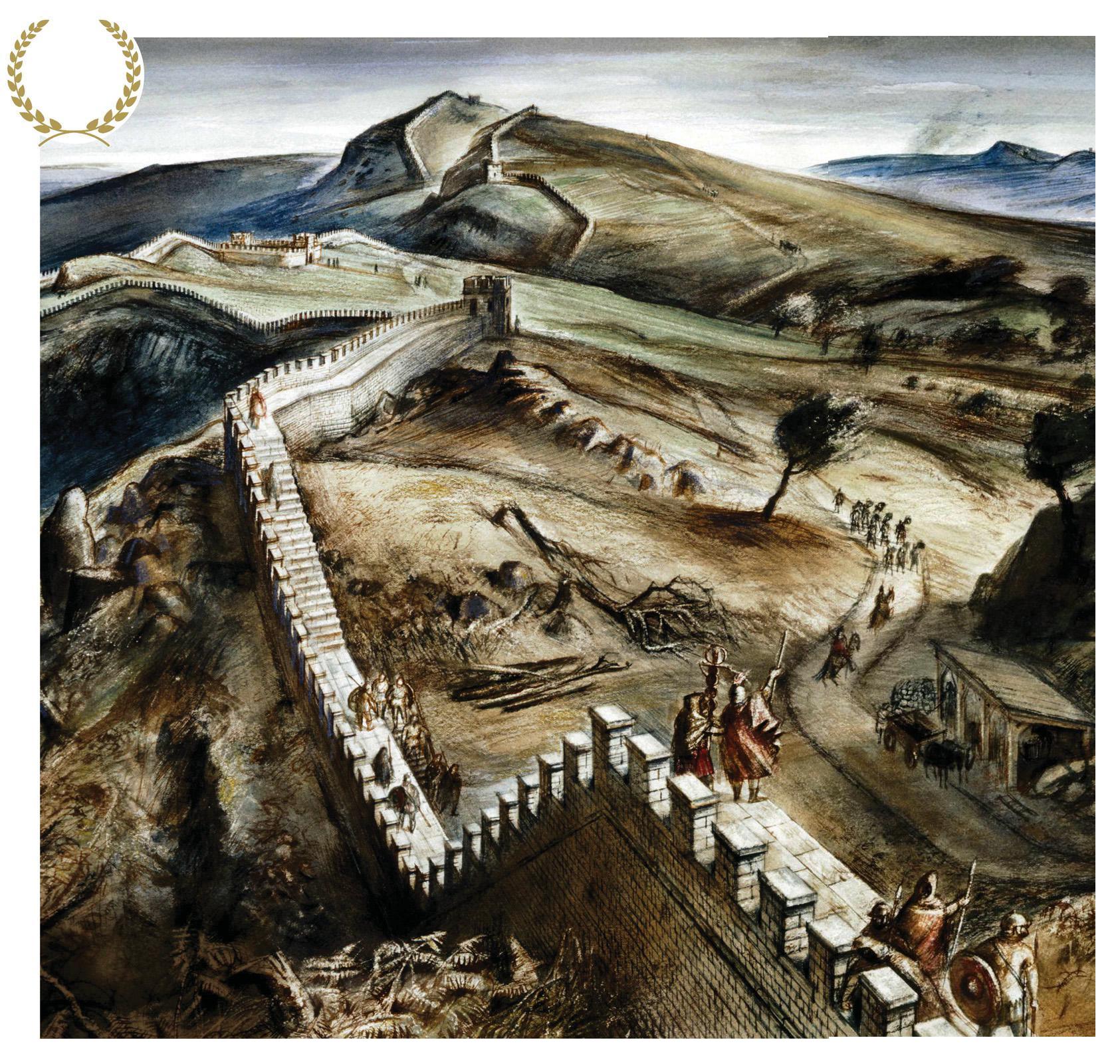
On a June day in 2003, metal detectorists in the north Staffordshire village of Ilam unearthed a curious object. The second-century AD trulla – a small saucepan – is made of a copper alloy, inlaid with colourful, slightly psychedelic enamel whirls. What makes the artefact, now known as the Staffordshire Moorlands Pan (or Ilam Pan), special, though, is the Latin inscription running around its rim: MAIS COGGABATA VXELODVNVM CAMMOGLANNA RIGORE VALI AELI DRACONIS.
What does it mean? Well, the first four words are names of Roman forts in Cumbria: Mais (at Bowness-on-Solway), Coggabata (Drumburgh), Uxelodunum (Stanwix) and Cammoglanna (Castlesteads). The second part of the inscription – RIGORE VALI AELI DRACONIS – can be translated as: “Along the line of Hadrian’s Wall, [this is the cup of] Draco.” If that interpretation is correct, then this is a vessel commissioned by Draco to commemorate his time at these forts – in other words, a souvenir of Hadrian’s Wall. And it’s not the only one – other pans found elsewhere in Britain and France also reference forts on the wall. So how did a Roman military monument come to inspire such keepsakes?
Desirable souvenirs
The construction of Hadrian’s Wall was unprecedented. It was – and in many ways remains – a unique creation. Once completed, the wall was garrisoned for nearly 300 years, during which time tens of thousands of Roman soldiers served along the monument.

هذه القصة من طبعة August 2022 من BBC History UK.
اشترك في Magzter GOLD للوصول إلى آلاف القصص المتميزة المنسقة، وأكثر من 9000 مجلة وصحيفة.
هل أنت مشترك بالفعل؟ تسجيل الدخول
المزيد من القصص من BBC History UK
History Extra
Drawn to the past
JAMES OSBORNE offers the definitive word on a game that casts players in the role of illustrators creating fantastical images for medieval manuscripts

1 mins
July 2026
History Extra
Young (and old) guns
Well into the 16th century, guns were considered unmanly - the armament of cowards and ne'er-do-wells.
1 mins
July 2026

History Extra
The president and the comedian
Details were sketchy as HistoryExtra went to press, but the latest series from Higher Ground, the production company founded by Barack and Michelle Obama, looks like it could be a hoot.
1 min
July 2026

History Extra
Meet the Boleyns
The cultured charmer, the moneybags lord mayor, the powerful heiress, the scheming uncle. Anne's colourful family shaped the mind and character of the future queen of England, as Tracy Borman reveals
9 mins
July 2026

History Extra
Kyoto in five places
Japan’s imperial capital for 11 centuries remains its most enchanting city. LESLEY DOWNER suggests the most enticing and historic temples, gardens and palaces to visit
3 mins
July 2026
History Extra
Did a bear once serve in the Polish army?
In 1942, Polish troops making their way through Iran to join the Allied effort in Europe came across a young boy carrying a Syrian brown bear cub, whose mother had been shot by hunters.
1 min
July 2026
History Extra
Voices from the past
What did those who lived through the American Revolutionary War 250 years ago make of the conflict as it unfolded?
1 min
July 2026
History Extra
Is it true that Arthur Conan Doyle helped to solve real-life crime cases?
Inevitably, as the creator of Sherlock Holmes, Conan Doyle was inundated with requests to solve mysteries, often of a criminal nature.
1 mins
July 2026

History Extra
Fight the patriarchy!
The work of modernist novelist Virginia Woolf isn't renowned for delivering laughs.
1 min
July 2026

History Extra
National hero
In 1828, following a distinguished career in European politics and diplomacy, Ioannis Kapodistrias (1776–1831) became the first governor of Greece.
1 min
July 2026
Translate
Change font size