يحاول ذهب - حر
SOME FRESH HELL
February 10, 2025
|The New Yorker
The poet Shane McCrae journeys through the land of the damned.
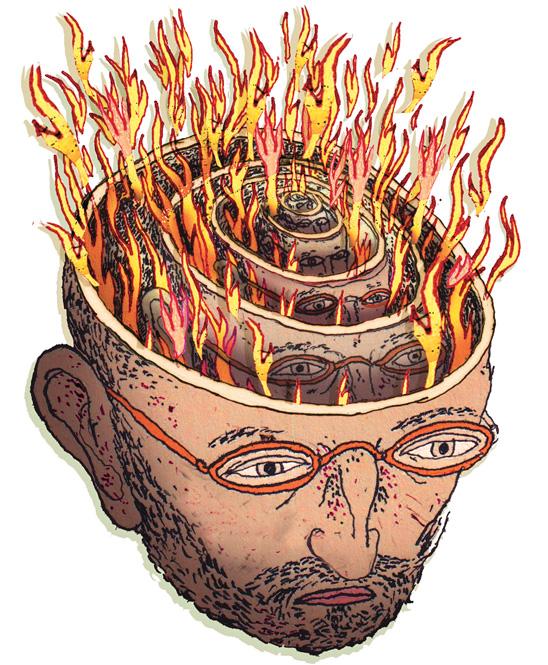
Along Interstate 71, in a flat stretch of Ohio, an otherwise modest billboard proclaims that “HELL IS REAL.” The type, set against a black backdrop, is white, except for the “H,” which is painted a red that in certain lights flickers orange. The sign is meant to give passing drivers an eschatological jolt, and it has become a much photographed landmark—enough of a fixture that it has its own listing on Google Maps. The simplicity of its message and the vulgarity of its medium make it an exemplar of religious expression in this American moment, as if God (or maybe Satan) placed an ad. Yet its stark certainty feels like a transmission from an earlier, less complicated world.
What is Hell, these days? “New and Collected Hell” (Farrar, Straus & Giroux), a book-length poem by Shane McCrae, is an audacious effort to stage a tour of the underworld in an almost painfully post-millennial context and vernacular. McCrae’s Hell contains a human-resources “bunker,” conducts intake interviews, shows the damned on screens that hang above gray cubicles sprawling endlessly in all directions, and communicates—pure evil—by fax machine only. The Devil must be reimagined for each age.
McCrae, who teaches at Columbia University, is a celebrated Black poet who has published nine previous collections of poetry and a memoir, “Pulling the Chariot of the Sun.” His fifth book, “In the Language of My Captor” (2017), was a finalist for the National Book Award for poetry. His work often explores America’s racial agon and its brutal history of enslavement. He has a long-standing affinity for allegorical settings, and many of his poems take place in skewed versions of a Christian afterworld. (Parts of “New and Collected Hell” appeared in “The Gilded Auction Block,” from 2019, and “Cain Named the Animal,” from 2022.)

هذه القصة من طبعة February 10, 2025 من The New Yorker.
اشترك في Magzter GOLD للوصول إلى آلاف القصص المتميزة المنسقة، وأكثر من 9000 مجلة وصحيفة.
هل أنت مشترك بالفعل؟ تسجيل الدخول
المزيد من القصص من The New Yorker
The New Yorker
CONTRIBUTORS
Eliza Griswold (\"Young Americans,\" p. 12) is a contributing writer.

1 mins
June 29, 2026

The New Yorker
THE READERS
Early in my treatment, we decided that you wouldn't read my work.
24 mins
June 29, 2026

The New Yorker
URBAN LEGEND
Closing out a crime trilogy about a changing New York, Colson Whitehead excavates his own foundations.
33 mins
June 29, 2026
The New Yorker
ABOUT TOWN
POST-ROCK | Last year, the Chicago instrumental post-rock band Tortoise returned with \"Touch,\" its first album in nearly a decade, the further explorations of an inquisitive nature.
3 mins
June 29, 2026
The New Yorker
GOINGS ON JUNE 24-30, 2026
What we're watching, listening to, and doing this week.
1 min
June 29, 2026
The New Yorker
LONGING FOR ITHACA
There’s a reason Homer’s homecoming epic has long defeated the directors.
16 mins
June 29, 2026

The New Yorker
HOT PURSUIT
The repo man coming for your ride.
35 mins
June 29, 2026
The New Yorker
WILD THINGS
Why do animals have sex, anyway?
14 mins
June 29, 2026

The New Yorker
PRICKLY PAIRS - “The Invite.”
“The Invite” begins with an aphorism: “One should always be in love.
6 mins
June 29, 2026
The New Yorker
BRAVE NEW WORLD DEPT.INSTANCING
Wednesday evenings at Hex&Co., board-game café and bar in Morningside Heights, are dedicated to \"RPG Encounters,\" in which fans of role-playing games gather to create collaborative stories over espresso drinks.
3 mins
June 29, 2026
Listen
Translate
Change font size