يحاول ذهب - حر
ART OF THE REAL
November 17, 2025
|The New Yorker
Robert Rauschenberg's transformative energy.
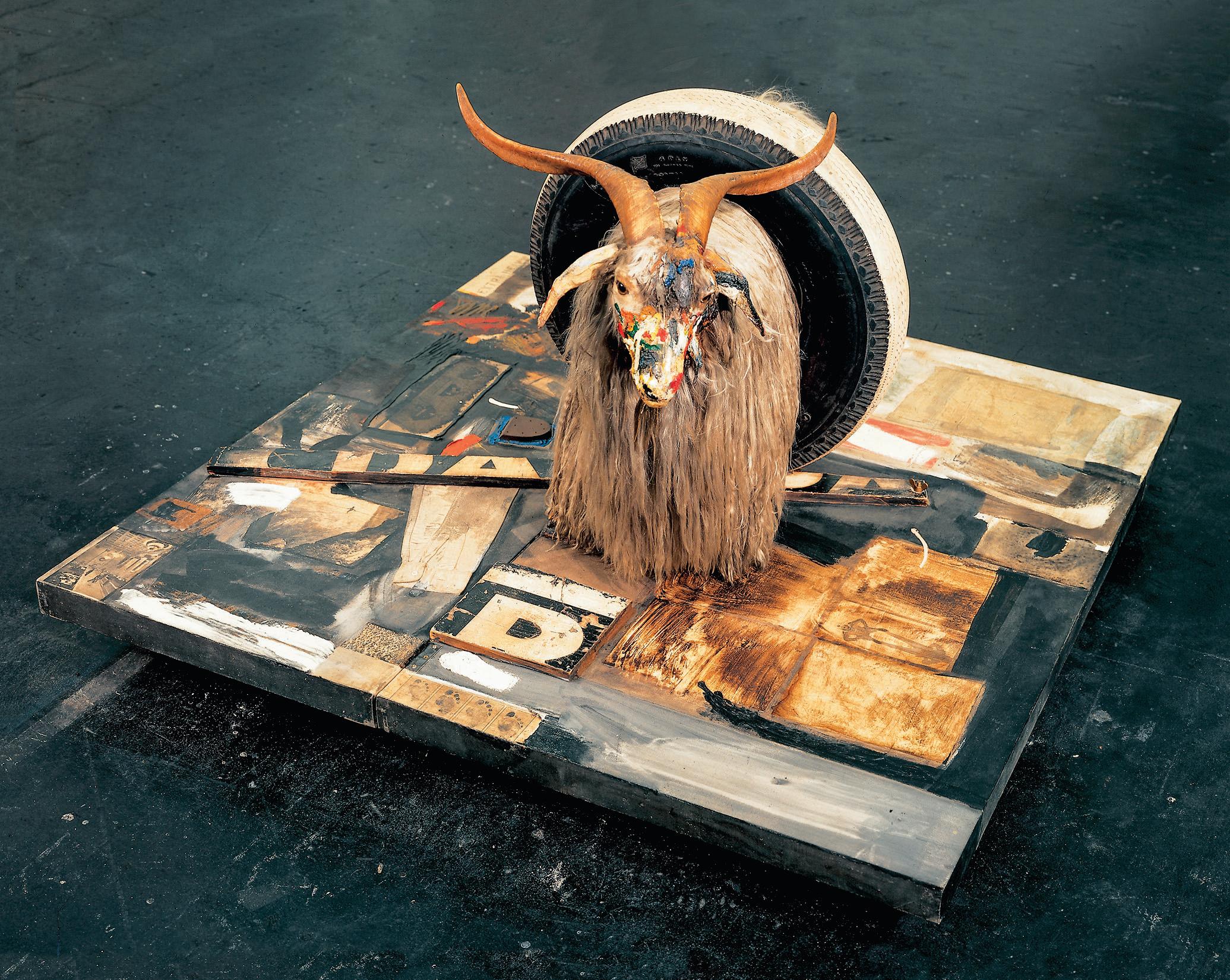
On certain days, I'd cut school and head over to the Museum of Modern Art to dream awhile. This was in the mid-nineteen-seventies, and my high school—then called the High School for Performing Arts—was on West Forty-sixth Street. I lived in Brooklyn, and the world within the walls of that school, and beyond them, was a wonderland to me. In addition to all that I was learning in my classes, there was Manhattan itself, and, a block or so away, the Gotham Book Mart, Frances Steloff's fabulous bookstore stuffed with treasures, and, a little farther, the MOMA. I didn’t know much about modern art, European or American (though I'd seen some African art at the Brooklyn Museum), but I was porous, and entering that storied building one afternoon and encountering a stuffed goat on a multi-panelled wooden platform remains one of the more destabilizing experiences of my life. The goat had a goatee, horns, and a long-haired silver torso. Its head and neck were streaked with several colors of paint, as though it had put on makeup while drunk. Not only that—there was a black-and-white rubber tire around its middle. Standing before the goat, I felt as if I were having the worst or best possible dream, and, to steady myself, I read the wall label. Titled “Monogram,” the piece had been made in 1955-59 by an artist whose retrospective I'd walked into: Robert Rauschenberg. (I learned later that, in his twenties, he'd changed his name from Milton to Robert, because he liked the approachable sound of “Bob.”) Who was this man? And what did the word “monogram” mean in this context, or in any context? I remember perspiring, not because the museum was too hot but because something was happening to me: an aesthetic experience I did not understand was changing my body temperature, changing my mind.


هذه القصة من طبعة November 17, 2025 من The New Yorker.
اشترك في Magzter GOLD للوصول إلى آلاف القصص المتميزة المنسقة، وأكثر من 9000 مجلة وصحيفة.
هل أنت مشترك بالفعل؟ تسجيل الدخول
المزيد من القصص من The New Yorker

The New Yorker
Amanda Petrusich on Katy Grannan's Photograph of Taylor Swift
There’s something uncanny about this still and stunning portrait of a twenty-one-year-old Taylor Swift, shot by Katy Grannan for Lizzie Widdicombe’s Profile of the singer, in 2011.

1 mins
January 12, 2026

The New Yorker
DEAL-BREAKER
Pam is seeing someone, but she’s not talking about it.
19 mins
January 12, 2026
The New Yorker
THE OTHER BOOMERS
Kathryn Bigelow, the director, and Alexandra Bell, the arms-control expert, are both nuclear-attack-submarine literate. Bigelow—whose new Netflix film, “A House of Dynamite,” imagines the U.S. government’s response to an incoming intercontinental ballistic missile (ICBM) eighteen minutes from impact—shot part of her 2002 submarine film, entitled “K-19:
3 mins
January 12, 2026

The New Yorker
THE MUSICAL LIFE BROADWAY BABY
At Joe’s Pizza on Carmine Street, Marc Shaiman, the celebrated composer and lyricist, dropped his slice on the floor. “Ugh, it’s the Shaiman vortex,” he said. “Everything I come near breaks.”
3 mins
January 12, 2026

The New Yorker
NOTORIOUS M.T.G.
Marjorie Taylor Greene and Donald Trump break up over Epstein.
26 mins
January 12, 2026

The New Yorker
YES, AND?
How consent can—and cannot—help us have better sex.
14 mins
January 12, 2026

The New Yorker
LET IT BLEED
When Helen Frankenthaler remade painting.
5 mins
January 12, 2026

The New Yorker
THE AMERICAN POPE
How the Chicago-born Robert Prevost became Leo XIV.
32 mins
January 12, 2026
The New Yorker
DEPT. OF RECYCLING SWIPE OUT
In 1994, when the MetroCard made Its 22, many straphangers were reluctant to say farewell to the subway token. Across the city, commuters struggled to master \"the swipe.
2 mins
January 12, 2026
The New Yorker
THE TALK OF THE TOWN
Easily missed on the back side of the November ballots that brought Zohran Mamdani to Gracie Mansion was a proposal for a new map of New York City.
4 mins
January 12, 2026
Listen
Translate
Change font size