يحاول ذهب - حر
How to Make Scenario Planning Stick
winter 2026
|MIT Sloan Management Review
Developing future scenarios can deepen leaders’ strategic insights. Establishing scenario planning as an ongoing capability and reaping its full benefits require linking it to other processes.

WITH MANAGERIAL ANXIETY RISING IN step with economic, geopolitical, and technological uncertainty, scenario planning is of increasing interest to executives seeking to be prepared for what they cannot yet see. But while there is much to learn by envisioning a wide range of possible external scenarios, many organizations fail to fully absorb and integrate these lessons into strategic decision-making.
Scenario planning is a good starting point for navigating uncertainty in business. As one of us (Paul) explained in these pages 30 years ago, the strength of scenario planning is that it goes beyond extrapolating known key trends to contemplate major uncertainties that companies do not fully understand yet.¹ Scenario planning assumes that an organization's future environment may be markedly different from what it is today due to external forces, including political, economic, social, technological, environmental, or legal developments. The art and science of scenario development involve examining the most important of these drivers, exploring their potential developments, and modeling how they might interact to create vastly different futures. Testing multiple scenarios lets leaders assess the robustness of their strategies and prepare the organization for new threats and opportunities. As Louis Pasteur put it, “Chance favors the prepared mind”; mentally mapping out future-scenario narratives positions managers and organizations to benefit from as yet unseen developments.
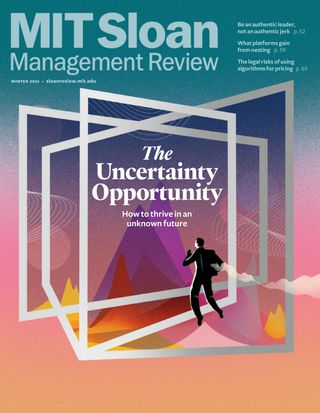

هذه القصة من طبعة winter 2026 من MIT Sloan Management Review.
اشترك في Magzter GOLD للوصول إلى آلاف القصص المتميزة المنسقة، وأكثر من 9000 مجلة وصحيفة.
هل أنت مشترك بالفعل؟ تسجيل الدخول
المزيد من القصص من MIT Sloan Management Review

MIT Sloan Management Review
Why Digital Dexterity Is Key to Transformation
To make headway with digital transformation, executives are redefining the challenge: Build a workforce to take advantage of new technologies.

17 mins
Spring 2026

MIT Sloan Management Review
Ask Sanyin: What Makes a 'Listening Tour' Meaningful?
I've just stepped into a new leadership role and was advised to embark on a \"listening tour.\"
2 mins
Spring 2026

MIT Sloan Management Review
Build Business Advantage With Real-Time Decision-Making
Stop running your business on yesterday's data. Real-time data, empowered employees, and agile systems can lead to higher margins.
11 mins
Spring 2026

MIT Sloan Management Review
Balancing Innovation and Risk in the Age of AI
Monica Caldas is executive vice president and global CIO of Liberty Mutual Insurance.
2 mins
Spring 2026

MIT Sloan Management Review
Turn Customer Complaints Into Innovation Blueprints
You can reframe client grievances as an opportunity instead of a burden. At one Swiss hospital, complaints have become a pipeline for improvements to the customer experience.
6 mins
Spring 2026

MIT Sloan Management Review
The Eight Core Principles of Strategic Innovation
A company's future depends on the new directions it explores and develops today — and that requires different structures and capabilities from incremental innovation.
14 mins
Spring 2026

MIT Sloan Management Review
What AI Can Teach Us About Designing Better KPIs
Machine learning research offers four proven strategies to prevent people from gaming measures of organizational performance.
12 mins
Spring 2026

MIT Sloan Management Review
A Smarter Approach to Measuring Customer Experience
Many companies collect more customer experience data points than they need or can use effectively. Here's how to focus on the metrics that matter.
10 mins
Spring 2026

MIT Sloan Management Review
THREE THINGS TO KNOW ABOUT Learning by Hiring
LEADERS WHO RECOGNIZE THAT OUT-siders can be major drivers of innovation often seek to bring new knowledge into their organizations by making external hires.
2 mins
Spring 2026

MIT Sloan Management Review
Validating LLM Output? Prepare to Be ‘Persuasion Bombed’
Research demonstrates how generative AI ramps up the rhetorical pressure on users who question the AI's output.
8 mins
Spring 2026
Listen
Translate
Change font size