
استمتع بـUnlimited مع Magzter GOLD
احصل على وصول غير محدود إلى أكثر من 9000 مجلة وصحيفة وقصة مميزة مقابل
يحاول ذهب - حر
Why the Brahman?
August 15-22, 2025
|Farmer's Weekly
The Brahman is known as the 'king of crossbreeding' and demonstrates a range of economically important traits that make it an ideal beef breed.
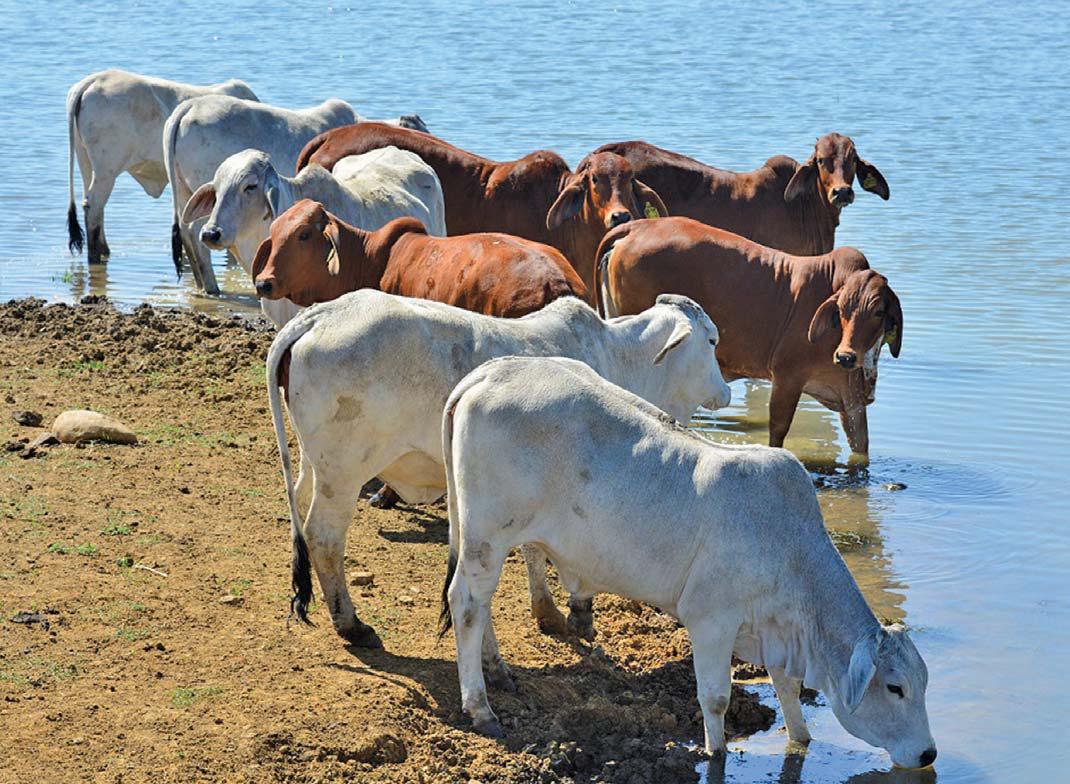
The Brahman was recognised as a distinct breed in 1924 with the formation of the American Brahman Breeders' Association. The breed as we know it today was developed in the US, but its genetic roots trace back thousands of years to Bos indicus cattle breeds from India (like the Gyr, Guzerat, Nellore and Krishna Valley).
Since the establishment of the breed in the 1920s, the Brahman has become one of the most popular breeds worldwide, with its global popularity seemingly on the increase.
The breed can be found in 55 countries, with an estimated global population of 1,8 million head of registered cattle. While this number is seemingly small, particularly compared to breeds like the Angus, the Brahman has influenced many cattle breeds in crossbreeding programmes, and so the influence of the Brahman on the global cattle population cannot be understated. For example, it's estimated that around 70% of all cattle in Namibia have Brahman genetics, while 80% of all cattle in Zimbabwe have Brahman genetics. In South Africa, it's estimated that around 55% of all cattle have some type of Brahman influence, according to AgriOrbit.
The Brahman is one of the most numerous cattle breeds in Australia, particularly in Queensland. In key beef-producing countries including Brazil and Argentina, the Brahman has a significant presence. While its rise in the US was initially slow, the Brahman is now widely found throughout that country.
'KINGS OF CROSSBREEDING'
One of the reasons for the breed's influence on global beef production is its ability to generate maximum hybrid vigour (heterosis) when crossed with other breeds, particularly B. taurus (European) breeds.
Hybrid vigour is the phenomenon in which the offspring of two genetically diverse parents show superior performance in certain traits compared to the average of those parents.

هذه القصة من طبعة August 15-22, 2025 من Farmer's Weekly.
اشترك في Magzter GOLD للوصول إلى آلاف القصص المتميزة المنسقة، وأكثر من 9000 مجلة وصحيفة.
هل أنت مشترك بالفعل؟ تسجيل الدخول
المزيد من القصص من Farmer's Weekly

Farmer's Weekly
More about growing vegetable seedlings in trays
By considering various factors and tailoring care to specific vegetable needs, you can produce healthy, robust seedlings ready for transplanting into the garden, writes Shane Brody.

2 mins
March 27 - April 3, 2026

Farmer's Weekly
Prodigy of agriculture and land is now a presidential envoy
Wandile Sihlobo will be armed by state powers to accelerate any decision-making that the Presidency deems crucial to grow the sectors of agriculture and land
2 mins
March 27 - April 3, 2026

Farmer's Weekly
Notes from the Western Cape agricultural roadshow
We spent time last week engaging with agribusinesses and farmers in the Western Cape. The primary agricultural focus of the province is various fruits, citrus, table grapes, wine, wheat, barley, livestock, and aquaculture, among many value chains.
3 mins
March 27 - April 3, 2026

Farmer's Weekly
AGOA's promise fades under new US tariffs
Although the African Growth and Opportunity Act has been extended for another year, new US reciprocal tariffs have largely erased its duty-free benefits. Recent modelling shows sharp declines in African exports to the US, particularly in apparel-dependent economies such as Lesotho and Madagascar.
4 mins
March 27 - April 3, 2026

Farmer's Weekly
Egon Zunckel: a lifetime of learning from the soil
The Zunckel name is synonymous with no-till farming in South Africa. Egon Zunckel, a pioneer in the field and a passionate advocate for soil health, shared with Lindi Botha the lessons he has learnt over the years about building resilient soils and sustainable farming systems.
10 mins
March 27 - April 3, 2026
Farmer's Weekly
Researchers explore new tools to combat herbicide resistance
Research by students from Stellenbosch University aimed at combatting herbicide resistance was highlighted during a recent technical trial information day hosted by the Western Cape Department of Agriculture.
6 mins
March 27 - April 3, 2026

Farmer's Weekly
Lepas leaps into South Africa as the latest Chery-owned brand
Lepas has become Chinese carmaker Chery's latest local subbrand with the introduction of the L4 compact SUV. The Citizen's Charl Bosch reports.
2 mins
March 27 - April 3, 2026
Farmer's Weekly
La Rhone Limousins: a small mixed herd turned renowned stud
The Western Cape is not typically known for cattle farming, particularly in its fruit-growing regions. Yet nestled among the orchards below the mountains of Tulbagh is a Limousin stud that has made a name for itself. AJ du Toit of La Rhone Limousins spoke to Henning Naudé about producing high-quality genetics now found on farms in all nine provinces.
6 mins
March 27 - April 3, 2026
Farmer's Weekly
Nitrogen: no easy fix
Products that claim to herald a nitrogen revolution that will boost global food production are nothing more than snake oil, say scientists.
4 mins
March 27 - April 3, 2026

Farmer's Weekly
Potato soup
Rich, creamy, and indulgent, this soup is the ultimate in comfort food.
1 mins
March 27 - April 3, 2026
Listen
Translate
Change font size